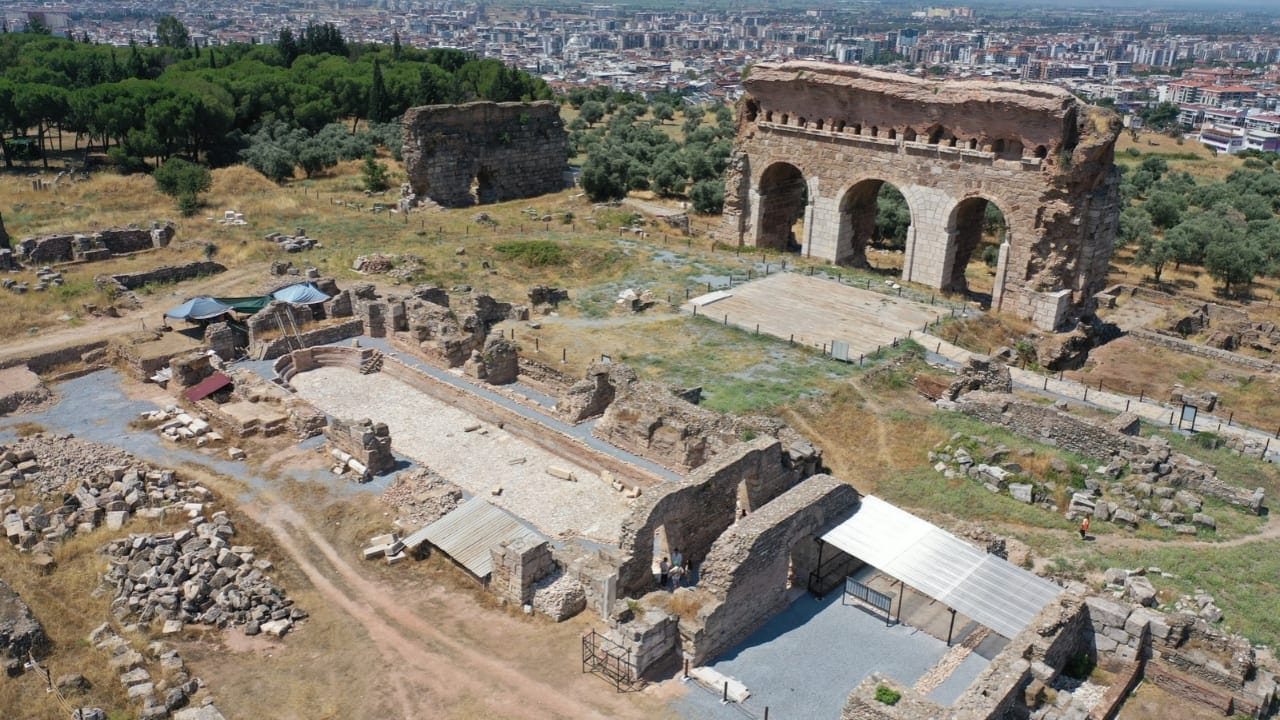
Archaeologists in Turkey have unearthed two ancient finds during excavations in the ancient city of Tralleis in Turkey’s southwest province of Aydin as part of the country’s “Legacy for the Future” project at the site.
Two weeks ago, Turkey’s Culture and Tourism Ministry, announced that a 2,000-year-old pool was found inside the Hamam Gymnasium complex’s frigidarium, the cold room of a Roman bath.
Frigidariums, often located at the northern end of Roman baths, were used as the second to last stage of the bathing process in order to tighten the skin, invigrate the body, and close pores. After the frigidarium, bathers would cover themselves in oil.
It was unearthed during excavations lead by Professor Dr. Murat Çekilmez of the Aydin Adnan Menderes University, in collaboration with Turkey’s Culture and Tourism Ministry, and the Turkish Cultural Heritage and Museums general-directorate.
Measuring to approximately 37 meters long and 12 meters wide, the pool has the capacity to hold around 300 people, and is believed to have been used by young people receiving training at the gymnasium.

“I wholeheartedly thank all the employees of our General Directorate of Cultural Heritage and Museums, our excavation team, our academics, and everyone who contributed to this valuable work,” said Turkish Culture and Tourism Minster Mehmet Nuri Ersoy in a post to X/Twitter announcing the discovery. “We will continue to protect the traces of our civilization through scientific studies and carry the legacy of the past into the future with unwavering determination.”
Ancient mosaic found in gymnasium complex
In late July, a separate excavation in Tralleis led by Cekilmez unearthed a nearly 2,000-year-old hall with a Roman-era floor mosaic of the hippocampus, according to Turkey’s state-run news agency Andalou Agency (AA).
The hippocampus is a sea creature from Greek mythology, commonly associated with the deity Poseidon.
Cekilmez told Andalou Agency that the find was made more exciting since the area had at first appeared to only house a Byzantine-era workshop, but as excavations went on, “we realised there was a mosaic floor beneath the structure.”
“That was an exciting moment for us because it is a very well-preserved mosaic within the bath-gymnasium complex at Tralleis.” Cekilmez said to Andalou Agency. “It is significant both scientifically and for what it reveals about the daily life and mythology of the period.”
The discovery of the mosaic “indicates that the hall was actively used during the Roman Imperial period,” according to Cekilmez.
Gymnasium trained doctors, engineers in antiquity
Cekilmez explained to Andalou Agency that the Hamam Gymnasium complex is thought to have been an important educational institution where children were able to learn from an early age.
“We also believe this was a centre of science because the structure contains spaces related to schooling,” said Cekilmez. “Physical education was also highly valued here. The gymnasium we see today trained many scholars, including doctors and engineers.”
“Tralleis was known in antiquity as a place that produced writers and scientists, and our excavations are bringing this heritage back to light.”
According to the Greek geographer Strabo, Tralleis was founded by the Argives and Trallians, before falling to the Persian Empire and later, in 334 BCE, surrendered to Alexander the Great.
The ancient city continued to trade hands from Antigonus I Monophthalmus, who served as Alexander’s general, to the city of Pergamon and the Romans. The city was eventually Christianized, and then, in the late 11th century, reconquered by the Byzantine Empire.
One of Tralleis’s famed residents is Anthemius of Tralleis alles, who went on to become the architect of the Hagia Sophia in Constantinople.