
Today, in a small coastal city of Pula, Croatia’s largest Ukrainian flag – stretching 35 meters – found its way to the city’s old-town square, marking 35 years since Ukraine declared its independence in 1991.
Three years have passed since Ukrainians displaced by the war first gathered to mark their country’s independence. The Cultural and Artistic Society of Ukrainians in Istria, Vatra, has organized the annual celebration ever since.
Follow our coverage of the war on the @Kyivpost_official.
This year’s event marks the fourth consecutive commemoration in Pula, led by Olesia Rusinova.
The celebration of that same identity now stands in sharp juxtaposition with the country well into its fifth year of defending itself against Russia’s aggression.
For Ukrainians in exile, the public commemoration reflects a deeper, private reality; though they now live in Croatia, they remain tied to Ukraine by an invisible thread, its tension palpable in their work, memories and everyday lives – further shaping what remains of their sense of home.
Olesia, an Odesa-born professional artist and performer, and Valeriia Pohrebniak Bednaić, a Kyiv-born ceramic and art teacher with a master’s degree in fine arts, spoke with Kyiv Post about displacement, identity and the effort – at times a struggle – to keep Ukraine visible and alive abroad.
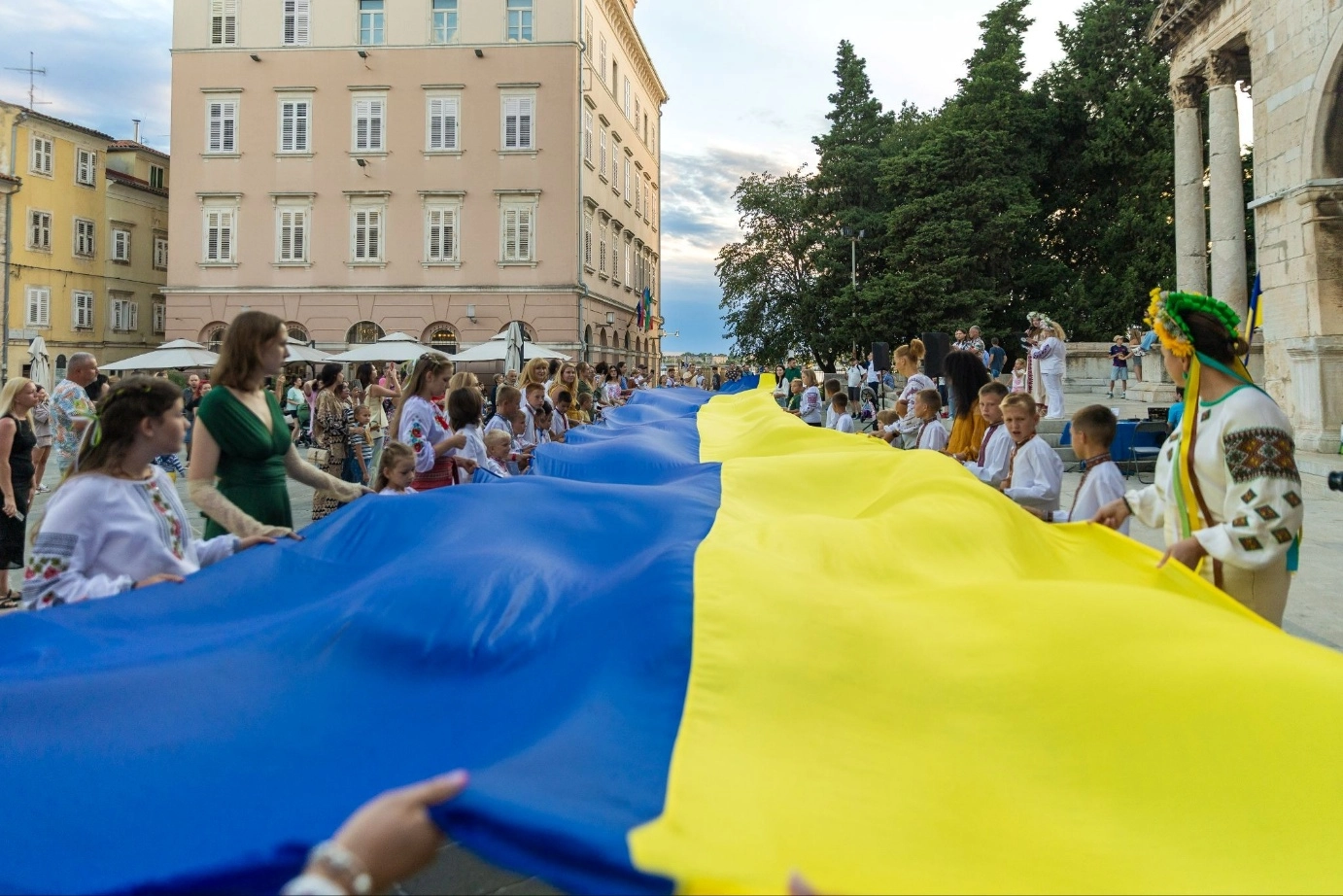 35-meter Ukrainian flag in Pula’s old town square. (Photo courtesy of Olena Rusinova)

Other Topics of Interest
Fedorov Says Corruption Prevents Ukraine’s Victory
Former Defense Minister Mykhailo Fedorov said that systemic corruption involving “hundreds of people” is preventing Ukraine from ending the war from a position of strength.
“I feel like a bridge between Ukraine and Croatia,” Olesia said.
“You must learn the language, customs and traditions of the country where you arrive. Only then can you bring something of your own. Otherwise, what makes you any different from the occupier?”
Knocking on all doors
Before coming to Croatia, Olesia had already built a life rooted in Ukrainian culture.
She worked at the Odesa Academic Theater of Young Spectators and later earned a master’s degree in performing arts from the Luhansk State Academy of Culture and Arts in Kyiv.
Her connection with Ukrainian tradition began early. At 16, she had already released a video for a traditional Ukrainian song and helped coordinate an Independence Day festival in Odesa. Her first job was in a shop selling traditional Ukrainian clothing.
She left Ukraine for a holiday on Feb. 21; three days later, Russia launched its full-scale invasion.
“People tell me that it is good that I am outside Ukraine – this way, I can be a voice for Ukrainian people.”
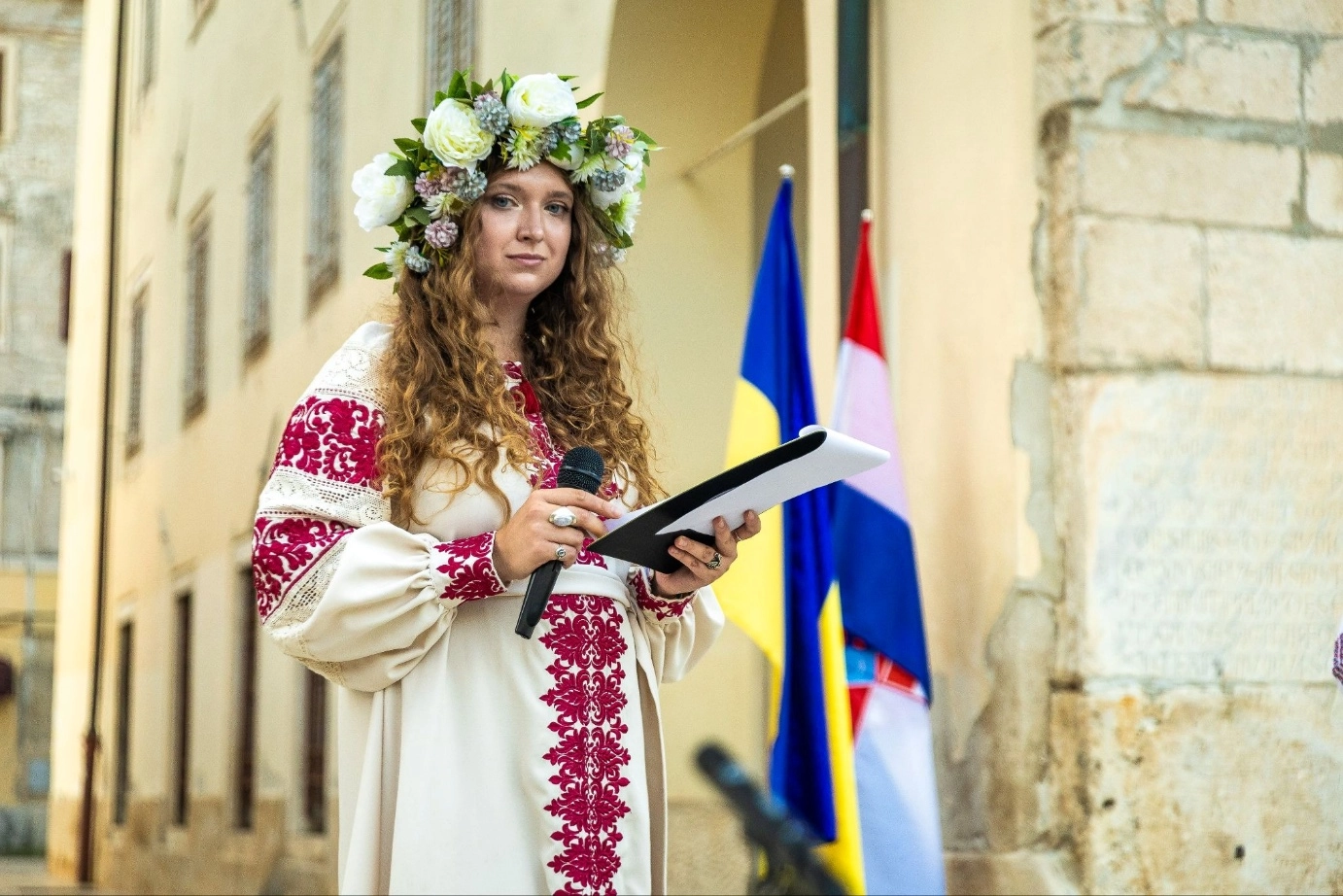 (Photo courtesy of Olena Rusinova)
Having arrived by car during the night, she said she went knocking on the doors of local communities and cultural centers the following day. “This is just who I am. I knock. Some doors open, some don’t,” Olesia said.
Within two weeks, she staged “Ukrainian Season,” a performance about Ukraine and its culture at the Dr. Inat Theater. Within five months, she had learned Croatian by ear and was talking on local radio.
Her later performances included “How Are You?” about emotions people conceal, and “(Un)plugged,” which examined propaganda and manipulation.
“People can no longer distinguish what is true from what is not,” Olesia said. “They often believe what is a lie, which we could see clearly from this war. That is propaganda for me – a system that suffocates you and closes your eyes.”
Carrying Ukraine
Olesia wears Ukraine openly. Traditional jewelry accompanies even her simplest clothes: rings, bracelets in national colors and handmade floral wreaths.
Pointing to her rings, she describes a dragon breathing fire and protecting Ukraine, while her bracelet bears the country’s national emblem.
“I carry Ukraine every day through jewelry,” she said. “For me, identity is not only the songs, folklore, traditional dress and jewelry. It is what you feel inside.”
In many ways, Olesia’s work has entered Istria’s cultural record. Now held by the Ethnographic Museum of Istria in Pazin, she created a Ukrainian traditional-style wreath placing her art within an institution dedicated to preserving the region’s cultural heritage.
The wreath reflects the role she has taken on in Pula – not simply preserving Ukrainian tradition abroad, but also allowing it to enter into the dialogue with the culture of the place she now calls a second home.
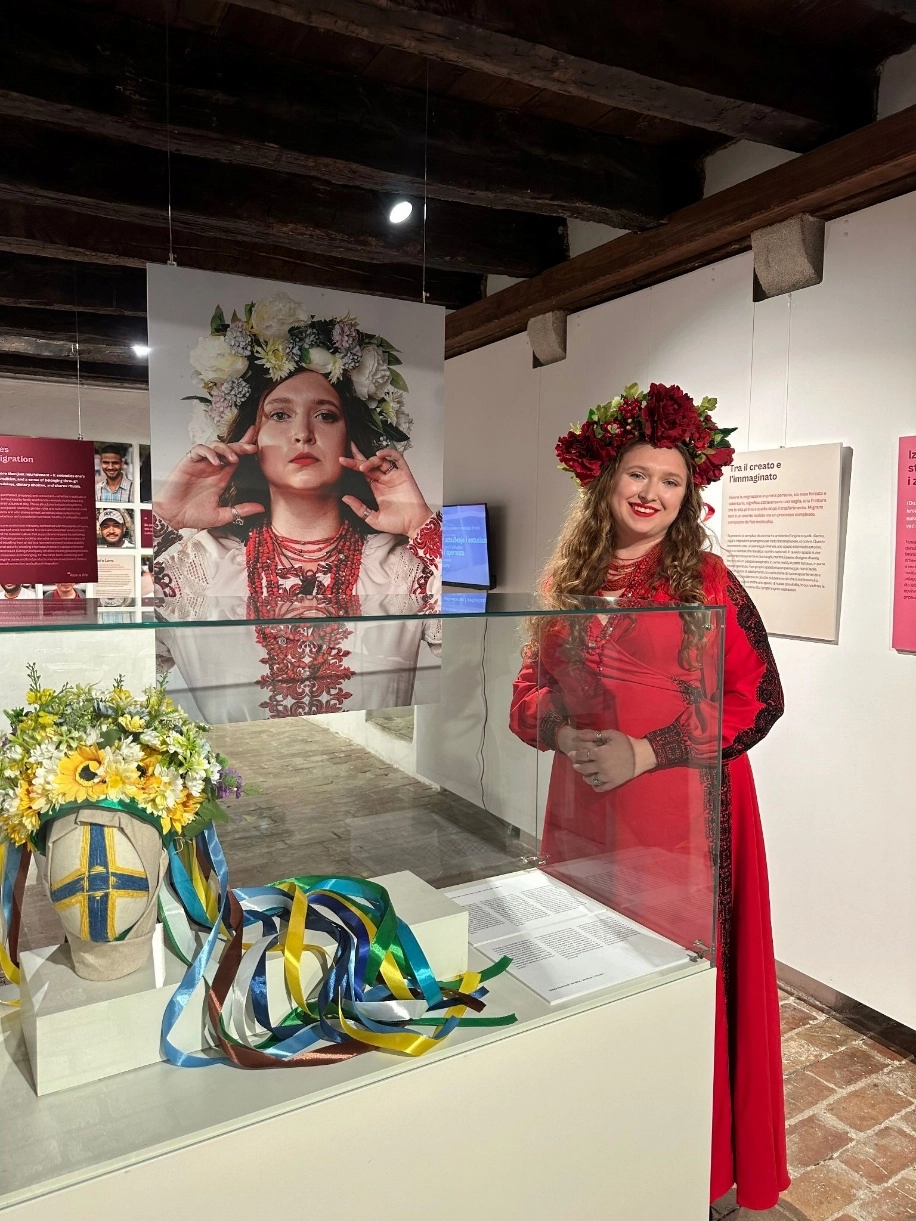 Olesia’s traditional-style Ukrainian wreath held in Ethnographic Museum of Istria in Pazin. (Photo courtesy of Olena Rusinova)
Local media first called her “a Ukrainian in Pula,” then “a Ukrainian with a Pula address.” Eventually, she became known as “the Pula Ukrainian” – Pulska Ukrajinka in Croatian – a label she accepted wholeheartedly as an expression of her belonging to both places.
Her cultural work reflects that dual identity. In 2024, Olesia released her first album, blending traditional Ukrainian music with original lyrics in a genre she describes as folktronica. Her 2025 mini-album, “Kolo,” brought Ukrainian and Balkan folklore into the same musical space.
Separately, she hosts a program called “Cultural Bridge [Kulturni Most]” as part of the European Solidarity Corps (ESC) program at Radio Rojc.
“I feel like a crossing between two cultures – someone who can help Ukrainians who have just arrived and connect Croatians with them,” Olesia said.
Valeriia, too, carries Ukraine through her art, but in quieter, tactile forms. In the first two years after the full-scale invasion, she marked every ceramic piece with a small blue-and-yellow heart – a sign of identity and solidarity embedded in the objects leaving her studio.
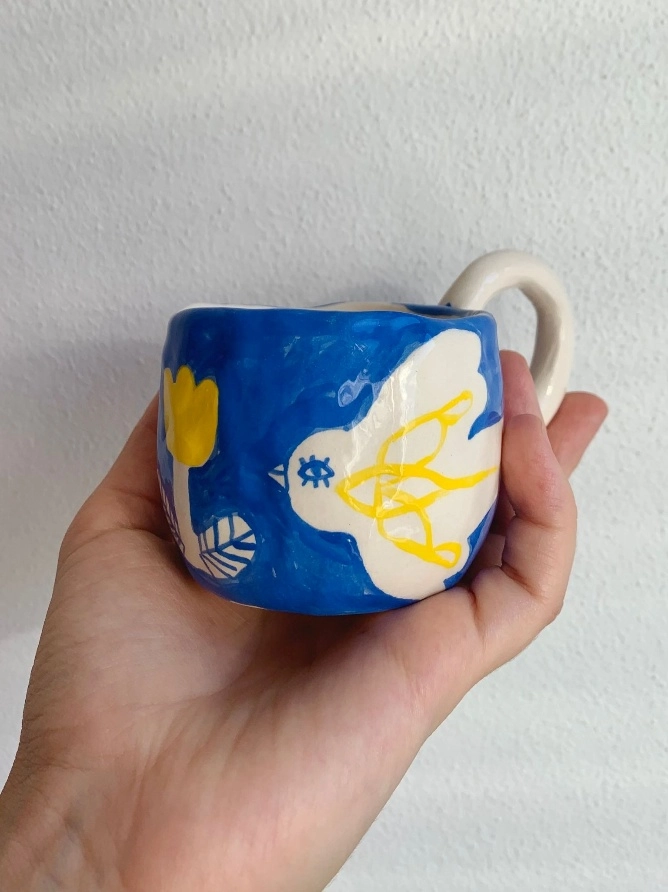 A ceramic cup representing Ukraine. (Photo courtesy of Valeriia Pohrebniak Bednaić)
Valeriia’s business, “Sea of Cups,” continues to present itself as a space for Ukrainian and Croatian art. Its website tells the story of its founders and their connection to Ukraine, while a donation board for Ukraine’s military in the space directs visitors toward supporting Ukraine.
A life between homes
Valeriia’s connection to Istria began more than a decade ago, after her parents bought a small apartment there. Her father had initially considered buying property in Crimea, but Russia occupied the peninsula shortly after.
After February 2022, the journey to Croatia became one of escape. A trip that would normally have taken around a day lasted seven days amid long lines of cars leaving Ukraine.
Through her Instagram account, “Valerie Creating Things,” she began posting about the war alongside her art. She recalled posting from a shelter when the first explosions were heard.
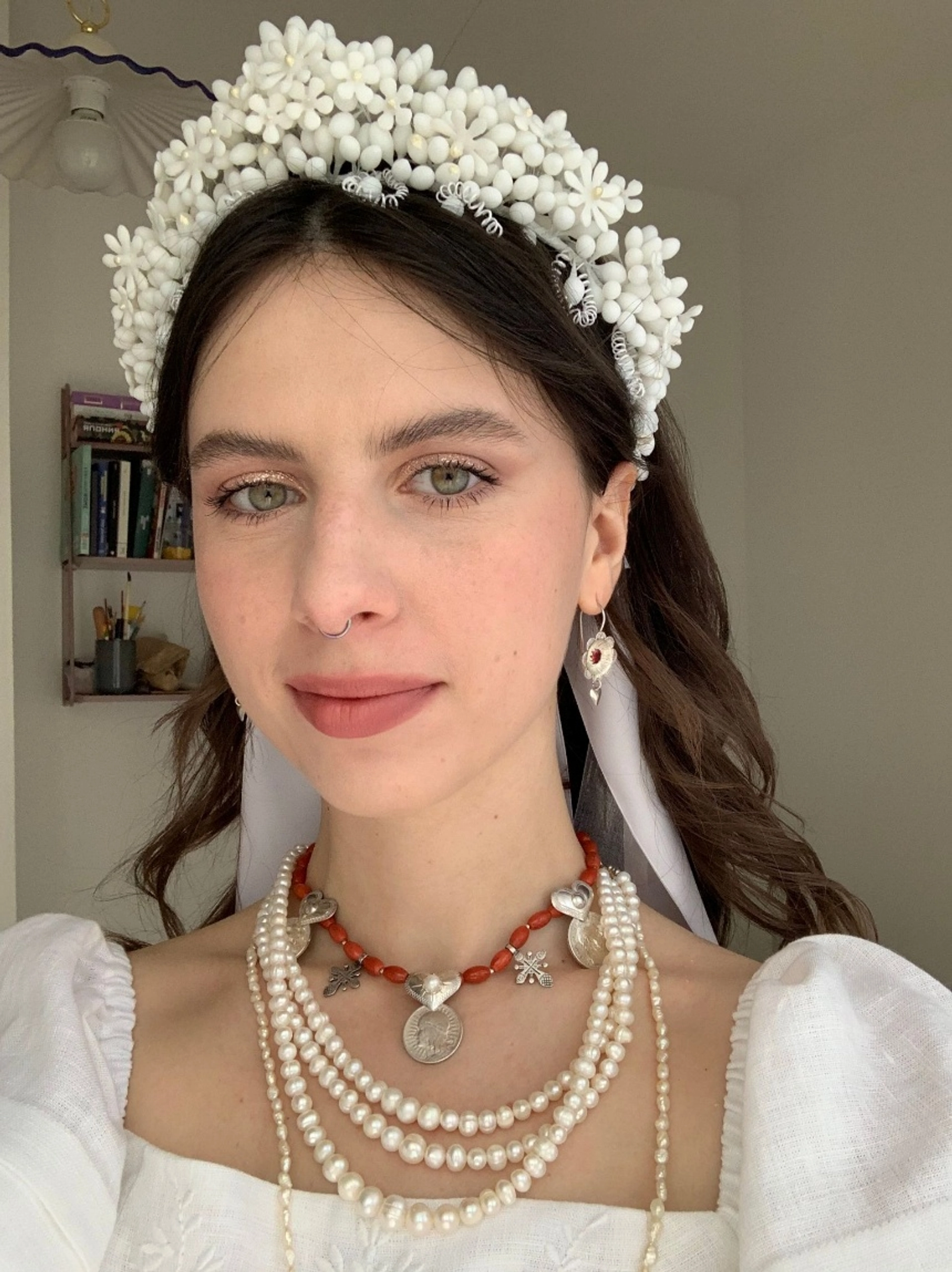 Valeriia’s photo. (Photo courtesy of Valeriia Pohrebniak Bednaić)
“I was very afraid [to relocate to another country], of course. But the page helped me,” she said. “People started sharing my posts, and I found connections in Croatia that helped me find a job in a gallery.”
She later met and moved in with her husband, a Croatian national, and opened a business. Learning Croatian regulations and navigating bureaucracy were difficult for both. “I don’t think I would have opened the business without my husband,” she said.
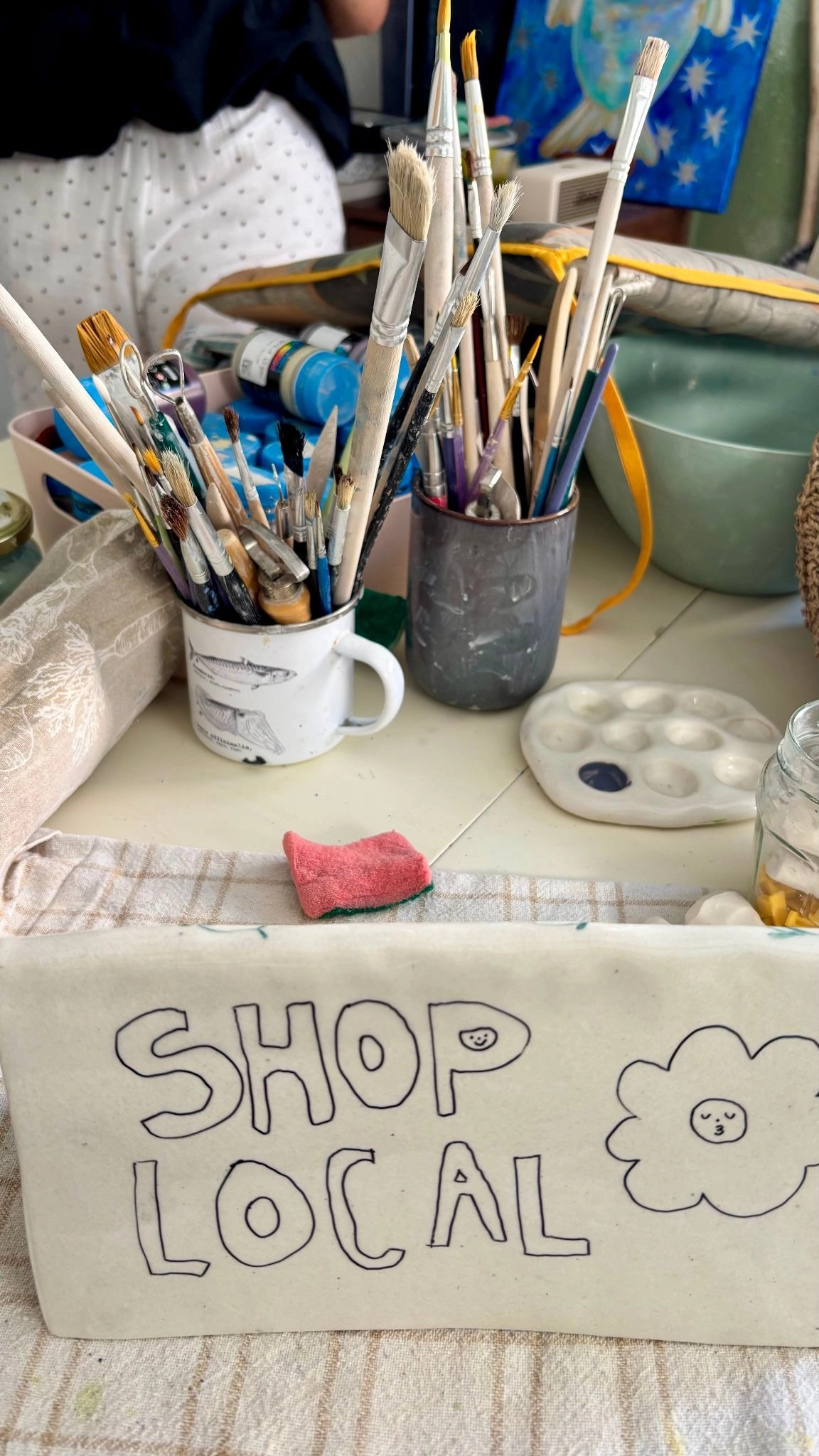 “Shop Local” sign on Valeriia’s work table. (Photo courtesy of Valeriia Pohrebniak Bednaić)
Her child will go to kindergarten and school in Croatia, she said, and she does not plan to leave. Yet Kyiv remains her true home. Her parents still live there: though her father is now retired, her mother still works at a Ukrainian university.
“I live a double life,” Valeriia said. “My day starts with reading the news.”
She says she has not yet found a real community in Croatia. The war, she said, can feel like an invisible barrier between her and the people around her.
“I feel a big wall between myself and the people I speak to, as if the war is a wall,” she said. “No one wants to ask questions or talk about it. When I mention the war, people feel uncomfortable. There is no real connection – only small talk.”
“Still, I do not plan on leaving Croatia,” she added.
Country seen only through Russia
For both women, the war did not begin in 2022.
It began in 2014, with Russia’s occupation of Crimea and the outbreak of war in eastern Ukraine – a period often eclipsed abroad by the full-scale invasion eight years later.
“People did not know about the beginning of the war. They did not know about Crimea,” Valeriia said. “We expected a big war to happen. But then nothing happened. No one stepped in to protect Ukraine; our land was simply taken.”
She recalled repeatedly having to explain where Ukraine was to people she met abroad.
“Even in Europe, people rarely knew anything about Ukraine,” Valeriia said. “Before the war, I had to tell people it was near Russia.”
Language was also part of that erasure. Both women said that before the full-scale invasion, people often treated Ukrainian as interchangeable with Russian or were surprised to hear it spoken.
Both Valeriia and Olesia switched entirely to Ukrainian language in 2014, after Russia’s occupation of Crimea. It was a personal act of protest.
It is worth noting that Ukrainian and Croatian languages share more similarities than Ukrainian and Russian do. While Russians cannot understand Ukrainians, they said, Ukrainian and Croatians share between 60 and 80 percent linguistic similarities.
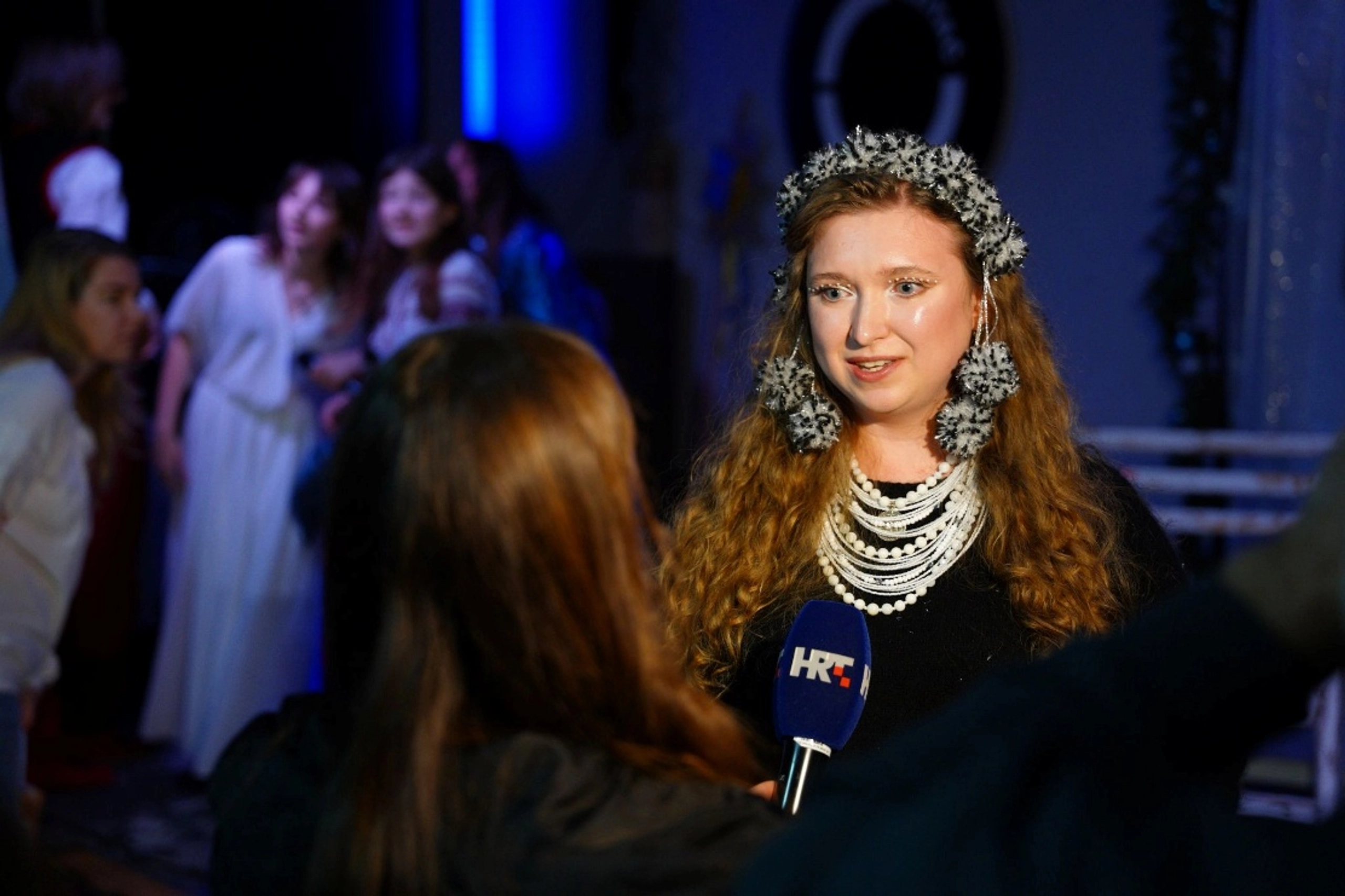 (Photo courtesy of Olena Rusinova)
“I was born in 2000, and the Orange Revolution was in 2004,” Olesia said with a laugh. “My whole life has been revolutions.”
“Before, when we were not so present in public space, Ukraine was recognized through famous people,” Olesia said. “Now that we are everywhere, people recognize Ukraine through those they know personally and through what they do.”
Olesia confirmed Ukraine’s previous invisibility, saying that many people thought Ukraine was “something in Russia,” rather than a country with its own language, culture and political history.
She also recalled how distant the war in Donbas could feel even within Ukraine. At university, she had friends from Donetsk, but she said many of their fellow students did not grasp what they had escaped.
“You knew they had fled, but you did not know exactly what from,” she said. “It was like watching a movie. I think it’s the same for Europeans now. They don’t understand what people were really living through.”
For Olesia, the first images from the Bucha massacre after the Russian occupation were a moment of unbearable rupture.
“I wanted to scream and show it to the whole world,” she said. “But everyone’s life simply continued.”
Visibility with a cost
The full-scale invasion made Ukraine significantly more visible to the world. But both women say that visibility has weakened as the war has continued.
“In 2022, there was more compassion,” Valeriia said. “People shared content about the war, spoke to me and wanted to help. Now, people are more unhappy about it.”
“Sometimes I feel that the fact I am Ukrainian works against me,” she continued.
She does not, however, conceal her identity. Her work continues to blend Ukrainian and Croatian art together.
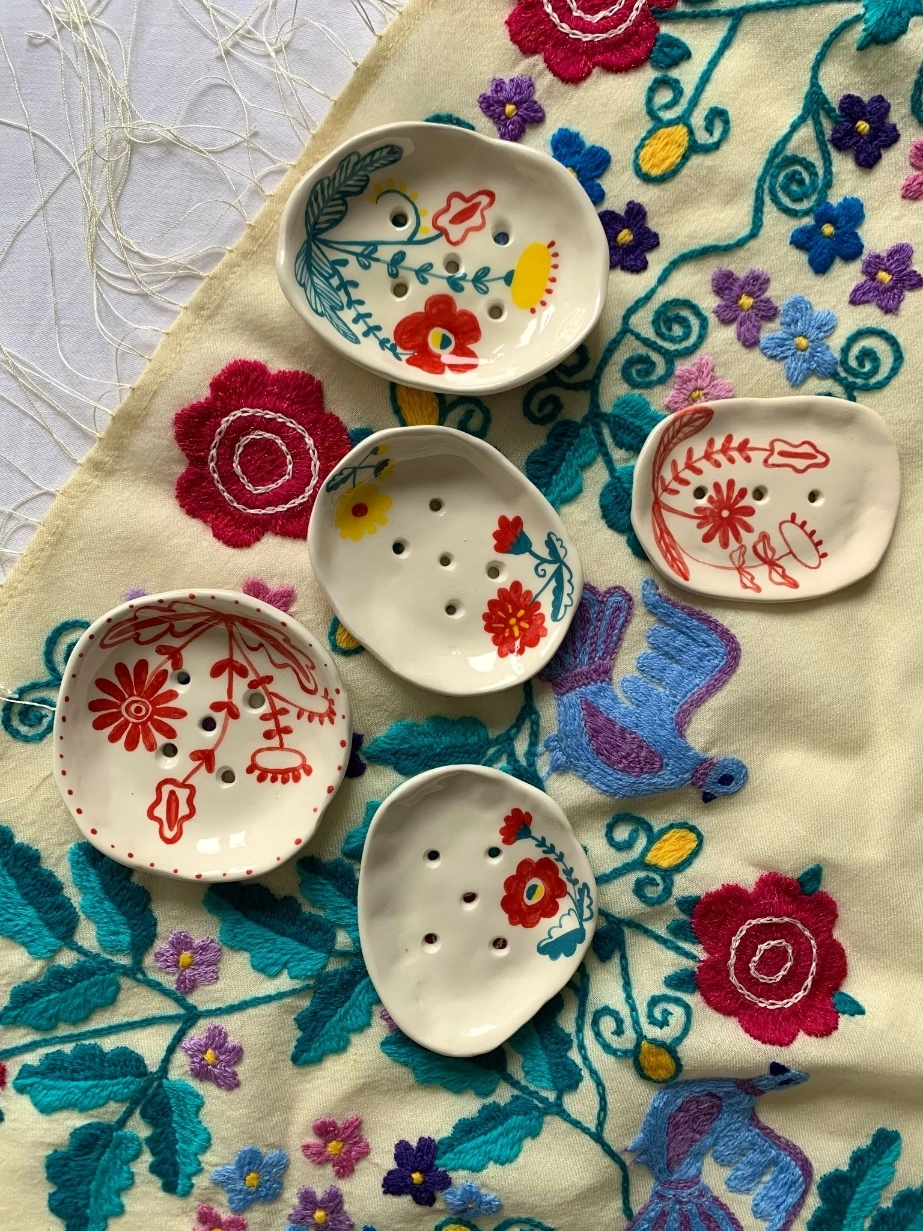 Some of Valeriia’s ceramic art. (Photo courtesy of Valeriia Pohrebniak Bednaić)
Olesia also sees a growing anxiety around public visibility. Under online announcements for Ukrainian events, she has read hostile comments telling Ukrainians to “go back to Putin.”
Yet she believes silence is not an answer.
“People ask, ‘Why should we be loud again? Why should we disturb others?’” Olesia said. “But it’s not disturbing people. It’s informing them about what’s happening in Ukraine.”
War beyond the front line
Memories of Yugoslavia’s violent breakup remain deeply felt across the Balkans, even after decades have passed. A shared nation, once framed around “brotherhood and unity,” dissolved into wars marked by ethnic cleansing, mass displacement, war crimes and genocide.
That experience, including Croatia’s own war of independence fought throughout 1991-95, has helped shape the empathy most Ukrainians encounter in Pula.
Olesia recalls cultural workers providing space, equipment and support without charge because of this. She also learned one of her first Croatian words: polako.
“What I learned most from Croatians is to live slowly,” she said. But the war does not slow down for those whose families remain in Ukraine.
Olesia says Ukrainians have learned to work, laugh and perform while carrying the knowledge that their cities are under attack. “If a Ukrainian is smiling, it does not mean they are fine,” she said. “It means they have made every effort to smile.”
Through art, language, grief, work and ordinary routines, Ukraine remains – carried by the people who have rebuilt their lives abroad without ever fully leaving home behind.