
Experts warn that accepting North Korea as nuclear-armed could test the U.S. alliance and spur proliferation debates in Seoul and Tokyo.
U.S. President Donald Trump speaks at a campaign rally for Sen. Darline Graham at the Myrtle Beach Convention Center in Myrtle Beach, South Carolina, on Aug. 21.
AP/YONHAP
Concerns are growing that the United States may be moving toward de facto acceptance of North Korea as a nuclear-armed state following U.S. President Donald Trump’s remarks on Wednesday that Pyongyang has “57 nuclear weapons.”
The JoongAng Ilbo asked eight foreign policy and security experts from South Korea and abroad about the direction South Korea should take on national security.
The experts warned that if North Korea’s nuclear arsenal comes to be accepted as a reality, South Korea should be prepared for a potential nuclear domino effect, with South Korea and Japan pursuing their own nuclear weapons, as well as a weakening of the South Korea-U.S. alliance.
Among U.S. experts, a growing number argue for a more pragmatic approach that focuses on managing the threat posed by a nuclear-armed North Korea rather than holding on to the longstanding goal of denuclearization.
“The United States and even its allies already recognize North Korea as a nuclear-armed state,” said Ankit Panda, a senior fellow at the Carnegie Endowment for International Peace. “We must prioritize deterrence and seek to manage a nuclear-armed North Korea.”
Harry Kazianis, former director of Korean studies at the Center for the National Interest, also called for moving beyond the goal of North Korea’s complete denuclearization.
“The nuclear issue, something we will never get solved in the way we want, which is full disarmament, is never going to happen, and holds back a better tomorrow,” Kazianis said. “However, if we can find the political courage to move past dead ideas like complete, verifiable and irreversible denuclearization, we can unlock a better future on the Korean Peninsula.”
![(평양 노동신문=뉴스1) = 북한 노동당 기관지 노동신문은 15일 '조선인민군 서부지구 장거리포병구분대의 화력타격훈련이 14일에 진행됐다'면서 '훈련에는 600㎜초정밀다련장방사포 12문과 2개의 포병중대가 동원됐다'고 보도했다.[국내에서만 사용가능. 재배포 금지. DB 금지. For Use Only in the Republic of Korea. Redistribution Prohibited] rodongphoto@news1.kr](https://www.europesays.com/wp-content/uploads/2026/08/12817893.webp)
North Korean leader Kim Jong-un, third from left, walks by a long-range artillery unit of the Korean People’s Army with his daughter Kim Ju-ae on March 14, in this photo distributed by the Rodong Sinmun.
NEWS1
Joel Wit, a distinguished fellow at the Stimson Center, however, voiced concern that a shift in Trump’s approach and the cancellation of joint military exercises could have broader consequences for U.S. alliances in the region.
“I think the recent shift in President Trump’s approach to North Korea as well as his cancellation of exercises with the South will only fuel the underlying currents in South Korea and also Japan to seriously consider requesting the redeployment of American tactical nuclear weapons or building their own nuclear forces,” Wit said.
“Both moves will only fuel doubts about the U.S. alliance and the [protection] provided by Washington’s nuclear arsenal.”
Experts were divided over whether South Korea should develop its own nuclear weapons.
“North Korea has at least 60 nuclear weapons and the ability to likely kill every person in South Korea with its atomic arsenal in minutes,” Kazianis said. “We need to state the threat out loud and plan for how to deter it. That means nuclear weapons.”
“South Korea, if it decides to build nuclear weapons, should have nuclear weapons,” he added.
Panda, however, said neither South Korea nor Japan has yet reached the point of pursuing its own nuclear arsenal.
“States do not seek nuclear weapons idly, but they do if alternative security arrangements are deemed to be insufficiently credible to meet their needs,” Panda said. “Right now, South Korea and Japan are each struggling with an unreliable United States, but neither has reached a breaking point.”
!['천마총 금관 모형'과 한미 정상 (경주=연합뉴스) 한상균 기자 = 이재명 대통령이 29일 경북 경주박물관에서 도널드 트럼프 미국 대통령에게 '천마총 금관 모형'을 선물한 뒤 악수하고 있다. 2025.10.29 [대통령실통신사진기자단] xyz@yna.co.kr/2025-10-29 15:56:57/](https://www.europesays.com/wp-content/uploads/2026/08/12828645.webp)
President Lee Jae Myung, right, shakes hands with U.S. President Donald Trump after presenting him with a replica of the Cheonmachong gold crown at the Gyeongju National Museum in Gyeongju, North Gyeongsang, on Oct. 29, 2025.
JOINT PRESS CORPS
South Korean experts placed greater emphasis on strengthening U.S. extended deterrence than on developing an independent nuclear arsenal.
“The South Korea-U.S. Nuclear Consultative Group needs to operate on a permanent and substantive basis,” said Jun Bong-geun, a visiting research fellow at the Sejong Institute. He also suggested a freeze on North Korea’s nuclear activities through a North Korea-U.S. summit as a second-best option.
Lee Sang-kyu, a research fellow at the Korea Institute for Defense Analyses, also called for stronger U.S. extended deterrence.
“It would be preferable to enhance the credibility of extended deterrence,” Lee said.
Lee Byong-chul, a professor at Kyungnam University’s Institute for Far Eastern Studies, called for accelerating nuclear-related negotiations with the United States.
“If the trend toward accepting North Korea’s nuclear arsenal continues, South Korea should accelerate negotiations on nuclear-powered submarines, low-enriched uranium enrichment and spent nuclear fuel reprocessing,” Prof. Lee Byong-chul said.
Shin Beom-chul, a principal research fellow at the Sejong Institute, proposed a “South Korean-style nuclear sharing” arrangement under which U.S. tactical nuclear weapons stationed in locations such as Guam could be deployed to the Korean Peninsula aboard nuclear-powered submarines or through F-35A fighter jets.
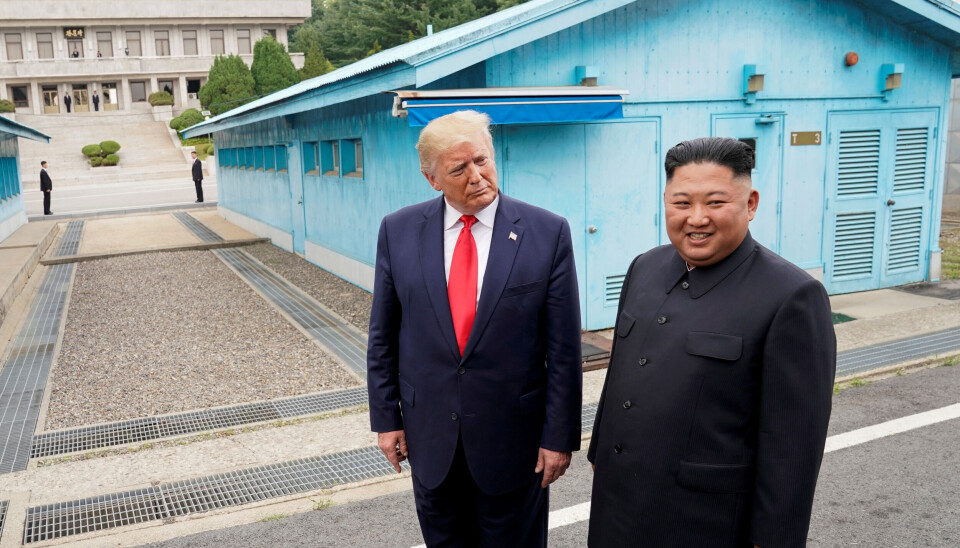
U.S. President Donald Trump, left, meets with North Korean leader Kim Jong-un at the demilitarized zone separating the two Koreas in Panmunjom on June 30, 2019.
REUTERS/YONHAP
Jeon Kyung-joo, a research fellow at the Asan Institute for Policy Studies, suggested coordinating with Washington on the potential use of U.S. tactical nuclear weapons, including sea-launched cruise missiles, on the Korean Peninsula.
Experts also raised the possibility that alliance issues could become bargaining chips if a North Korea-U.S. summit takes place.
Wit said North Korean leader Kim Jong-un could demand an end to joint military exercises and a reduction in U.S. Forces Korea.
“President Trump would agree given his longstanding skepticism about the alliance and fixation with the financial cost of the American military commitment,” Wit said.
BY SHIM SEOK-YONG, YOON JI-WON [kim.jiye@joongang.co.kr]
This article was originally written in Korean and translated by a bilingual reporter with the help of generative AI tools. It was then edited by a native English-speaking editor. All AI-assisted translations are reviewed and refined by our newsroom.