
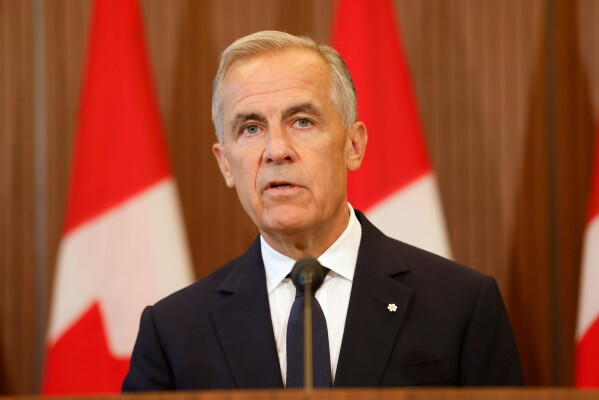
Prime Minister Mark Carney speaks about Canada’s response to new U.S. tariffs during a news conference on Parliament Hill in Ottawa on Saturday, Aug. 22, 2026. (Patrick Doyle/The Canadian Press via AP)
Prime Minister Mark Carney speaks about Canada’s response to new U.S. tariffs during a news conference on Parliament Hill in Ottawa on Saturday, Aug. 22, 2026. (Patrick Doyle/The Canadian Press via AP)
Add AP News on Google
Add AP News as your preferred source to see more of our stories on Google.
Share
Read More
Canada’s Carney has announced the tariffs against the U.S. would begin Sept. 8, noting they would target steel, dairy, appliances, agricultural equipment, pulp and paper and electronics.
The prime minister said Canada was willing to drop remaining retaliatory tariffs on steel, aluminum and autos if the U.S. substantially lowered its own, and to encourage provinces to restore U.S. alcohol sales. But eventually, he said Washington’s final demands went too far.
Carney accused Washington of using “economic integration as a weapon,” and that Canada had been “attacked” by the latest U.S. tariffs. He said his country had the reserves and resilience to respond.
Trump’s top trade negotiator, Jamieson Greer, pledged additional measures to respond to Canada’s retaliation — without immediately specifying what that would look like. In a Saturday interview with “Fox & Friends Weekend,” Greer also claimed the administration offered to cut tariffs on steel, autos and lumber, but Canada “didn’t want” the deal.