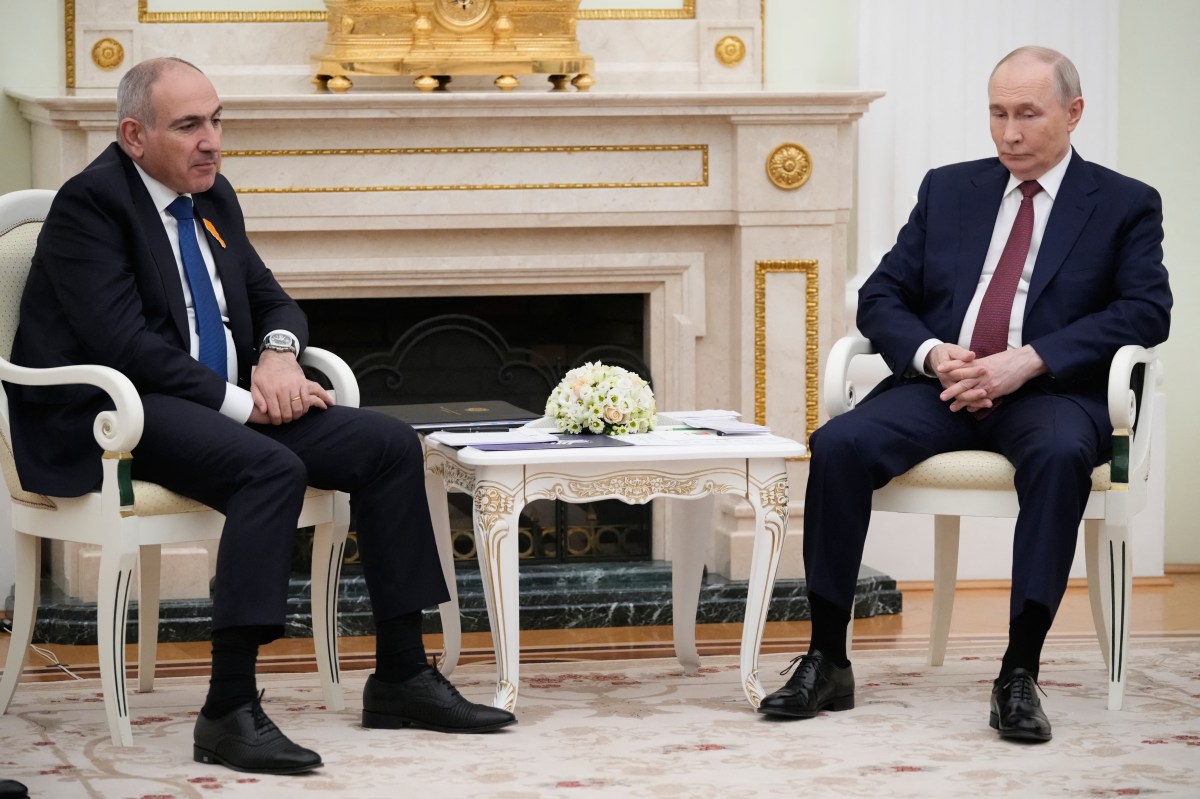
A founding member of Russia‘s post-Cold War answer to the U.S.-led NATO alliance is moving forward with plans to exit the bloc, putting pressure on Moscow’s historic influence at a crossroads of Europe and Asia.
Speaking before parliament on Monday, Armenian Prime Minister Nikol Pashinyan reiterated his February 2024 decision to freeze cooperation with the Collective Security Treaty Organization (CSTO) after its perceived failure to aid his country in recent conflicts with Azerbaijan and indicated he would support any move by the six-nation coalition to expel his country.
“I can say with certainty that we will not activate our work in the CSTO, we will not activate it,” Pashinyan said. “And I know there are discussions in the CSTO and in the organization.”
Read More on World
“The statute provides for such a thing, the country can be expelled from the organization,” he added. “I will be very pleased if the organization decides to expel the Republic of Armenia from the Collective Security Treaty Organization. At least it will free us from the dilemma of not leaving.”
In response, Kremlin spokesperson Dmitry Peskov told reporters in Moscow that “if Yerevan no longer needs to be a member of such an important organization for ensuring regional security to serve its national interests, then it is free to take the appropriate decision and leave this organization.”
Richard Giragosian, director of the Regional Studies Center in Yerevan, described the language on Armenia’s part as “rather belated” as the CSTO “has proven to be an unreliable security provider” in the face of “attacks and incursions of Armenian sovereign territory by Azerbaijan.”
“Although that crisis with Azerbaijan has largely been superseded by unprecedented progress in diplomatic negotiations between Armenia and Azerbaijan, the Russian-dominated CSTO now stands out as a dead end for Armenian security,” Giragosian told Newsweek.
“Yet the Armenian leadership is both prudent and cautious in not unnecessarily provoking an over-reaction from Russia,” Giragosian said. “Hence, the real leverage from Armenia has been from suspending its contribution to the CSTO rather than exiting the ’empty alliance’ that now defines the CSTO.”

Why Armenia Wants Out
Russia’s consolidation of influence over Armenia dates back nearly 200 years to a postwar 1828 treaty with Qajar Iran that saw much of the modern territory of the South Caucasian nation incorporated into the Russian Empire, with Russia portraying itself as a protector of Armenian interests against rival Ottoman and Persian aims. Armenia briefly gained self-rule in 1918 after the Russian Civil War but was incorporated alongside neighboring Azerbaijan and Georgia into the Soviet Union in 1920.
Armenia once again secured independence in 1991 after the collapse of the Soviet Union. However, Armenia retained close military ties with Russia, joining the newly established Collective Security Treaty—the precursor to the CSTO—the following year as conflict intensified with Azerbaijan over the disputed Nagorno-Karabakh territory, with Yerevan emerging as the victor.
Azerbaijan and Georgia joined the Collective Security Treaty in 1993 but later withdrew in 1999 amid negotiations toward extending the alliance into what would become the CSTO in 2002. Uzbekistan also joined the Collective Security Treaty but declined to sign its extension in 1999 and went on to join the CSTO in 2006 until leaving in 2012.
Nagorno-Karabakh and the establishment of the Armenia-backed Artsakh Republic on internationally recognized Azerbaijani territory remained a major source of tensions between Yerevan and Baku, leading to several skirmishes over the years. A series of conflicts in 2020, 2022 and 2023 ultimately led to Azerbaijan dismantling the separatist presence and serious casualties among both Armenian and Armenian-backed forces.
Russa deployed thousands of peacekeepers but its hesitance to intervene in favor of Armenia in response to Azerbaijani attacks on Armenian territory raised doubts among Armenian leadership as to the extent of Moscow’s willingness and capability to safeguard the country, especially after Russia’s 2022 invasion of Ukraine.
In his latest remarks, Pashinyan said that relations between Yerevan and Moscow over the past two centuries have been “built on the foundation and understanding that Russia is the guarantor of the security of the Armenian people and the Armenian state.” However, he said, “due to its own security challenges, the Russian Federation can at times face significant limitations in its ability to perform this role.”
The current CSTO alliance member states are Armenia, Belarus, Kazakhstan, Kyrgyzstan, Russia and Tajikistan.
Out of these nations, only Belarus has provided direct support for Russia’s war with Ukraine. Just one month before the conflict erupted, the CSTO deployed troops at Kazakhstan’s request to quell domestic opposition unrest in January 2022.
Still, Russia continues to seek strong cooperation within the CSTO framework.
During a meeting among representatives earlier this month, CSTO Joint Staff Chief Colonel General Andrey Serdyukov—who was replaced as Russian Airborne Forces commander shortly after a failed effort to seize Ukraine’s Hostomel airfield at the start of the Ukraine war in 2022—was cited as saying that “the importance of ensuring collective security continues to grow, requiring close cooperation with all relevant international organizations”
But Mher Sahakyan, founder and director of the China-Eurasia Council for Political and Strategic Research in Yerevan, argued that “the central issue is that the CSTO has ceased to function as a reliable component of Armenia’s security architecture” since 2018, years before the Russia-Ukraine war, when a transition of power in Armenia led to a crisis in the alliance’s leadership as Armenia recalled then-CSTO Secretary-General Yuri Khatchaturov to face charges of suppressing opposition protests at home.
Since then, Sahakyan said, there have been multiple attacks by Azerbaijan on Armenian territory and a deepening rift between Armenia and Russia exacerbated by “Moscow’s deepening strategic partnership with Azerbaijan’s main ally, Turkey, thereby raising questions in Armenia whether the country should stay [in the CSTO] or not.”
“At the same time, Armenia has sought to avoid a direct escalation with Russia,” Sahakyan told Newsweek. “Consequently, rather than formally withdrawing from the CSTO, Yerevan has opted to freeze its participation in the organization using this step as a political signal of dissatisfaction with the CSTO’s failure to uphold Armenia’s territorial integrity while preserving strategic flexibility.”
“In turn, currently Russia escalates the situation seeking to force Armenia to choose a side in an emerging Multipolar World Order 2.0 using its traditional soft balancing mechanisms, including economic pressure and threats to weaponize energy sources, to discourage Yerevan from further strengthening its relations with the U.S. and the EU,” he added.

Trump Steps In
While Russian President Vladimir Putin has struggled to retain Armenia’s confidence, his U.S. counterpart has sought to step in to prove Washington a better partner.
During his first term, then-President Joe Biden began accelerating diplomatic moves with Armenia and, as Moscow’s influence continued to wane, secured a strategic partnership agreement with Yerevan days before President Donald Trump took office for a second time in January of last year. In August 2025, Trump hosted Pashinyan and Azerbaijani President Ilham Aliyev to initial a peace agreement and lay the foundation for the “Trump Route for International Peace and Prosperity” (TRIPP).
Advanced in May, as the U.S. and Armenia deepened relations through a new comprehensive strategic partnership agreement, the TRIPP would see the establishment of a 27-mile rail route linking Azerbaijan’s mainland to its exclave province of Nakhchivan via southern Armenian territory. To this day, Trump counts the long-running Armenia-Azerbaijan dispute as one of “eight wars” he has resolved throughout his presidency.
Washington, Yerevan and Baku reaffirmed their commitment to the TRIPP in a joint statement published last week on the anniversary of the U.S.-mediated peace agreement. The statement noted that surveys to advance the initiative, which will also allow the U.S. to invest in infrastructure and resource projects, were currently underway.
Pashinyan has announced his intentions to seek closer partnerships elsewhere in the West as well. As he emphasized his desire to distance from the CSTO on Monday, he also revealed plans to submit Armenia’s application for European Union membership in the near future.
But as Giragosian pointed out, Pashinyan simultaneously demonstrated his desire to retain a close relationship with Moscow, having taken his first post reelection trip to meet with Putin earlier this year. The Armenian leader also has yet to part with Russia’s own economic bloc, the Eurasian Economic Union (EAEU), making any total pivot to the West unlikely.
“Armenia is now engaged in a daunting effort to regain balance between its deepening of ties to the West and its reliance on Russia in terms of energy, economic and trade,” Giragosian said.
At the same time, he argued that Armenia’s “diversification” policy, “which is driven by the need for garnering a broader group of security partners, is working.”
“And it has been successful because it is avoiding being trapped within the confines of a zero-sum confrontation between Russia and the West,” Giragosian added.
Treading Carefully
Though Trump has championed his Armenia-Azerbaijan diplomacy as among his lauded accomplishments on the desired path to achieve a Nobel Peace Prize, the U.S. leader’s attention has been more recently focused across another border of Armenia.
Since February, the U.S. has been engaged in direct military operations against Iran, whose northern territory lies along the planned TRIPP route. While Iran has traditionally maintained positive ties with Armenia, the fallout of the conflict has already expanded to include strikes and disruptions to competing global trade routes that put nations beyond the Middle East at risk.
As Yerevan attempts to recalibrate its geopolitical alignments, Sahakyan argued that “Armenia needs to tread carefully without taking a side, combining balancing and hedging as a coherent geostrategy in engaging actors in the West, East, North, and South simultaneously.”
He also doubted Trump’s desire to further expand NATO into the post-Soviet sphere of influence, effectively meaning “the door is closed” for Armenia swapping its CSTO allegiance to join the Western alliance.
And while Sahakyan said that the U.S.-Armenia comprehensive strategic partnership agreement established in May “is important and can be utilized in bringing an opportunity to Armenia to develop its economy, science, high-tech, and people-to-people contact with Americans,” he highlighted that Washington’s commitment to the region may ultimately be limited.
“There is a need to remember that the South Caucasus is not a top priority region for the U.S., even if it is concentrating selective capacities to maintain regional balance of power.”