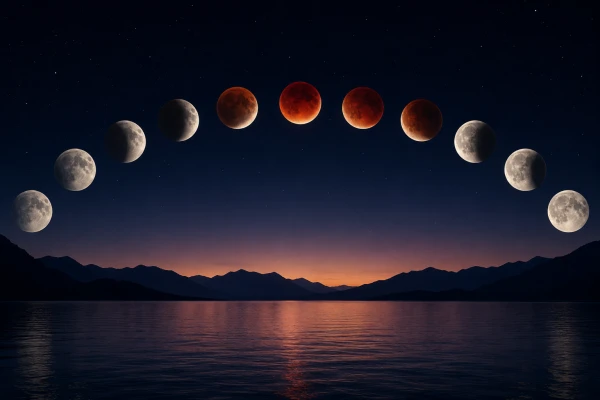
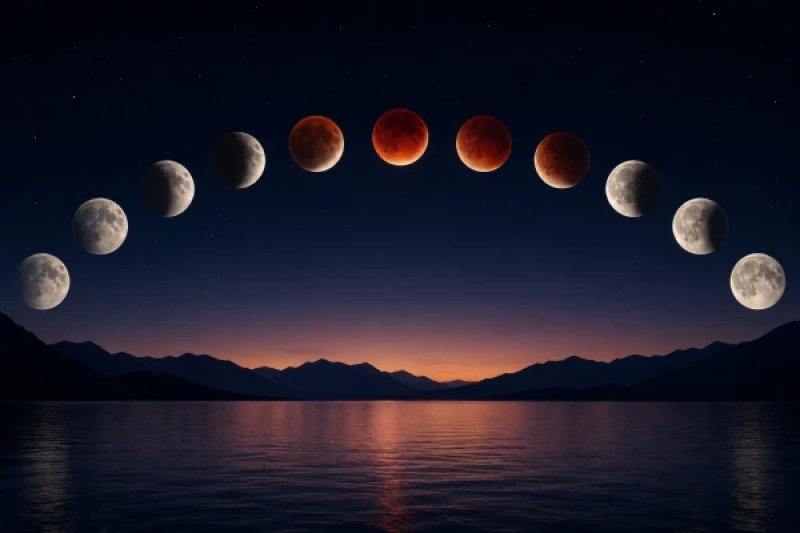
On the night from Thursday to Friday, August 28, 2026, a partial lunar eclipse will occur. At the global maximum, the Earth’s shadow will cover a large part of the lunar disk; however, the observation conditions will vary significantly depending on the region.
A lunar eclipse occurs when the Earth is positioned between the Sun and the Moon, casting a shadow on its natural satellite. During a partial eclipse, the Moon is not completely immersed in the shadow: part of the disk remains illuminated.
The best conditions for observation are expected in North and South America. Various stages of the eclipse will also be visible to residents of Europe, Africa, and parts of Asia.
### What Will Be Seen in Latvia?
In Latvia, the eclipse **will be visible**, but only its initial part. In Riga, the penumbral phase will begin on August 28 at approximately **4:23 AM**, and the noticeable partial phase will start around **5:33 AM**.
The most interesting moment for residents of Riga will occur around **6:17 AM**. By this time, the Moon will be nearly at the horizon — its height will be only about 0.2 degrees. Around **6:22 AM, the Moon will set**, so the global maximum of the eclipse, which will occur later, will not be visible from Riga.
Thus, the maximum figures announced for the eclipse should not be applied to Latvia. In Riga, just before the Moon sets, only part of the phenomenon will be visible; calculations indicate that the visible degree of coverage here will be significantly less than the global maximum.
Residents of the western part of Latvia will have slightly better conditions, as the Moon will set there a little later. For example, on the western coast, the maximum visible phase may be observed until about **6:28–6:33 AM**.
### Where to Look for the Moon
Residents of Riga who wish to see the eclipse will need to wake up early and choose a location with a **maximally open western or southwestern horizon**. At the beginning of the partial phase, the Moon will be only about five degrees above the horizon and will then quickly drop even lower.
Therefore, houses, trees, and other obstacles may completely block the view. Open fields, coastlines, or elevated places will be the best options. Of course, observation will only be possible with a sufficiently clear sky.
Unlike a solar eclipse, viewing a lunar eclipse can be done **without special glasses and protective filters**. Binoculars or a small telescope are not necessary but will allow for a better view of how the Earth’s shadow gradually covers the surface of the Moon.
So, residents of Latvia will not miss out on the astronomical spectacle, but they will have to wake up before dawn for it. The main thing is not to expect the maximum phase: in Riga, the Moon will disappear below the horizon around 6:22 AM, so the best time for observation is approximately from 5:30 to 6:15 AM.