
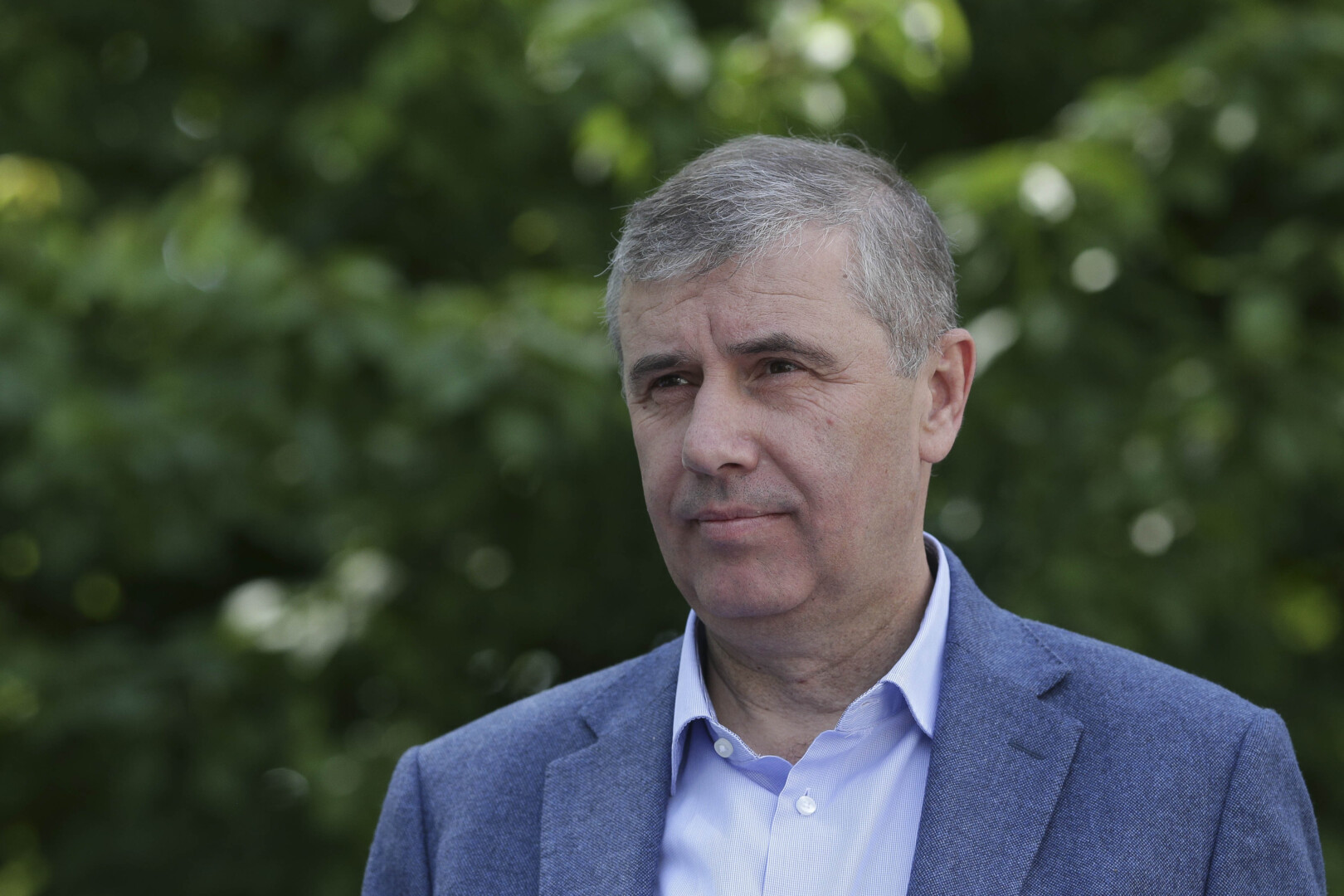
Romania’s longest-serving security chief also worked for Nicolae Ceausescu’s repressive security agency and was present at a key pro-democracy protest during the 1989 revolution where dozens were killed as Ceausescu’s regime crumbled, an investigation has revealed.
Recorder.ro said that General Lucian Pahonțu (a retired general), head of the SPP security service since 2005, working under three presidents and 15 governments, was part of Communist leader Ceausescu’s security services in the years leading up to 1989.
They said the 61-year-old was physically present, as a platoon commander, on December 21, 1989 near the former Intercontinental Hotel in Bucharest, where military and security forces loyal to Ceausescu opened fire on unarmed protesters in one of the bloodiest moments in Romania’s recent history.
According to reports, some 49 people were killed overnight and hundreds wounded outside the Intercontinental although there has never been a full investigation into the revolution where an estimated 1,666 people died and 3,000 were injured, according to incomplete figures.
There was no immediate reaction from Pahontu who has confirmed he was present, but denied wrongdoing, Recorder reported in its investigation called “The hidden biography of General Pahontu” .
“It’s a big surprise for me. He should lose his job,” said former President Traian Basescu, reacting to the news.
The news which comes decades after Romania threw off communism is further confirmation that Romania’s revolution was hijacked by second-tier communists such as late President Ion Iliescu who served three terms as president.
After communism ended, some former Securitate officers kept their jobs, or went into politics, the media and business and retained influence through semi-formal and informal networks, making lucrative careers, only occasionally facing public scrutiny.
Romania began to open its Securitate files as it prepared to join NATO in 2004, but that has been patchy and met with fierce resistance. There has never been a proper investigation into the 1989 revolution, the bloodiest in Eastern Europe, or the state violence against pro-democracy demonstrators in the months and years afterwards which saw civilian deaths and injuries.
Recorder, a respected investigative journalism website said it had culled its information from the “ Revolution file,” in which Pahonțu, says he was present at the Intercontinental, but claimed: “I had no contact with the demonstrators.”
It was unclear why it has taken so long for the information to be made public, but it may be because Pahontu is “the most influential and long-standing” security chief in Romania. Under his term, the SPP has provided security for the country’s presidents, Traian Basescu, Klaus Iohannis and Nicusor Dan, ministers and other high-ranking officials.
Revealing his background, Recorder said Pahonțu joined the Securitate after attending the courses of the Military School of Active Signal Officers in Sibiu, central Romania. Recorder.ro said it obtained testimonies that he was the nephew of General Vasile Milea, defense minister during the 1989 Revolution.
The Military Unit 0305, to which Pahonțu belonged, was already on alert on December 21, 1989, when Nicolae Ceaușescu organized a rally in front of the Central Committee (today’s Revolution Square). But demonstrators turned against the Communist leader sparked a revolt against the regime which fell within the week.
Later that day, plain clothes security troops arrived in downtown Bucharest at the Intercontinental including Lucian Pahonțu, according to the report of Major Gheorghe Rădulescu: “I received an order from Colonel Pavelescu Dumitru, the chief of staff of the troops (editor’s note – Security Troops), that together with a platoon commanded by Cpt. Potinteu Emil and Lt. Pahonțu Lucian to replace a subunit of UM 0396 commanded by Cpt. Ivan Aurel which was in the cordon of order made on 13 Decembrie Street at the intersection with 1848 Blvd. (…) The soldiers were equipped in gray-blue attire, with helmets and shields and of course with weapons and combat ammunition”, the document reads.
Lucian Pahonțu confirmed this in a statement that Recorder.ro found in the Revolution File: “The undersigned Lt. Pahonțu Lucian, son of Nicolae and Paraschiva, declare that between 17-22-12-1989 I executed the following. (…) On 21-12-1989 at around 15:00 the subunit received an alarm. After equipping and checking the subunit, we received the order to embark the servicemen in trucks and wait for new orders. Around 20:00 we received the order to go to the Scîntei Square to guard the Casa Scintei objective. Once here, we were ordered to stay in trucks on the spot. Around 21:00 we received an order through the radio station to move on the set in front of the “Cina” restaurant. Once there, the commander of the company contacted the commander of the MU. Around 10:00 p.m. we received an order to change a blockage subunit on “13 Decembrie” Street (now Ion Câmpineanu Street – editor’s note). I, together with the commander of the company, went by truck to the ordered place and entered the device.”
Here we took the shields from the subunit we replaced. In front of the device were units and armored vehicles of the MApN that were firing warning fire. I stayed in the device until around 2:00 a.m., after which I stayed at rest at the truck. During this entire period, neither I nor the subunit had contact with the demonstrators,” he wrote.
His testimony, however, is contradicted by another, of his device commander, Lt-Col Ion Alecu, who reported that he “had a hard time resisting the demonstrators”: “On 21.12.89 and 22.12.89 until 11:00-11:30 I ordered the subunits from the blockade of 13 Decembrie Street to the Intercontinental Hotel.
Throughout this period I had the permanent radio contact with col. Pavelescu, who coordinated our activity. I report that on several occasions I have communicated that I am struggling to resist the demonstrators.” Another officer from UM 0305, who participated with Lucian Pahonțu in the events in the area of the Intercontinental Hotel, Lt. Radu Grigoraş, confirmed to Recorder.ro that the unit they were part of had clashes with the revolutionaries.
“They were, how could they not?! We were present right there, at the barricade, when the tanks came and ran over them, they stepped on them, shot them in the head… We took them, we put them in trucks, we washed the streets together with the firefighters. That night fire opened on the demonstrators, how could it not? That’s it, that’s what happened. People were shot, but our ammunition consumption was zero,” said Radu Grigoras. The evening of December 21, 1989 was one of the bloodiest of the 1989 Revolution: the repressive troops then killed 48 people, while another 150 were wounded and 1,245 were beaten and arrested.
Read the full investigation Recorder.ro here.