
Many NASA missions and instruments on those missions are named for acronyms. Many are rather dull and not at all related to the word they form like Cloud-Aerosol Transport System (CATS), Radiometer Assessment using Vertically Aligned Nanotubes (RAVAN), or Wide-field Infrared Survey Explorer (WISE).
Recently the mission teams have gotten more clever buliding backronyms that fit the mission like Interior Exploration using Seismic Investigations, Geodesy and Heat Transport.(InSIGHT) that listened for Mars quakes, Gravity Recovery and Interior Laboratory (GRAIL) that searched for clues about the Moon’s interior by studying changes in its gravitational field and the Double Asteroid Redirection Test (DART) which was aimed at an asteroid to see if we could change its trajectory (it worked).
Space Telescopes are most often named for people
Hubble Space Telescope: named for astronomer Edwin Hubble, whose observations established that galaxies exist beyond the Milky Way and provided evidence for the expanding universe.James Webb Space Telescope: named for James E. Webb, NASA’s second administrator and a Granville County native, who despite the focus on crewed spaceflight during his tenure in the early 60s, made sure NASA’s scientific, especially astronomy programs would continue to flourish.Spitzer Space Telescope: named for astronomer Lyman Spitzer Jr., one of the earliest scientists to advocate putting telescopes in space.
The latest space telescope scheduled for launch on Sunday is named for named for Nancy Grace Roman, NASA’s first chief astronomer and its first female executive. She became known as the “Mother of Hubble” for her pivotal role in making the Hubble Space Telescope a reality.
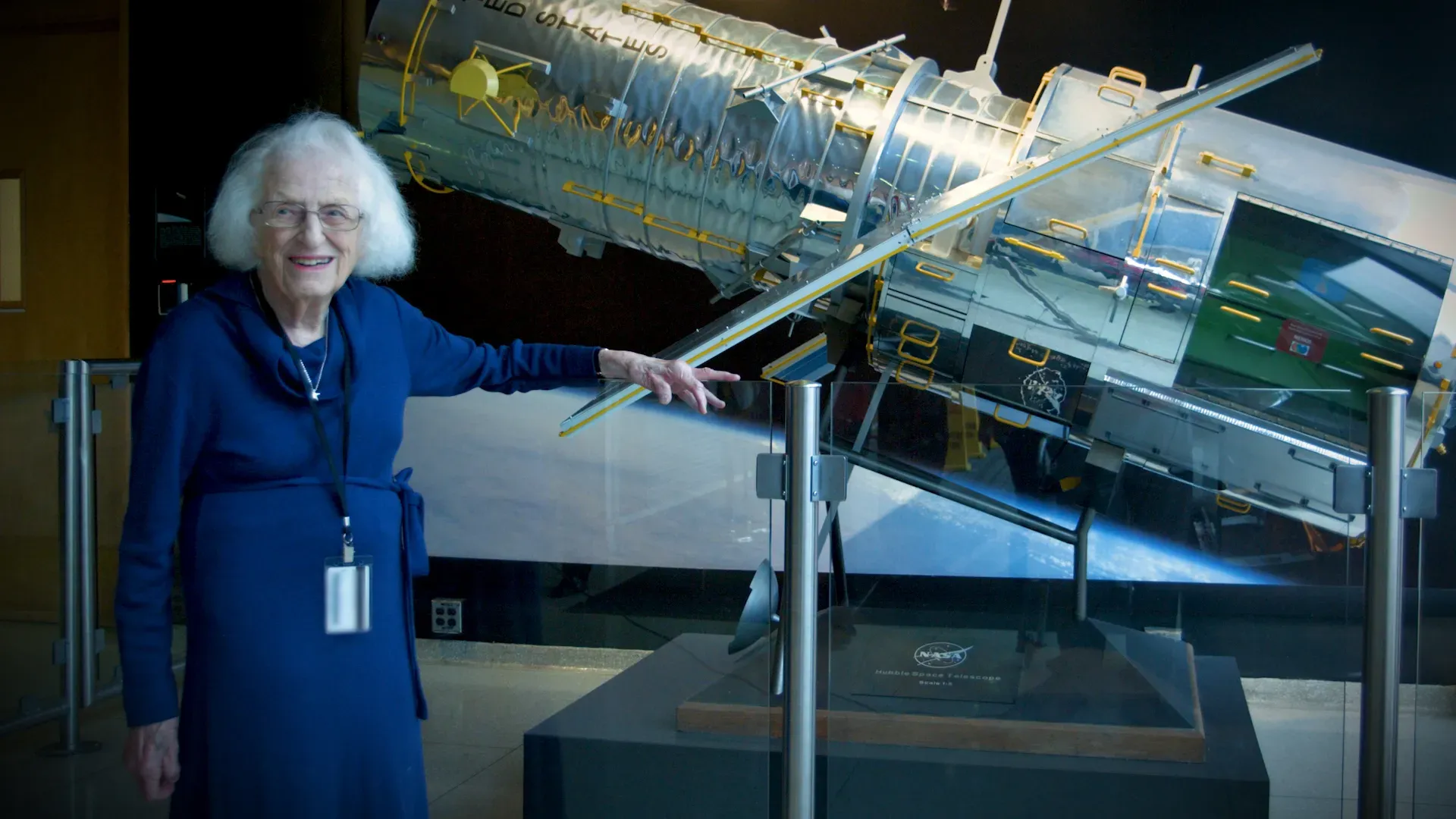 Grace with a scale model of the Hubble Space Telescope she helped champion
Roman was born May 16, 1925, in Nashville, Tennessee. Her interest in astronomy began when she was a child. By age 11, she had organized an astronomy club with classmates. She later attended Swarthmore College, earning a bachelor’s degree in astronomy in 1946, followed by a doctorate from the University of Chicago in 1949.
Roman encountered skepticism because she was a woman pursuing a scientific career. When it became clear advancement at the University of Chicago was unlikely, she left for the Naval Research Laboratory, where she worked in radio astronomy.
Six months after NASA was established in 1958, Roman joined the agency. She became its first chief of astronomy and eventually became the first woman to serve as a NASA executive. Her responsibilities included developing astronomy programs, managing grants and helping select the space-based scientific projects that would move forward.
Among the most consequential projects she championed was the Large Space Telescope, which eventually became Hubble.
RRoman helped establish its scientific goals and specifications and advocated for the technology that would ultimately allow Hubble to produce some of the most influential astronomical images in history. She also worked with scientists, engineers, NASA officials and members of Congress to build support for the telescope.
Her persistence earned her the nickname “Mother of Hubble.”
Roman retired from NASA in 1979 but continued working in astronomy and education. She later returned to NASA’s Goddard Space Flight Center and eventually became director of its Astronomical Data Center. She also taught science and recorded textbooks for people who were visually impaired.
Roman died on Dec. 25, 2018, at age 93.
Now, her name is attached to a telescope designed to tackle some of the biggest questions in modern astronomy.
A space telescope with a big view
NASA’s Roman Space Telescope will have a field of view at least 100 times larger than Hubble’s, allowing it to survey enormous portions of the sky. Scientists expect it to examine billions of galaxies and investigate dark energy, dark matter, exoplanets and other questions about the evolution of the universe.
The observatory also will search for planets beyond our solar system and use technology designed to block the glare of stars so scientists can directly study some nearby exoplanets and planet-forming disks.
After launch, Roman will travel roughly 1 million miles from Earth to a location known as the Sun-Earth Lagrange Point 2, where it can maintain a stable position for observations of deep space. NASA expects the primary mission to last five years, with enough fuel for a potential extension.
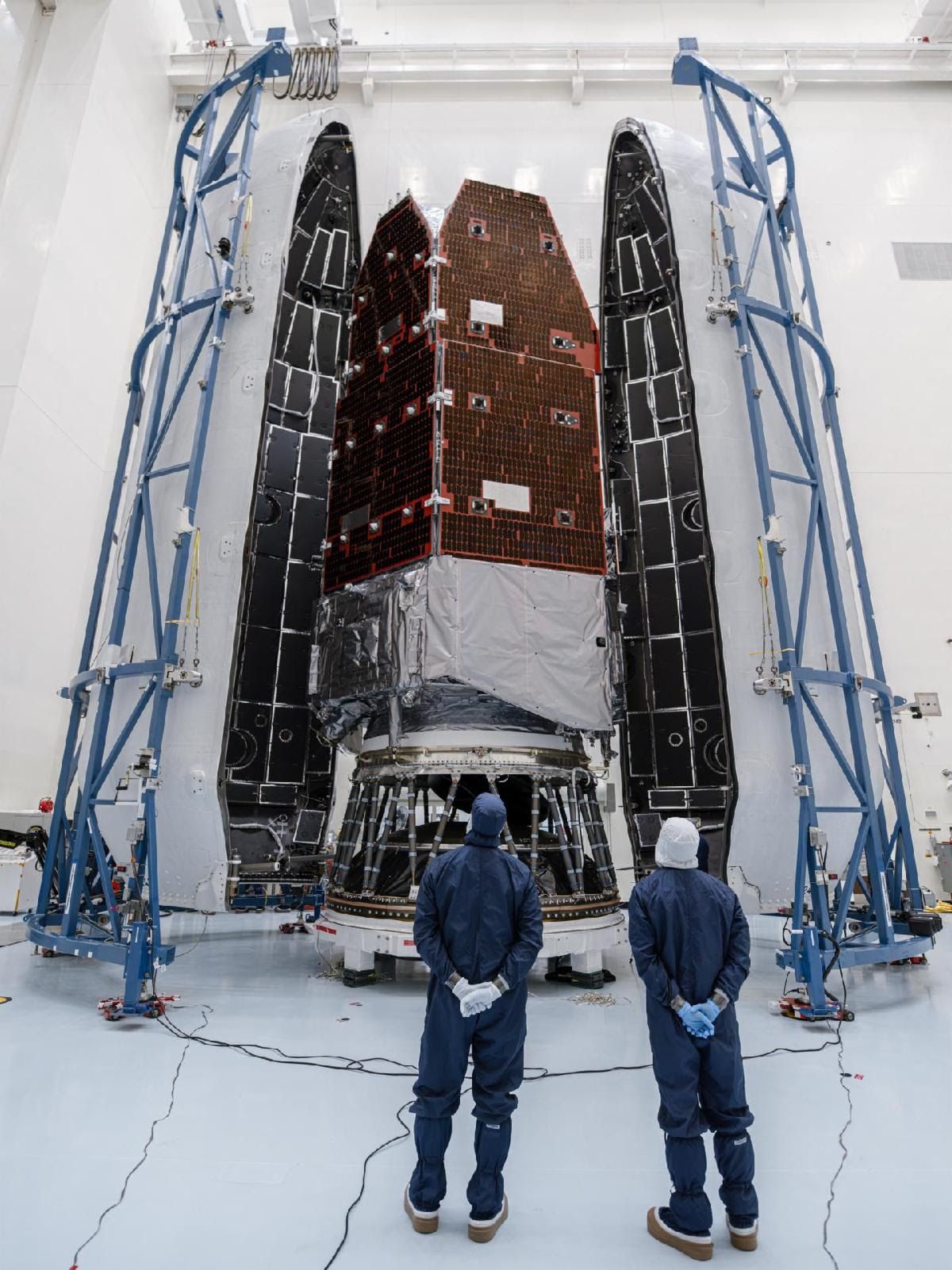
Preparing for launch
The telescope’s arrival in Florida marked a major milestone in the mission. In June, NASA transported the nearly 18,000-pound observatory from Maryland to Kennedy Space Center aboard a Pegasus barge, used used to transport shuttle fuel tanks and now Artemis rockets from their assembly facility near New Orleans.
Launch of the Nancy Grace Roman Space Telescope is set for 7:26 a.m. EDT Aug. 30 aboard a SpaceX Falcon Heavy rocket from Launch Complex 39A at NASA’s Kennedy Space Center. NASA’s live launch coverage is scheduled to begin at 6:20 a.m.
The North Carolina Museum of Natural Sciences in downtown Raleigh is also hosting a launch party from 7 to 8:30 a.m. Sunday in the SECU Daily Planet Theater.