
Deeprobotics.cn
The first full-body weatherproofed industrial humanoid robot ever to appear on Japanese soil stepped into the Shinjuku Sumitomo Building’s Triangle Square atrium on August 26, 2026 — and the question it raised for Japan’s enterprise sector was not just whether the DEEP Robotics DR02 could perform in the rain, but whether Japanese companies facing an acute labor crisis are ready to accept a robot from a manufacturer legally obligated to cooperate with China’s National Intelligence Law obligations on demand.
The robot was brought to AI Expo Summer 2026 — the 10th edition of the AI Hakurankai series, organized by AIsmiley — by ELSA Japan, the Hangzhou company’s Japanese distribution partner. The two-day event ran August 26–27 at Triangle Square in Shinjuku, targeting 10,000 visitors and presenting over 100 companies with more than 200 AI solutions across physical AI, generative AI, AI agents, and enterprise automation. Both days of the expo have now concluded.
The DR02’s debut marks the first time the world’s first full-body IP66-rated humanoid has appeared on Japanese soil, and it arrived in a country where the labor shortage is severe enough that the robot’s outdoor operating capability is not a specification detail but a potential answer to a structural economic problem.
Inside the Physical AI Zone: What ELSA Japan Brought
ELSA Japan’s booth in the expo’s dedicated Physical AI and Robotics Zone drew sustained attention with a dual presentation: the DR02 humanoid alongside the DEEP Robotics Lynx M20 Pro wheel-legged quadruped. The exhibit marked the ELSA Japan AI Expo exhibit of both platforms on Japanese soil.
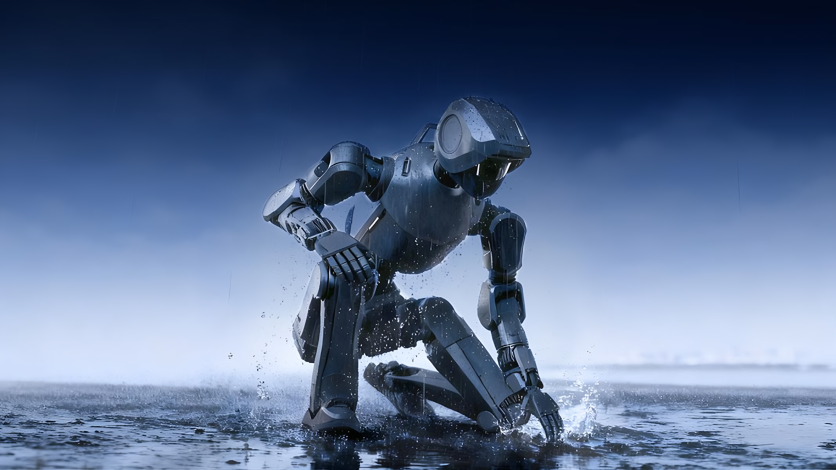
The DR02’s central claim is industrial rather than theatrical. It is the first humanoid robot in the world to carry a full-body IP66 protection rating across the entire platform — not limited to specific components but applied to joints, actuator housings, sensor ports, and cable routing throughout. Under the IEC 60529 ingress protection standard, an IP66 rating means the enclosure is completely dust-tight (requiring vacuum-applied testing over eight hours) and protected against powerful water jets: a 12.5 mm nozzle delivering 100 liters per minute (26.4 gallons per minute) at 100 kPa (14.5 psi) from any direction for a minimum of three minutes. This is a categorically more demanding test than the IP65 standard — which uses a 6.3 mm nozzle at 30 kPa — that most industrial electronics carry.
Applying that rating to a walking robot’s full body is not a straightforward extension of standard enclosure engineering. Every articulated joint in a humanoid is a potential water ingress point; every cable entry must be sealed while still allowing the conductor to move. The DR02 weighs approximately 65 kilograms (143 pounds) and stands approximately 175 centimeters (5 feet 9 inches) tall. Those DR02 weight and height specifications reflect the engineering cost of full-body sealing: sealed connectors, protected cable routing, and reinforced actuator housings add mass that a climate-controlled indoor-only platform does not carry.
The practical operational consequence is what makes the exhibit relevant in Shinjuku rather than in a laboratory. The DR02 can operate across a DR02 operational range and speed from −20°C to 55°C (−4°F to 131°F), function during rain, handle complete dust immersion, and maintain performance in high-humidity environments. It walks at 1.5 meters per second (3.4 mph), can sprint to 4 meters per second (8.9 mph), climbs slopes of up to 20 degrees, and each arm carries a payload of 10 kilograms (22 lbs). Its sensor stack — LiDAR, depth cameras, and wide-angle cameras — is powered by an NVIDIA Jetson AGX Orin compute platform delivering 275 TOPS (trillion operations per second) of processing capacity, enabling real-time terrain perception, navigation, and control. A DR02 modular quick-detach design allows forearms, full arms, and legs to be replaced in the field without returning the unit to a depot — a field-maintenance architecture that matters for deployments in remote or hazardous environments.
The Lynx M20 Pro, also on display, is a wheel-legged quadruped that won a Lynx M20 Pro CES award and shares the DR02’s IP66 chassis protection. It reaches speeds of up to 5 meters per second (11.2 mph) in controlled conditions, operates at 2 meters per second (4.5 mph) for field missions, climbs continuous steps up to 25 centimeters (9.8 inches) high, clears isolated obstacles up to 80 centimeters (31.5 inches), and carries a 15 kilogram (33 lb) payload.
Japan’s Labor Shortage Is the Real Audience
The DR02 is not exhibiting in a vacuum. Japan is in the middle of a structural labor crisis that has been building for decades and reached a breaking point in 2026. With a total fertility rate of approximately 1.2 — far below the replacement level of 2.1 — and more than one in three people over age 65, Japan’s working-age population has been shrinking since 1995. As of April 2026, Teikoku Databank data shows that Japan labor shortage 2026 statistics find 50.6 percent of Japanese companies report full-time staff shortages — above half for a fourth consecutive April. Bankruptcies explicitly attributed to staffing shortages exceeded 400 cases in fiscal year 2025, a third straight record year, with construction accounting for 112 cases and road freight transport 55.
The ripple effects of what analysts call the “2024 Problem” — new overtime regulations in the logistics sector — have spread from transportation into manufacturing, construction, and services, reaching a point where some companies fail not because demand has collapsed but because they can no longer staff operations. Japan’s manufacturing sector employs approximately 10.33 million workers, and the Japan 2024 logistics overtime problem shortage of skilled labor in outdoor, physically demanding roles is precisely the gap a weatherproofed outdoor-capable humanoid is positioned to fill.
The sectors the DR02 targets — energy infrastructure inspection, chemical plant operations, port logistics, construction site monitoring, and emergency response — are exactly where Japan’s labor shortage is most acute and where conventional indoor-only humanoid robots, which require climate-controlled operating environments, are simply not viable. For an enterprise buyer in any of those sectors, the IP66 rating is not a specification detail. It is the reason the robot can do the job at all.
The Domestic Counter-Argument: Donut Robotics and the Trust Play
Japan’s own humanoid ambitions were on display at the same expo in pointed contrast. Donut Robotics, a Tokyo-based startup founded in 2014, took the opening keynote slot at Venue A on August 26 to argue that Japan’s humanoid future should not be imported. The session was listed in the AI Expo Summer 2026 timetable under the title “The World’s Strongest Humanoid Will Be Made in Japan.”
The company’s CEO, Taisuke Ono, framed Donut Robotics’ cinnamon 1 humanoid not as a performance competitor to Chinese hardware — it is not, at present — but as the geopolitically safer choice: a Japanese-branded, eventually domestically manufactured platform that carries none of the data-access obligations that follow every Chinese-origin device to market. The argument, as the keynote framed it, is that against a backdrop of continuing US-China geopolitical tension, Japanese-made humanoids can claim a positioning advantage as “the most trusted humanoids.”
The cinnamon 1’s technical differentiator is a patented system Donut Robotics calls Silent Gesture Control — a computer vision and vision-language-action AI stack that allows the humanoid to be directed entirely through hand and finger movements, with no voice commands required. Details are available on the cinnamon 1 official product page. The design targets noisy industrial environments — airports, construction sites, factories — where voice-based robot control fails, and accommodates the approximately 430 million people worldwide with hearing loss, as noted in the cinnamon 1 launch announcement.
The practical status of the cinnamon 1 is important context for the trust argument. As of the AI Expo Summer 2026, the robot’s hardware is sourced from overseas suppliers; Donut Robotics layers its own AI software on top and plans to move toward fully domesticated hardware over time, with worksite pilots planned for the end of 2026, as documented in cinnamon 1 hardware and deployment coverage. The trust argument is a forward-looking frame — accurate in principle, but not yet fully realized in the platform’s current build.
The cinnamon 1’s pricing for the earlier cinnamon communication robot (a smaller, retail-focused product) is detailed on the Donut Robotics cinnamon pricing page: ¥2.2 million (approximately $13,800 USD) with a monthly subscription of ¥62,000 (approximately $389 USD). Pricing for the full-sized bipedal humanoid has not been disclosed.
What Japan’s Buyers Don’t Have That US Buyers Do
American enterprises evaluating Chinese-origin humanoid hardware operate within a regulatory framework that Japanese companies currently lack. On July 28, 2026, the US Federal Communications Commission added Chinese humanoid and quadruped robots to its Covered List — barring new models from receiving the equipment authorization required for importation, marketing, or sale of wireless devices in the United States. The FCC ban Chinese humanoid robots means the DR02 is therefore not available as a new purchase in the US regardless of buyer willingness. Japan has no equivalent regulatory mechanism.
That asymmetry matters for the procurement conversations happening at AI Expo Summer 2026. Japanese enterprise buyers are evaluating the DR02 without the regulatory warning architecture that the US government has already activated. They are doing so under the same structural legal conditions that apply everywhere: DEEP Robotics, as a company headquartered in Hangzhou, China, is legally required to comply with the China National Intelligence Law full text (2017), Article 7, which mandates that all organizations “support, assist, and cooperate with national intelligence efforts in accordance with law,” with Article 14 authorizing intelligence agencies to formally demand that assistance. The China AI cybersecurity law 2026 — effective January 2026 — additionally requires network operators to provide technical support to government authorities during inspections. The China Data Security Law translation (2021) adds data classification obligations and explicit government access provisions.
The legal obligation’s scope is genuinely contested among scholars. The Jeremy Daum Article 7 analysis at China Law Translate has argued that Article 7 lacks a direct enforcement mechanism for proactive data sharing and that “intelligence” is undefined in the statute — suggesting the obligation may not require active cooperation beyond what other security laws already mandate. That qualification is material. But the structural legal condition is not contestable: a formal government demand under Article 14 cannot be legally refused, and no corporate structure, contractual arrangement, or privacy policy can override a home-jurisdiction legal obligation.
The DR02’s sensor array — LiDAR, depth cameras, and wide-angle cameras — collects detailed environmental mapping data about the facilities in which it operates. Its wireless connectivity architecture has not been publicly disclosed, as reflected in the DR02 official product specifications. No independent third-party security audit of the DR02 has been published as of August 27, 2026. For Japanese enterprises evaluating deployment in sensitive industrial environments — power substations, chemical plants, port logistics — this combination of undisclosed connectivity and unaudited hardware represents a meaningful due-diligence gap.
Enterprises in Japan considering the DR02 should apply the same precautions applicable in any non-US market: network segmentation to prevent unauthorized data exfiltration, contractual requirements for firmware audit access, and a hardware-level security review before deployment in facilities where environmental mapping data is operationally sensitive.
DEEP Robotics’ Funding Position and the Japan Market’s Significance
The DR02’s Tokyo appearance is part of a broader global market expansion push by DEEP Robotics that runs parallel to its ongoing STAR Market IPO process. The Shanghai Stock Exchange accepted the company’s DEEP Robotics STAR Market IPO application on May 18, 2026, targeting a raise of CNY 2.5 billion (approximately $372 million USD at current rates) to fund embodied AI algorithm development, large model research, manufacturing capacity expansion, and industrial application programs. The company completed a DEEP Robotics Series C round exceeding CNY 500 million (approximately $70 million USD) in December 2025.
Japan is a strategically significant target for that expansion. The country’s enterprise market has historically maintained a strong preference for domestically manufactured industrial equipment — but the humanoid robotics gap between Japan and its international competitors, driven by the scale of Chinese and American research and development investment, is widening. The JAL Unitree Haneda deployment trial, launched in May 2026, has already demonstrated that Japanese enterprises are willing to field Chinese-origin humanoid hardware in active operations when domestic alternatives are not yet available at sufficient capability. The DR02’s ELSA Japan exhibit is the next chapter in that story: a second Chinese humanoid platform establishing a commercial presence in the Japanese market.
Whether the DR02 translates from expo exhibit to enterprise purchase orders will depend on factors beyond its specification sheet — pricing negotiations, local support infrastructure, the pace of regulatory development in Japan, and the willingness of risk-averse procurement departments to move before a domestic alternative reaches commercial maturity. But the Shinjuku exhibit is itself a signal: the conversation is happening.
The Broader Expo: Japan’s AI Adoption Landscape in Two Days
The DR02’s debut is the most visually distinctive element of AI Expo Summer 2026, but it stands within a much larger picture of where Japan’s enterprise AI adoption currently sits. The expo’s 40-plus conference sessions across three venues covered generative AI, AI agents, large language models, retrieval-augmented generation, AI-OCR, edge AI, and industry-specific applications ranging from retail demand forecasting to municipal government automation, all detailed in the AI Expo Summer 2026 timetable.
Two other exhibitors in the Physical AI Zone merit attention alongside ELSA Japan. APTO presented its physical AI data platform for dual-arm teleoperation robots, demonstrating live imitation learning data collection alongside simulation data generation using NVIDIA Isaac Sim — addressing the training data infrastructure layer that underpins all physical AI systems at scale. This was confirmed in the AIsmiley pre-event exhibitor announcement ahead of the expo. Donut Robotics, beyond its keynote, exhibited the cinnamon 1 at its dedicated booth, making the Physical AI Zone a three-way conversation: Chinese hardware targeting the industry specification gap, Japanese hardware targeting the trust gap, and US-ecosystem data infrastructure targeting the training gap behind both.
A session on Generative Engine Optimization — presented by CyberAgent’s Ken Kimura and a joint researcher at Kyoto University — argued that companies must now optimize for citation by generative AI systems rather than for page rankings in search results, per the AI Expo Summer 2026 timetable. Preferred Networks presented its PLaMo sovereign LLM foundation model as Japan’s answer to the question of whether enterprises can build AI capability without dependence on US or Chinese infrastructure. And sessions from Chiyoda Ward and Setagaya Ward documented municipal governments deploying Microsoft 365 Copilot and Genspark across administrative functions — a ground-level view of what AI adoption looks like when the adopter is a local government office rather than a technology company.
The expo has been run nine times previously across Tokyo venues and in Nagoya. The AI Expo Spring 2026 visitors edition at Tokyo International Forum drew 12,154 visitors; the Nagoya edition in June attracted 6,453. The Summer edition’s 10,000-visitor target was calibrated around the addition of live physical AI demonstrations — the kind of draw that corporate audiences who have been reading about humanoid robots in trade media but have not yet seen one operating in person are most likely to respond to.
Is What You See What You Get?
A note on what the AI Expo exhibit does and does not demonstrate about the DR02’s readiness for Japanese enterprise deployment. DEEP Robotics confirmed in recent press materials that the DR02 has completed DR02 substation firefighting field testing including substation field operation testing and outdoor firefighting rescue drills in China. Those are meaningful operational data points for the sectors the company is targeting. They are supervised demonstrations in controlled field conditions, not autonomous production deployments.
No public information indicates that any of the DR02’s documented field tests — including the August 13 stair-climbing video that demonstrated unassisted outdoor stair navigation — were executed without human supervision. The gap between a controlled field demonstration and a robot that autonomously identifies a task, plans its approach, navigates variable real-world conditions without supervision, and completes a multi-step operation without error is the central unresolved challenge for the entire humanoid industry in 2026. This distinction is examined in greater depth in the DR02 autonomy gap prior analysis. DEEP Robotics has not published its locomotion policy architecture, its simulation-to-real transfer methodology, or the extent to which its field demonstrations rely on pre-programmed trajectories versus learned policies.
For a Japanese enterprise buyer making a procurement decision, that distinction matters in practice: a robot that can perform scripted tasks reliably in known environments has operational value, but it is a different product from one that can independently adapt to the variable conditions of a live construction site or an active chemical plant. The DR02’s IP66 rating means it can survive the environment. Whether it can work autonomously within it is the question the expo did not answer.
Frequently Asked QuestionsWhat makes IP66 weatherproofing difficult to achieve on a humanoid robot?
On a smartphone or sealed instrument housing, achieving an IP66 rating means sealing a rigid enclosure against water jets — difficult but established engineering. On a walking humanoid, every articulated joint is a potential ingress point, and every cable entry must be sealed while still allowing the conductor to flex through thousands of motion cycles. The DR02’s IP66 rating covers the entire platform — joints, actuator housings, sensor ports, and cable routing. The engineering cost is visible in the weight: at 65 kilograms (143 lbs), the DR02 is heavier than comparably sized indoor humanoids, because sealed connectors, reinforced housings, and protected cable paths add mass that a climate-controlled-only platform does not carry. It is worth noting that IP66 does not mean submersion protection — that would require IP67 or IP68. IP66 protects against powerful water jets (100 liters per minute at 100 kPa from any direction), which is sufficient for rain, dust, and pressure washing, but not for operating underwater.
Why does Japan lack the regulatory protection against Chinese humanoid robots that the United States put in place?
The US Federal Communications Commission added Chinese humanoid and quadruped robots to its national security Covered List on July 28, 2026, barring new models from receiving the wireless equipment authorization required for importation or sale. Japan has no equivalent regulatory mechanism as of August 27, 2026 — no domestic equivalent of the FCC Covered List and no formal restriction on the procurement of Chinese-origin humanoid hardware by Japanese enterprises. This means Japanese buyers evaluating the DEEP Robotics DR02 are doing so without the regulatory warning architecture that US procurement decisions now carry. China’s National Intelligence Law obligations apply to DEEP Robotics regardless of where its hardware is deployed — the manufacturer’s legal obligation to cooperate with Chinese intelligence requests on demand follows the hardware to Japan just as it would anywhere else.
What is Donut Robotics’ cinnamon 1, and how does it compare to the DR02?
Cinnamon 1 is Donut Robotics’ first full-sized bipedal humanoid — a Japanese-branded platform distinguished by its patented Silent Gesture Control system, which allows it to be directed entirely through hand and finger movements without voice commands. It targets noisy industrial environments such as airports, construction sites, and factories. The key difference from the DR02 is geopolitical rather than technical: Donut Robotics is a Japanese company, and the cinnamon 1 is being developed under Japanese law and eventually under Japanese manufacturing. As of the AI Expo Summer 2026, the cinnamon 1 is still using hardware sourced from overseas suppliers — full domestic production is a planned future development, not a current reality. Pricing for the full-sized humanoid has not been disclosed; Donut Robotics’ earlier cinnamon communication robot sells for ¥2.2 million (approximately $13,800 USD), with a monthly subscription of ¥62,000 (approximately $389 USD).
What is Japan’s labor shortage, and why does it make humanoid robots strategically relevant now?
Japan’s labor shortage is structural and demographic. With a total fertility rate of approximately 1.2 and more than one in three people over age 65, Japan’s working-age population has been shrinking since 1995. As of April 2026, 50.6 percent of Japanese companies report full-time staff shortages. In fiscal year 2025, bankruptcies explicitly attributed to labor shortages exceeded 400 — a third consecutive record year — with construction and road freight transport among the worst-affected sectors. These are exactly the outdoor, physically demanding roles where weatherproofed humanoid robots are the only viable robotic substitute; conventional indoor-only humanoids cannot operate in the rain, dust, temperature extremes, or variable terrain conditions those jobs require. That specificity is what gives the DR02’s IP66 rating its market relevance in Japan beyond the engineering achievement it represents.