The most significant development in American policy under Trump has been his consistent effort to delink India from the security and stability architecture of the Indian Ocean Region, from West Asia to the Malacca Strait. Trump dropped Indo from ‘Indo-Pacific’, a decision which his ambassador to India Sergio Gor tried to brush away with a feeble non-sequitur. This might also explain the covert American support for Jamaat-e-Islami in the Bangladesh elections, and the continued effort to ring-fence India in South Asia.
India has emerged as a major power of the Indian Ocean, particularly after Prime Minister Narendra Modi strengthened its base in the Andaman and Nicobar Islands and moved towards a 200-ship navy, facts which have led to discomfort rather than accommodation in the present White House. Trump has been disconcerted by India’s determination to protect the independence of its foreign policy. He prefers the sound of obedience.
American presidents since Bill Clinton have respected India’s gradual rise from a beleaguered question mark in 1990 to a credible democratic, economic and nuclear power. There was fresh interest in India in the immediate aftermath of 9/11, the terrorist attack engineered by Osama bin Laden. America made its boldest effort to draw India into its strategic fold.
The concept of a second NATO is not original. After 9/11, the US offered India a lead role in a project labelled Eastern NATO. The public initiative was led by an India-friendly diplomat, Nicholas Burns. It was a cross-party offer to become a military ally in the international coalition against Islamic terrorism as defined by Washington, the Pentagon and Langley. America wanted India to put boots on the ground in its war against Saddam Hussein in 2003. Senior Cabinet ministers like Jaswant Singh were willing, but Prime Minister Atal Bihari Vajpayee stayed within the traditional parameters of foreign policy. America’s goodwill run continued into the Manmohan Singh administration but India was still not ready to be part of any external engagement. That goodwill run has slowed to a trot, if it is moving at all.
Gor’s recent statement on Jammu & Kashmir being an integral part of India was welcome, but it was no more than the distribution of Trump crumbs while the main meal was being served elsewhere. Such an assertion would be more useful in Islamabad. Indians know that Kashmir is an integral part of India; Pakistanis do not. Surface comfort might be better than no comfort, but it remains peripheral.
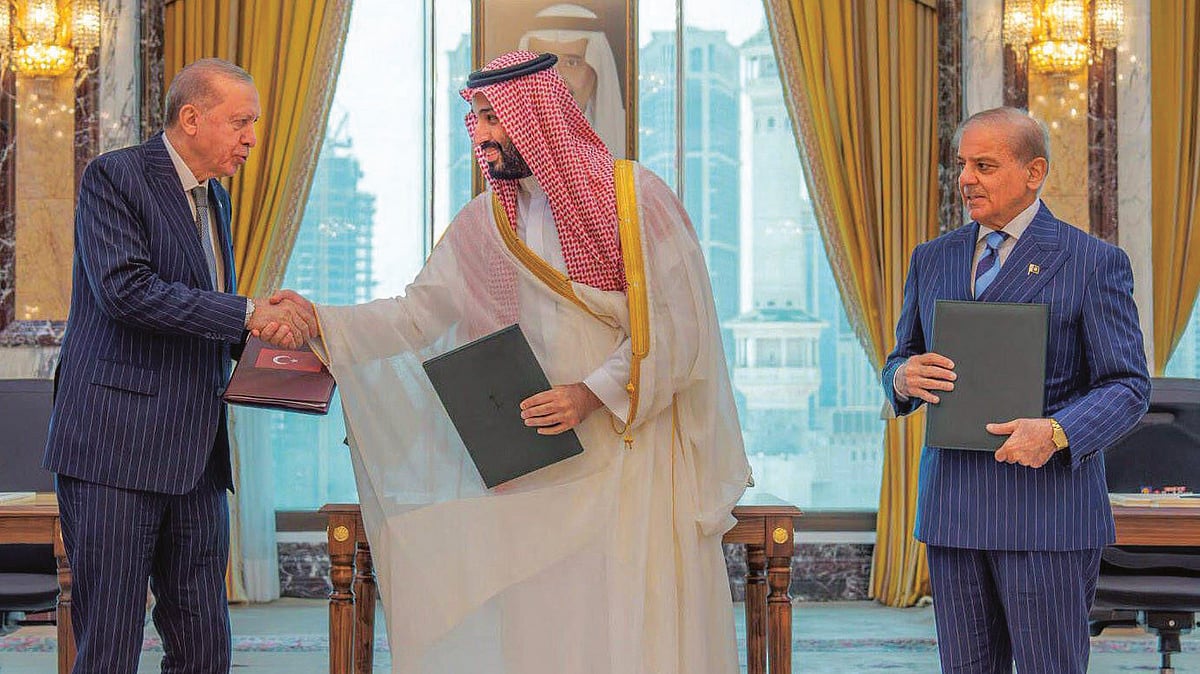
Kashmir is Pakistan’s fixation. It would like every Muslim country’s support in its permanent war against India. In South Asia, the Mecca pact has already become a useful ploy for India-baiters, not least in Dhaka where a powerful lobby threw a spanner into Prime Minister Tarique Rahman’s proposed visit to Delhi. The lobby is actively trying to improve cooperation with Pakistan. On August 15 this year, a six-member delegation of Bangladesh’s Directorate General of Forces Intelligence (DGFI) travelled to Pakistan, led by Colonel Magfuz-ul-Bari, along with Wing Commander Imrul Kais, Mohiuddin Asif, Murad Hossain Tushar, Khandokar Ariful Islam, and Squadron Leader Raihan Mohammad Chowdhury.
There is a pattern in Trump’s approach to the world: it is shaped by leaders, not nations. If they have a few medals strung on their chests, no harm done. He believes in decisions which affect policy rather than policy which affects decisions. It can become random. He has the advantage of being supremely indifferent to the past. He is unfazed by contradictions. The latest order is the operative policy, until the next one.
On current form, Pakistan’s Asim Munir is his favourite Field Marshal, although one wonders how many he had to choose from. Munir is an expert at ego-massage which the American president values. He needs it from his subordinates as much as from leaders. He removed an effective press secretary, Karoline Leavitt, because she preferred her recently born child to 80-year-old Trump. He is besotted by the devotion of another aide, Natalie Harp, who called him guardian and protector in a letter written in 2023, adding, “You are all that matters to me”, which was signed “With all my heart”. It was not a love affair; it was an admiration affair.
Trump shifts from sledge to hedge before those who do not genuflect, like China’s Xi Jinping or Russia’s Vladimir Putin. When India’s Prime Minister Modi and Canada’s Mark Carney refused to bend the knee, his policy towards India and Canada sank into a sulk. The relationship with Canada is threatened by serious rupture. On a milder scale, Trump has become punitive towards Britain and South Korea because they refused to send troops for his Iran war.