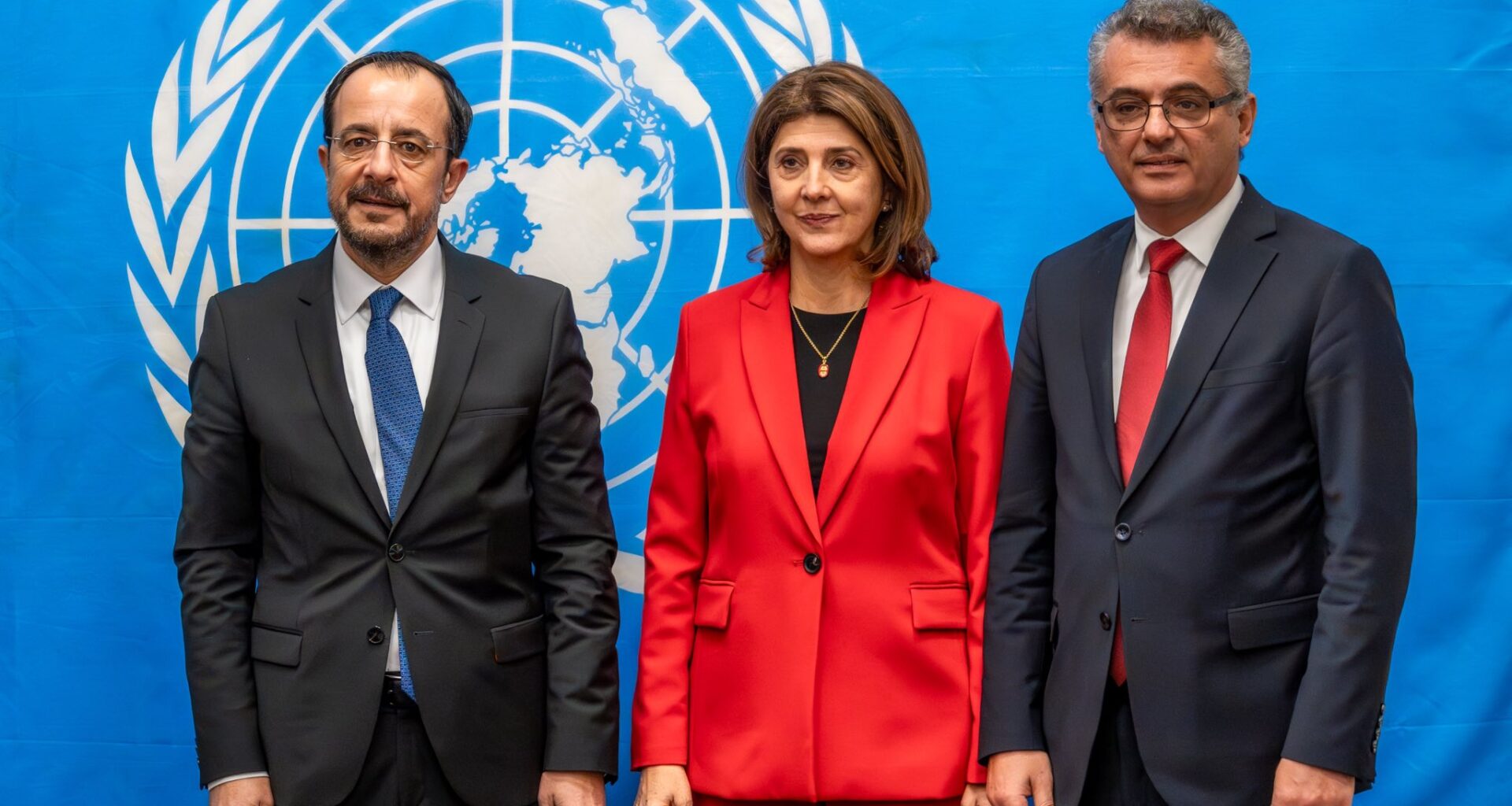
President Nikos Christodoulides on Sunday said that he had told Turkish Cypriot leader Tufan Erhurman that he would say “no” to any confidence-building measures which “normalise the current illegal state of affairs” with regard to the Cyprus problem.
“We are discussing various issues to do with confidence-building measures. What I mentioned to the Turkish Cypriot leader I also said publicly, that we are ready for confidence-building measure which will strengthen the great effort to reunify our homeland, to resolve the Cyprus problem,” he said.
On the matter of crossing points, he said that he and Erhurman had on Wednesday “discussed the issue of the four crossing points” as a package, which had first been devised as an idea during the enlarged meeting on the Cyprus problem held in the Swiss city of Geneva in March last year.
“For our part, during [United Nations Secretary-General Antonio Guterres’] recent visit, we accepted what the secretary-general himself mentioned as a reasonable compromise proposal. At the end of the day, there was no result, but we continue the effort,” he said.
Talks on the matter of crossing points have remained deadlocked over the question of whether to break up the package of four locations upon which the sides had agreed after the meeting in Geneva last year.
The Greek Cypriot side proposed removing Louroujina, northwest of Larnaca, from the package of four, instead opening crossing points near Athienou, and in the eastern Nicosia suburbs of Mia Milia and Aglandjia, and the Turkish Cypriot side flatly refused to entertain any discussions which did not include all four locations.
That notwithstanding, Christodoulides on Sunday said that “preparatory work has already begun on the basis of the deliverables from the secretary-general’s visit here, but also from the visit of [European Commission Cyprus problem envoy Raffaele Fitto”.
He also pointed out that UN Cyprus problem envoy Maria Angela Holguin will soon return to the island, “so that through intensive meetings, results can emerge, things can emerge”.
To this end, he said that an “informal milestone” in this endeavour is the UN general assembly’s “high-level week”, which will be held during the last week of next month, when both he and Erhurman will hold separate meetings with Guterres in New York “to inform” him of progress made.
“From our side, if the need arises, if the secretary-general deems it necessary, an enlarged meeting can also be held. We are fully prepared in this direction. Everything we do is with the sole aim of resuming the talks from where they were interrupted,” he said.
Asked whether there would be “deliverables” in the form of a confidence-building measure or substantive progress by the time he travels to New York, he said that “we have an obligation and that is what we are doing, to do everything possible to have deliverables”.
“So, if there are no deliverables, which is something we are not hoping for, which we do not want to happen, it will not be our fault,” he said.
Guterres had said at the end of his visit to Cyprus last month that a new enlarged meeting on the Cyprus problem will be convened “after adequate progress” is achieved on the matters of confidence-building measures, the meeting’s methodology and the substance of the talks.
More recently, Holguin had stressed that the implementation of confidence-building measures is an “indispensable condition” to be fulfilled ahead of an enlarged meeting, which will involve the island’s two sides, its three guarantor powers, Greece, Turkey, and the United Kingdom and the UN itself.
“Confidence-building measures should not be seen merely as symbolic steps which improve the atmosphere between the two communities, but rather as practical tools which test the viability of a future political order,” she told Turkey’s Anka news agency.
She added that confidence-building measures are “important in demonstrating whether cooperation works in practice” and said that “such initiatives help create the collaborative habits which a future solution will need”.
“People’s fear of a solution or change can only be overcome through concrete implementations in the field. Societies’ anxieties about a solution can be reduced to the extent that these measures do not impact daily life,” she said.