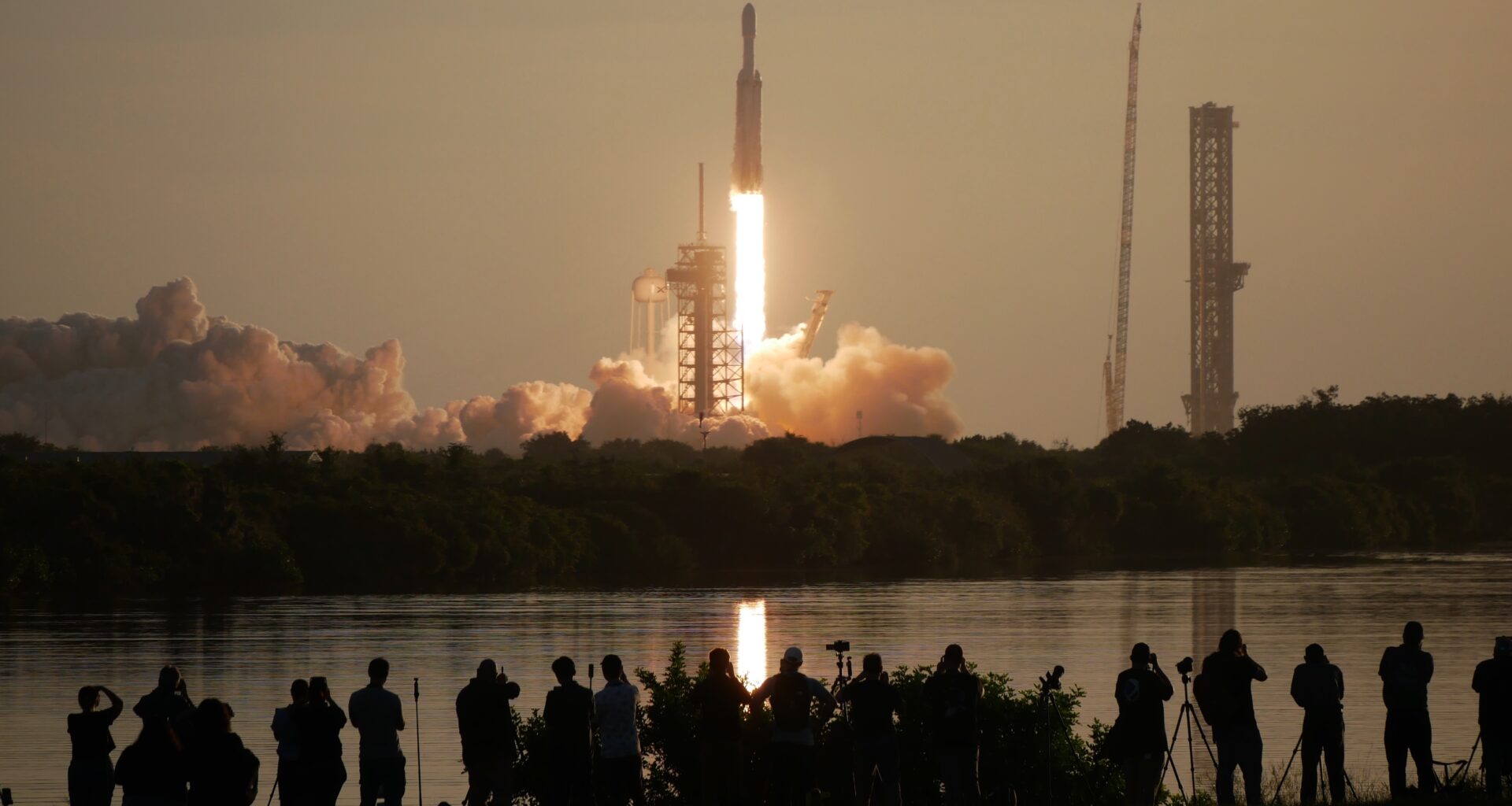
KENNEDY SPACE CENTER, Fla. — A Falcon Heavy launched NASA’s newest flagship telescope Aug. 30 on a mission to study the nature of the universe and discover thousands of exoplanets.
A SpaceX Falcon Heavy lifted off from Kennedy Space Center’s Launch Complex 39A at 7:26 a.m. Eastern. The rocket’s payload, the Nancy Grace Roman Space Telescope, deployed from the upper stage 31 minutes later. The rocket’s two side boosters landed at separate pads at Cape Canaveral Space Force Station, while the central booster was expended.
This was the 13th launch of the Falcon Heavy, dating back to its debut in 2018. It was the third NASA mission for the rocket, after the launch of the Psyche asteroid mission in October 2023 and the Europa Clipper mission to Jupiter a year later.
Roman will spend the next 100 days traveling to the Earth-sun L-2 Lagrange point, 1.5 million kilometers from Earth. During that journey, engineers will be commissioning the 9,200-kilogram spacecraft and its instruments.
That work will begin within an hour of deployment, with deployment of the spacecraft’s solar arrays and sunshield. A course-correction burn is planned a day after launch and a second three days later, but Jackie Townsend, Roman’s project manager, said at an Aug. 29 briefing that, depending on the accuracy of the launch, the first maneuver could be reduced and the second skipped entirely.
The first 10 days of commissioning will be devoted to spacecraft deployments and outgassing, she said. The following 30 days will be focused on commissioning the spacecraft, “making sure that all of the infrastructure parts of the bird are doing their jobs properly.”
Another 45 days will be devoted to commissioning the spacecraft’s instruments. At the 90-day mark after launch, she said Roman should be ready “to power into our early science operations.”
Discovering what the universe is made of
The $4.3 billion Roman is NASA’s latest flagship space telescope, with a five-year prime mission but enough propellant to operate in a halo orbit around the L-2 point for at least 10 years.
Roman’s main science instrument is the Wide-Field Imager, a 300-megapixel camera. It will be used primarily for several surveys planned by astronomers for the telescope’s five-year prime mission.
Roman has a field of view 100 times larger than the Hubble Space Telescope and can shift fields more quickly. “We can survey the sky more than 1,000 times faster than Hubble,” said Julie McEnery, Roman telescope senior project scientist, at an Aug. 29 briefing. “A survey that would take Roman a month would take a century for Hubble.”
That will allow Roman to tackle “entirely new, ambitious science questions,” she said. That includes a focus on understanding dark energy and dark matter, which combined comprise about 95% of the universe but remain largely mysterious to astronomers.
“We’re about to discover what the universe is made of,” said Lucas Paganini, Roman telescope program executive at NASA Headquarters.
A key area of interest is growing evidence that the cosmological standard model of the universe may not be accurate. One possibility is that a factor called the cosmological constant, linked to dark energy, may not be constant over the history of the universe.
“That means that the properties of dark energy may change as the universe expands,” McEnery said. “It could mean that we need to revisit how gravity itself works, that maybe our understanding of how gravity works on very, very large scales is, in fact, not very well described by general relativity.”
“What I’m sure of is that Roman’s observations are going to definitively address at least some of those questions,” McEnery said, “because it will definitively say the model works or it doesn’t.”
Roman’s surveys, beyond addressing cosmological studies, will provide a wealth of data for astronomers. That includes observations of 20 billion stars in the Milky Way and 2 billion galaxies. Astronomers expect to detect 100,000 exoplanets, about 40 times the number currently known. “Think of this as the largest census we’ve ever done of other planets in our galaxy,” she said.
Roman will generate up to 1.4 terabytes of data per day, downlinked to dedicated ground stations in New Mexico, Australia and Japan. The data will be made publicly available through a cloud-based system shortly after it is received, with no proprietary periods for astronomers who have been working on the mission.
Roman carries a second instrument, a coronagraph. It is designed to precisely block light from an individual star, revealing any planets or dust disks around it.
Trying to observe an exoplanet around a star is like detecting a firefly next to a lighthouse from hundreds of kilometers away, said Vanessa Bailey, Roman Coronagraph Instrument scientist at the Jet Propulsion Laboratory.
Coronagraphs used today allow the detection of exoplanets a million times fainter than their star, she said, but an Earth-like exoplanet would be 10 billion times fainter. “That’s too great of a leap in a single generation of instrumentation,” she said.
Roman’s coronagraph, using active deformable mirrors, will try to bridge that gap, detecting exoplanets 100 million times fainter than their stars. That would enable detections of planets similar to Jupiter.
The coronagraph is a technology demonstration with 2,000 hours of observing time over Roman’s first 18 months. “We’ll interleave our observations with those of the various surveys,” Bailey said.
“We’re going to try to push as hard as we can as fast as we can to understand what the instrument and the observatory are capable of,” she said, “and then plan an ambitious portfolio for the remainder of the 2,000 hours after that.”
McEnery noted that the telescope’s namesake, Nancy Grace Roman, was a proponent of space telescopes. She published a journal paper in 1959 that examined the potential of directly observing planets with such an observatory but concluded it was impossible given the state of technology at the time.
“If she was here now,” McEnery said, “she would really enjoy having been proved wrong.”
Related