
Agentic AI is set to change passenger journeys and the way airports and airlines operate, writes Chetan Dube.
The 80,000 plus complaints per year received by the US Department of Transportation about air travel just goes to show that aviation still has a lot of work to do to enhance the passenger experience.
Frustratingly for airports, the source of traveller dissatisfaction in the terminal is often beyond their control as it involves airline issues or government agencies responsible for security, immigration and customs.
Help is on the way, however, as agentic AI is set to enhance the airport experience for passengers, particularly in terms of checking in baggage, issuing boarding passes, changing or rebooking flights and even ordering your coffee on those 5am flights to paradise.
AGENTIC AI EXPLAINED
Agentic AI works autonomously with very little human oversight. It can understand natural language, plan and optimise workflows, make decisions independently based on changing circumstances, and adapt suggested solutions in real-time.
In simplest terms, it doesn’t see and then report a problem, it sees and then solves the problem. In the world of travel, this is revolutionary technology.
AGENTICS COULD ELIMINATE NEARLY ALL WAIT TIMES
AI is increasingly being used to predict passenger flows, open security lanes before bottlenecks form and dynamically allocate staff rather than simply reacting to congestion.
With an agentic operating system receiving information from all departing and arriving airlines, it will learn and predict when airport security needs to increase or decrease staff.
Based on lead time of airline scheduling, agentic AI can create a staff schedule months in advance.
As a result, in the US for example, there will be no need to hold a plane because the TSA is backed up for hours, thus causing downstream delays and fines.
This financial impact cannot be understated. Ground delays cost airports around €166 per minute in the EU and at $100.80 per minute in the US. That equates to billions in fines worldwide each year.
AIRPORT RETAIL GETS AN UPGRADE
People often move from a security line to another queue for food or coffee before getting to a line to get on a plane. Agentics can remove this middle line.
Retail globally is already benefiting from agentics, as shown in its predicted growth to over $231 billion by 2031. Airports must catch up with the rest of the world.
Some examples of agentic AI in action include the facts that agentics can dynamically schedule when a store should open or close, know how much staffing is needed, and handle all inventory and ordering.
And it learns more the longer it is in use, so before long can identify when spikes will occur and be able to order accordingly.
Indeed, if it used across all airport retail locations in the terminal it can accurately estimate the footfall they can expect throughout the day in real time.
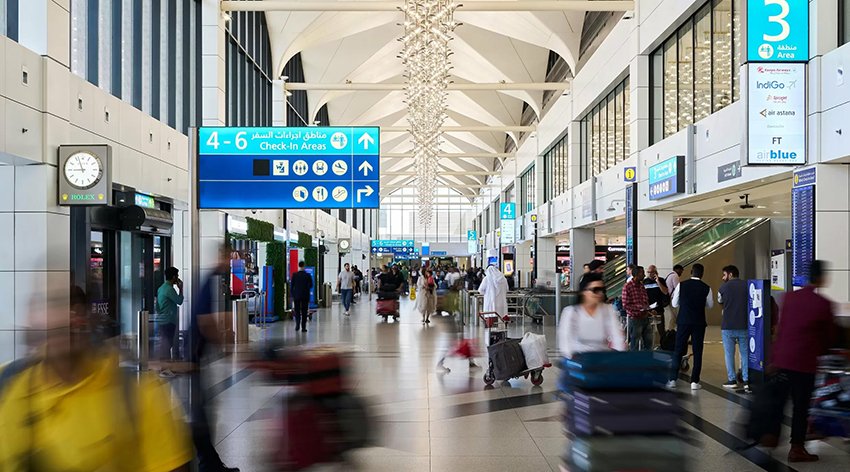
PREDICTIVE AIRPORTS
The running theme is prediction instead of reaction. Rather than responding to problems, airports can use agentic AI to predict delays, equipment failures, baggage issues and crowding before it happens.
In short, every aspect of travel is known far in advance and can be planned for without any lag time.
COULD AGENTIC AI TRANSFORM AIRPORT TERMINALS?
As biometrics, digital identity and AI become integrated, passengers may move from kerb to gate without repeatedly showing passports or boarding passes.
If the entire airport works upon an agentic operating system and all government agencies and airlines are connected as well, airports of the future might look very different to what we know today.
Yes, bags will still need to be checked, and scanned, as will people, but with processes streamlined (i.e. no need for passengers to show identification multiple times and wait times minimised, helped by more dynamic staffing levels) will there, for example, still be a need for expansive check-in halls?
AGENTIC ADVANTAGE TO THE AIRLINE
Agentic AI is the tool for airlines to localise monitoring and decision-making for delays, optimise flight times and routes, and to maximise fuel usage efficiency.
All of this minimises delays, decreases overheads, and increases affinity from customers and employees.
Agentic AI can change flight routes instantaneously due to inclement weather, increased turbulence, or traffic. Yes, it is all governed by humans, but it can act as independently as safety allows.
Speaking in terms of safety, agentic AI can become key to aircraft health. It can continuously monitor planes and potentially predict and solve issues that could affect flights before the issues occur.
Agentics also have the capacity to be the master scheduler of maintenance and retirement of an aircraft.
It knows when the last service was, what needs to be done based on age and flight hours, and based on historical data, will tell an airline when it is time to retire a plane completely. This is lifesaving technology, literally.
AIRLINE AGENTICS TODAY
From Saudia Airlines’ AI-powered Travel Companion booking an end to end travel via AI agent chat, to AI at Eindhoven Airport improving baggage handling, decreasing wait times and improving customer satisfaction, to Air Canada completely rewriting how it manages disruption (shortening average resolution time from 12 hours to 10 minutes) agentic AI is already changing the world of airports and travel. But, it is nowhere near its full potential.
Within this very decade agentic AI will bring super intelligent, asynchronous digital employees providing service to staff and customers once never even dreamed of. This is service available at any moment, to absolutely everyone, with zero wait time.
The airports and airlines that adapt the quickest, will be the ones that win and maintain the loyalty of dedicated employees and customers. Those that don’t will continue to burnout staff and lose customers.
About the author
Chetan Dube is an AI pioneer and founder and CEO of Quant, which develops cutting-edge digital employee technology.