

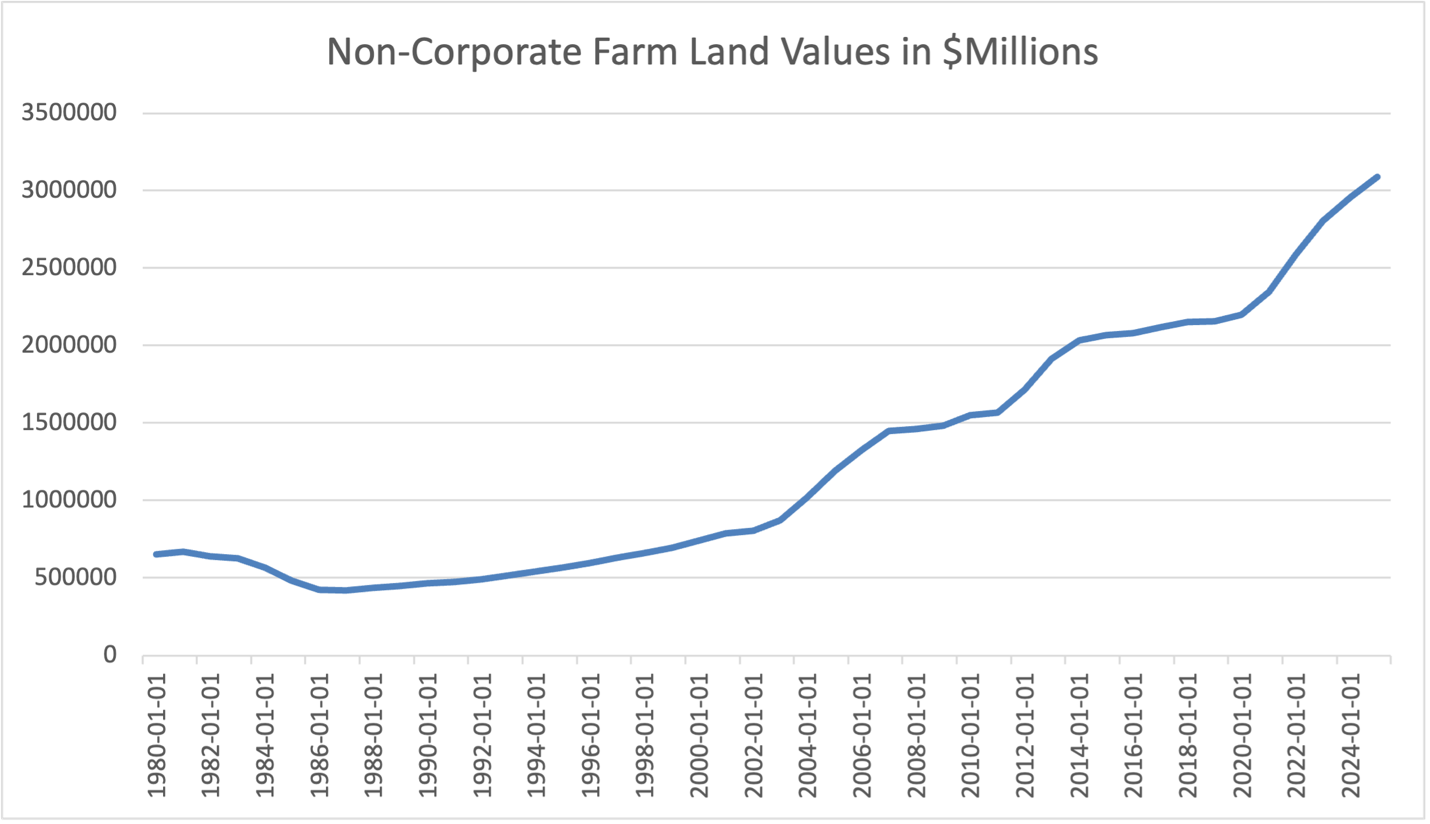
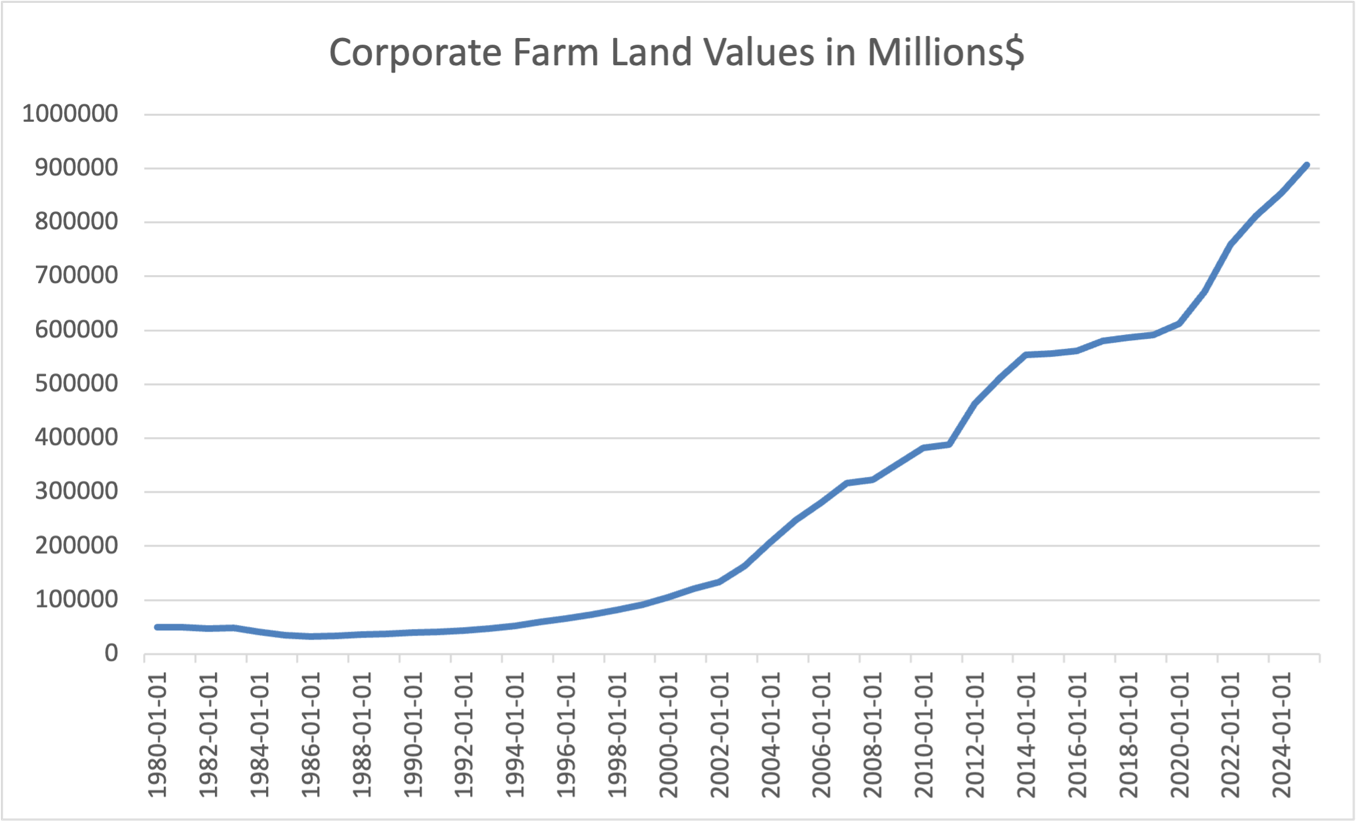
The U.S. farm sector presents one of the more striking conundrums in the American economy today. Farmers face weaker commodity prices, elevated production costs, downward pressure on working capital, and higher short-term borrowing costs than during the commodity boom of the early 2020s. Yet the underlying value of American farm real estate continues to rise. The U.S. Department of Agriculture’s Economic Research Service (USDA ERS) estimates that farm real estate, defined as land plus permanent structures and improvements, was valued at $3.77 trillion in 2026, up nearly 4.0% from 2025. The Federal Reserve uses a broader measure and estimates farm real estate at $3.99 trillion in 2026. Farm real estate accounts for about 83% of the nation’s farm-sector asset base.
Source: Board of Governors of the Federal Reserve System
Source: Board of Governors of the Federal Reserve System
Average U.S. Farmland Values
USDA data reveal that the average value of U.S. farm real estate was approximately $1,830 per acre in 2006. It climbed to $2,170 by 2008, slipped during the financial crisis to about $2,090 in 2009, and then resumed a long upward trajectory. By 2012, it had reached $2,520 per acre; by 2014, $2,940; and by 2014, roughly $3,030. Values then entered a period of relative stability through 2020, when the national average was approximately $3,160 per acre. Since then, however, the market has accelerated dramatically: $3,380 in 2021, $3,800 in 2022, $4,080 in 2023, $4,170 in 2024, $4,350 in 2025, and approximately $4,500 per acre in 2026.
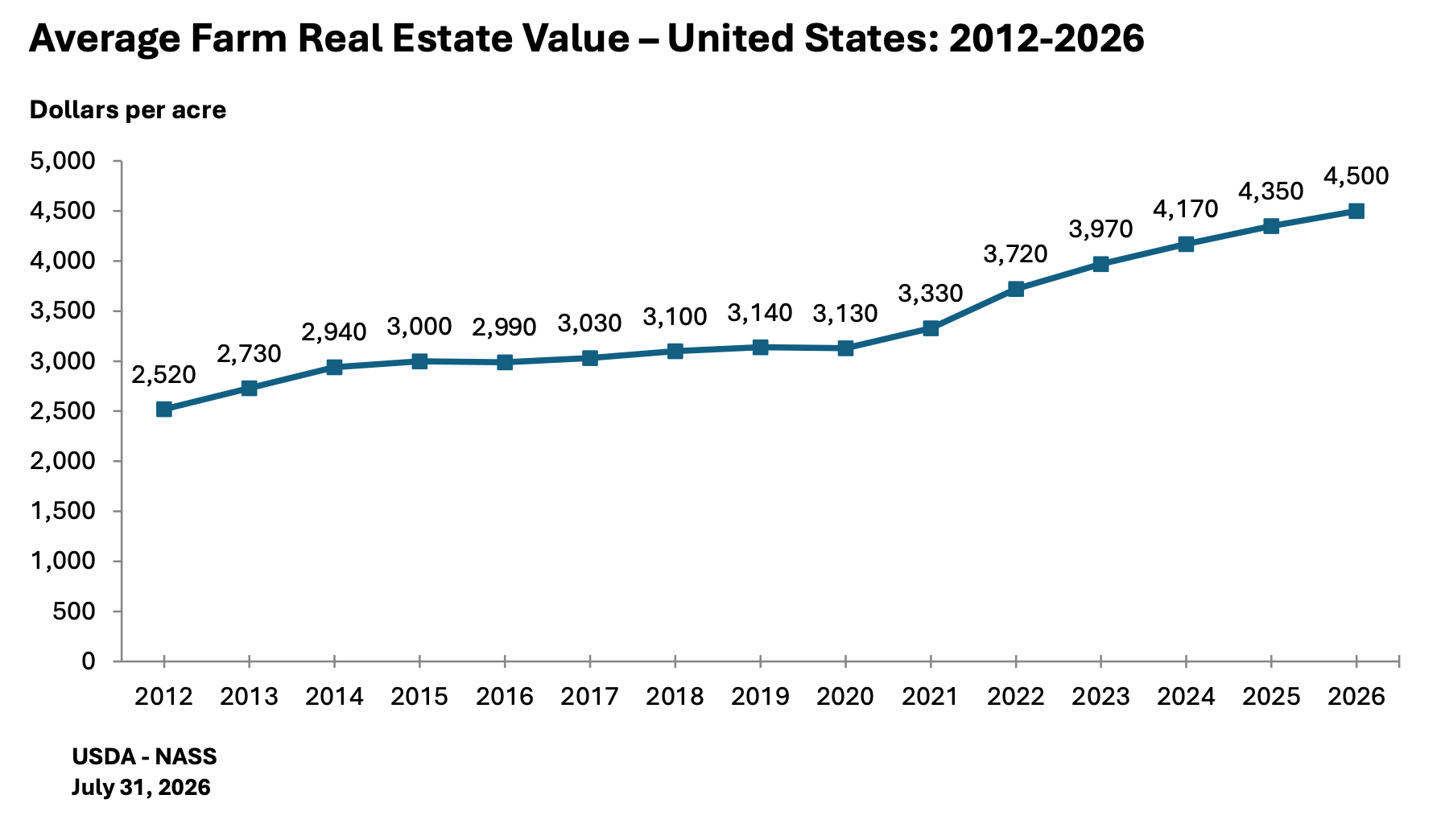
The result is a striking 45-year appreciation story. From 1980 to 2026, the nominal value of U.S. farmland has risen by 470%, and it is up 180% on an inflation-adjusted basis, according to data from the Bureau of Labor Statistics and the Federal Reserve.
The USDA data finds that, after a relatively flat stretch from roughly 2014 through 2020, farmland values began appreciating again in real terms in 2021. USDA estimates that the five-year compound annual growth rate from 2019 to 2024 was 5.8% in nominal terms and 2.0% on an inflation-adjusted basis.
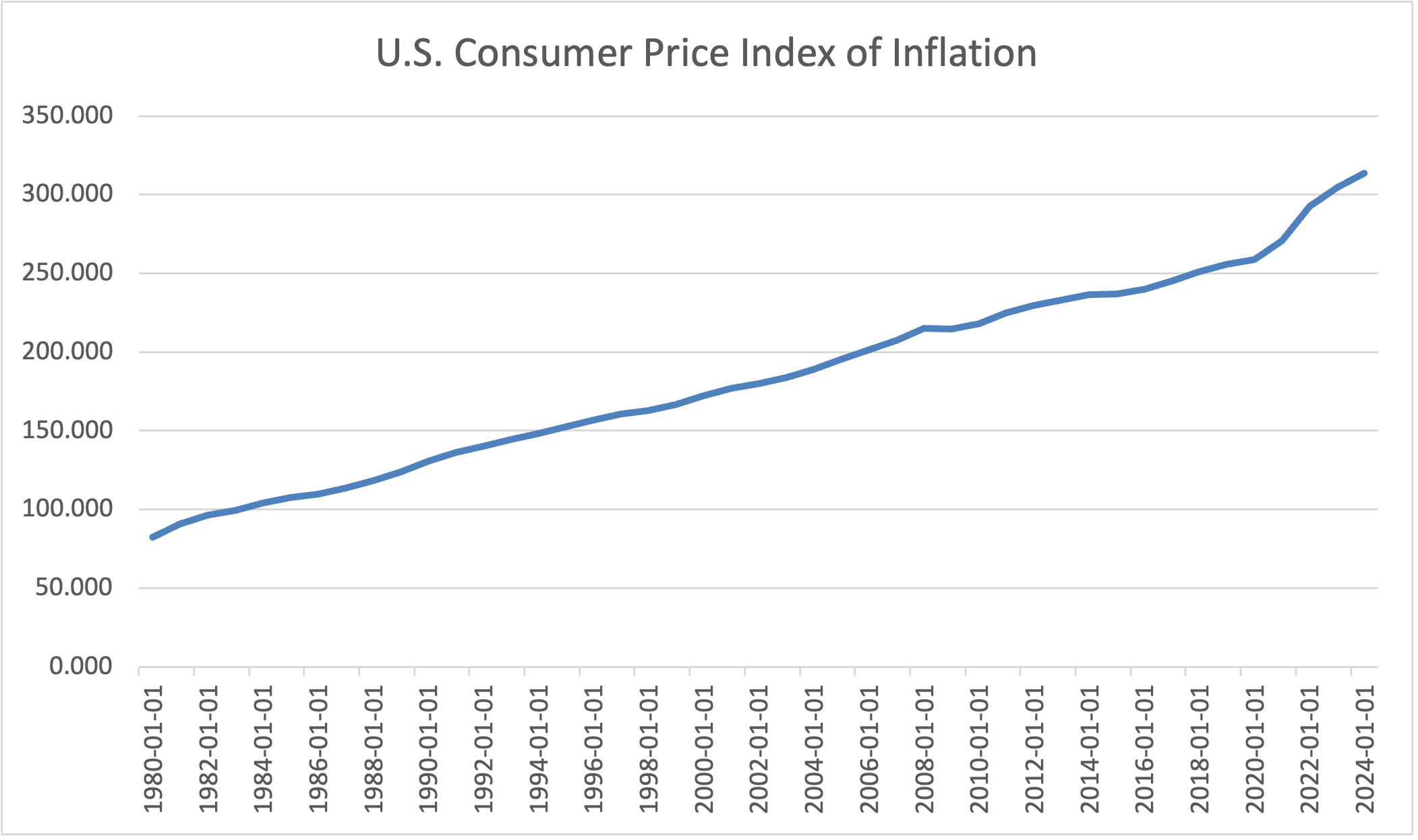
Source: The U.S. Bureau of Labor Statistics
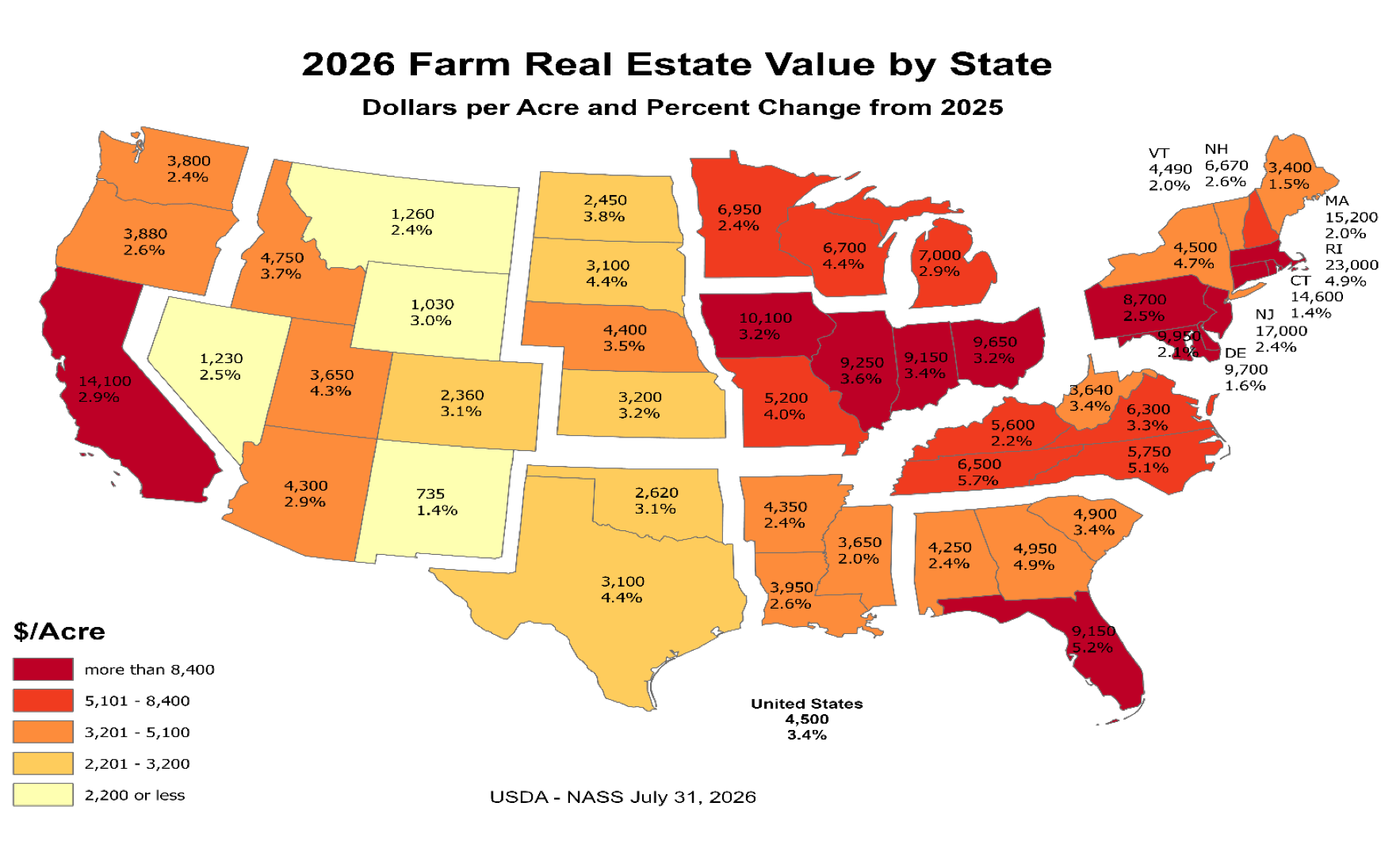
The 2026 national average of $4,500 per acre also masks substantial differences across land types. Cropland averages about $6,020 per acre, while pastureland averages about $2,000. Cropland commands a substantial premium because it can generate much higher agricultural income per acre, particularly where soil quality, rainfall, and irrigation support consistently high yields. The national cash rent average is about $160 per acre, only modestly below the previous year’s level. That combination of high land values and relatively sticky rents is one reason the market deserves analysis as both an asset market and an agricultural operating market.
Both the USDA and the Federal Reserve measure the value of farm real estate as land and permanent attachments, including buildings and other fixed improvements. It does not include tractors, combines, livestock, stored crops, or other movable operating assets. USDA estimates that total farm-sector assets will reach approximately $4.54 trillion in 2026, of which $3.77 trillion is farm real estate and the remainder consists of non-real-estate assets. Breaking these values down further, the latest Census of Agriculture survey estimates that about 60% of U.S. farmland was owner-operated, highlighting the significance of noncorporate ownership.
Why Are Agricultural Land Prices So High?
The first reason is scarcity. Farmland is not an ordinary financial asset because its supply is highly inelastic. We cannot manufacture another acre of prime cropland in Iowa, Illinois, or Indiana. Moreover, owners often have strong reasons not to sell. Land may have been in a family for generations, may provide retirement income through cash rents, or may serve as a long-term store of wealth. This is why a decline in farm profitability doesn’t automatically lead to a comparable decline in land prices.
A second factor determining farmland value is the land’s location and quality. Soil productivity, drainage, water availability, irrigation infrastructure, field configuration, and proximity to grain elevators, feedlots, and transportation infrastructure can lead to enormous differences in market value.
Finally, a third factor that should not be ignored is that U.S. farmland has become a pivotal alternative investment asset. Many investors, including farmers, view agricultural land as a good inflation hedge and a scarce real asset that provides stable rental income. This may explain the frequent disconnect between land prices and crop values and why land with poor crop margins often continues to enjoy substantial capital appreciation.
Finally, a fourth factor is nonagricultural demand. Land near expanding metropolitan areas often exceeds its agricultural value because opportunities for housing, commercial development, solar projects, wind installations, conservation programs, and other alternative uses often boost land prices. As a result, the highest-valued parcels are not always the most agriculturally productive; instead, they are often the parcels with the greatest potential for alternative use.
Government Policy
Supply of land is often constrained by the conservation reserve program, emergency commodity assistance program, solar energy development, and other disaster assistance, which make up elements of the agricultural safety net. Without these programs and additional federal assistance, the American Farm Bureau Federation projects that farmers managing row crops would incur $41.4 billion in losses in 2027.
Not surprisingly, these programs have reduced forced sales, thereby limiting the amount of farmland that comes to market compared with prior periods. During the 1980s, farmers faced high interest rates, falling commodity prices, high leverage, and collapsing land values. Today’s sector also has a much stronger aggregate balance sheet. USDA forecasts 2026 farm debt of $624.7 billion against $4.54 trillion of total farm assets, producing a debt-to-asset ratio of approximately 13.75%. At the same time, the difference between total farm assets and total farm debt, or farm-sector equity, is expected to reach a whopping $3.92 trillion.
Still, a farmer can own land worth millions of dollars yet struggle to finance next year’s fertilizer, seed, fuel, and labor. USDA forecasts that farm-sector working capital will decline by 9.2% in 2026. At the same time, farm debt is rising. This is the central financial paradox of today’s farm economy: the sector remains extremely wealthy on a balance-sheet basis, while some farmers continue to face substantial cash-flow stress.
Why Are U.S. Farmers Facing Such Losses?
A recent study by North Dakota State University finds that U.S. farmers lost $14.9 billion in sales due to retaliatory tariffs imposed by China in response to U.S. tariffs. These losses were 41% larger than those observed during the 2018-2019 trade war, when U.S. tariffs on China were lower. U.S. farm exports also incurred additional losses due to retaliatory tariffs imposed by Canada on U.S. agricultural goods in response to U.S. tariffs.
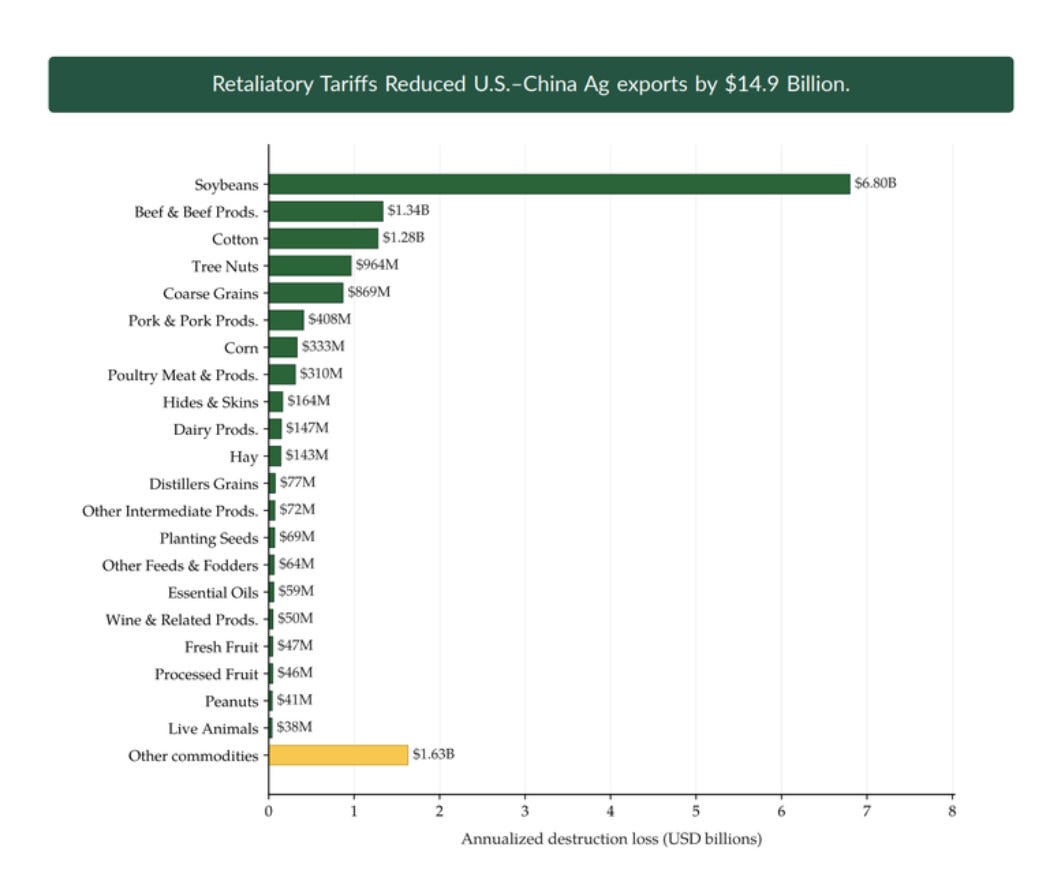
Source: North Dakota State University
How Can Treasury Debt Management Impact the Farm Sector?
While the U.S. Treasury’s recent announcements to keep long-term rates lower by purchasing some “off-the-run” Treasury securities may be well-intentioned, they can create problems for farmers struggling to borrow to manage working capital. Most farmers’ working capital debt is priced off the short-term interest rates.
That distinction becomes especially important when considering the hypothetical policy of the U.S. Treasury buying and retiring off-the-run Treasury securities, which would put downward pressure on long-term interest rates, while financing the purchases by issuing additional short-term Treasury bills, which would put upward pressure on short-term interest rates.
For farmland, that could have a meaningful effect, as lower long-term interest rates generally support the valuation of long-lived assets. Farmland is particularly sensitive to discount rates because its economic value is the present value of a stream of future agricultural rents or operating returns. If investors can earn less on long-term Treasury securities, farmland and other real assets may become more attractive by comparison. A lower long-term discount rate can therefore support higher land prices. The effect could be especially pronounced in a market where farmland supply is already severely constrained.
However, the benefit to farmers depends critically on short-term interest rates. Much of the financial pressure facing farm operators today stems not from the yield on the 10-year Treasury but from the cost of operating credit. Farmers routinely finance seed, fertilizer, fuel and other expenses with short-term operating lines. Those loans are commonly tied, directly or indirectly, to bank prime rates and other short-term funding costs. The Federal Reserve Bank of Kansas City reported in July 2026 that farm loan rates remained above historical norms even as new farm-loan originations eased.
The immediate winners could be landowners, as lower long-term discount rates would tend to put upward pressure on agricultural land prices. Existing owners with little or no mortgage debt could see further increases in net worth without a comparable reduction in operating expenses. Interestingly, the USDA estimates that 74 to 77% of U.S. farms operate debt-free!
The farmer who rents land or finances annual production with a short-term operating loan could be hurt if the Treasury lowers the 10-year yield, while the upward pressure on short-term rates from the Treasury replacing long-term securities with short-term securities puts upward pressure on the Federal funds rate and the U.S. bank prime rate, thereby increasing farmers’ short-term financing rates.
Summary and Concluding Thoughts
Looking out over the next several years, the most likely path for farmland is that high-quality land with excellent soils, dependable water, and strong agricultural productivity will likely remain relatively resilient. Scarce supply, accumulated land wealth, investor interest, and alternative land uses provide important support. At the same time, weaker commodity prices, elevated input costs, reduced working capital, and high short-term interest rates will continue to create meaningful downward pressure on income growth from farming operations.
The key variable may ultimately be the relationship between land capitalization rates and farm cash flow. If long-term interest rates decline, farmland could see another period of appreciation and land values could become even more detached from the economics of farming. However, if short-term rates rise as markets expect, farmers will face greater operating pressure and require even greater levels of government support to keep U.S. farmers afloat.
The remarkable lesson of the past 20 years is not simply that American farmland has appreciated. It is that farmland has become an asset whose value is determined by much more than the farmer’s current profitability. From about $1,830 per acre in 2006 to $4,500 today, U.S. farm real estate has weathered the financial crisis, the post-2013 agricultural downturn, the pandemic, inflation, and today’s farm-income squeeze.
At current levels, American farmers should remain proud that real estate represents an enormous reservoir of household and business wealth. But that wealth should not be confused with cash available to operate a farm. The central issue over the next several years will be whether the farmland balance sheet’s remarkable strength can coexist with deteriorating operating liquidity. However, if we achieve lower long-term Treasury yields while short-term borrowing costs remain high, landowners may benefit more than operating farmers.
However, if the Federal Reserve succeeds, as Fed Chair Warsh has promised, in lowering inflation from current levels, we may eventually see lower long- and short-term rates. If that happens, the agricultural sector could experience something even more significant: improved cash flow, stronger working capital, and continued support for farmland prices, which have already shown extraordinary resilience.