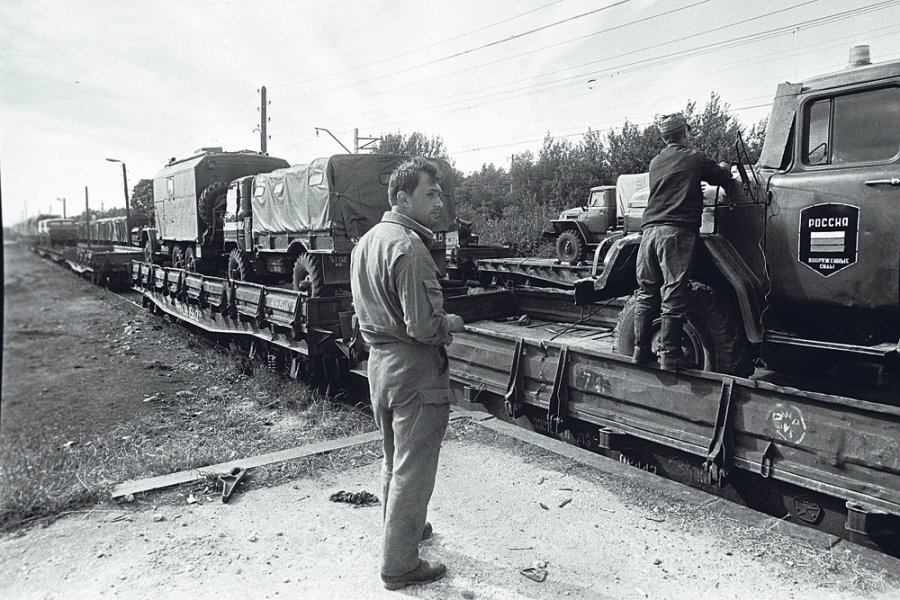
The last Russian soldiers left Estonia on 31 August 1994, after fraught diplomacy, Western pressure and an improbable vodka session between Lennart Meri and Boris Yeltsin.
On 31 August 1994, the last Russian troops left Estonia. Their departure, three years after the country restored its independence from Soviet occupation, brought almost half a century of foreign military presence to an end and completed a decisive stage in the restoration of Estonian sovereignty.
When the Soviet Union occupied Estonia in June 1940, it stationed troops across the country. Nazi Germany invaded the following year and occupied Estonia for three years. As German forces withdrew in the face of inevitable defeat in the Second World War, the Red Army returned in 1944. Soviet occupation would last for almost another half-century.
 The Soviet troops in Tallinn in 1940.
Estonia restored its independence in August 1991 and negotiations on the withdrawal of Soviet forces began almost immediately. When the Soviet Union ceased to exist that December, the troops still stationed in Estonia became part of the Russian armed forces. From April 1992, the talks continued with representatives of the Russian Federation.
On 21 August 1991, the Soviet military controlled more than 570 installations in Estonia, staffed by about 35,000 personnel. The force shrank considerably over the following years, but initially far outnumbered Estonia’s fledgling defence forces.
Moscow offers to leave in 2002
According to Estonia’s foreign ministry, the negotiations were arduous. In 1992, Moscow proposed 2002 as the withdrawal deadline. Tallinn refused. After further meetings and consultations, Russia offered to leave by 1997.
It was crucial for Estonia to secure the departure of Russian forces at the same time as their withdrawal from several other countries, particularly Germany, where the deadline was 31 August 1994.
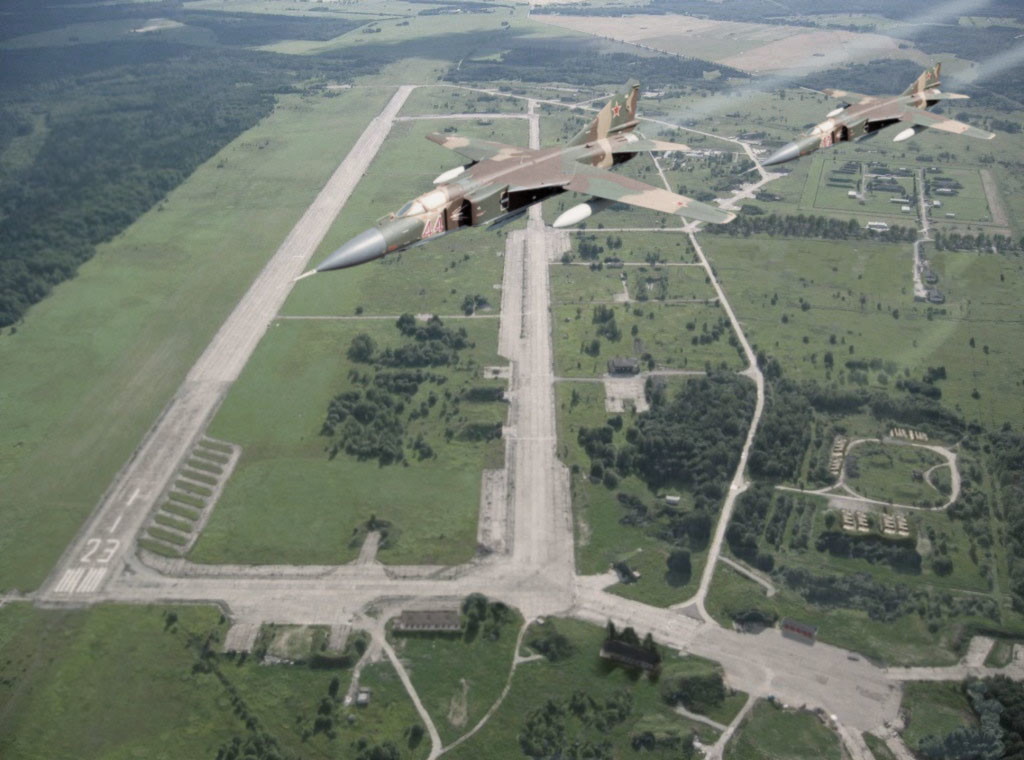 A pair of Soviet MIG-23 fighters above Tapa airfield in Soviet-occupied Estonia, 1980s.
Estonia received strong international support for that position. The United States and Sweden led the diplomatic pressure on Moscow, while other Western governments also intervened. The United Nations, the Conference on Security and Co-operation in Europe – now the OSCE – and the Council of Europe backed Tallinn as well.
Vodka diplomacy in Moscow
The negotiations culminated in Moscow on 26 July 1994, when an Estonian delegation led by President Lennart Meri met a Russian delegation headed by President Boris Yeltsin to settle the final withdrawal date.
The encounter has since passed into Estonian political folklore. According to the oft-told account, the reception in Moscow was initially frosty and Russian officials refused to budge. Yeltsin, however, had reportedly heard from the US president, Bill Clinton, that Meri was a man with whom he could do business. He left the officials to argue and invited the Estonian president to join him for vodka.
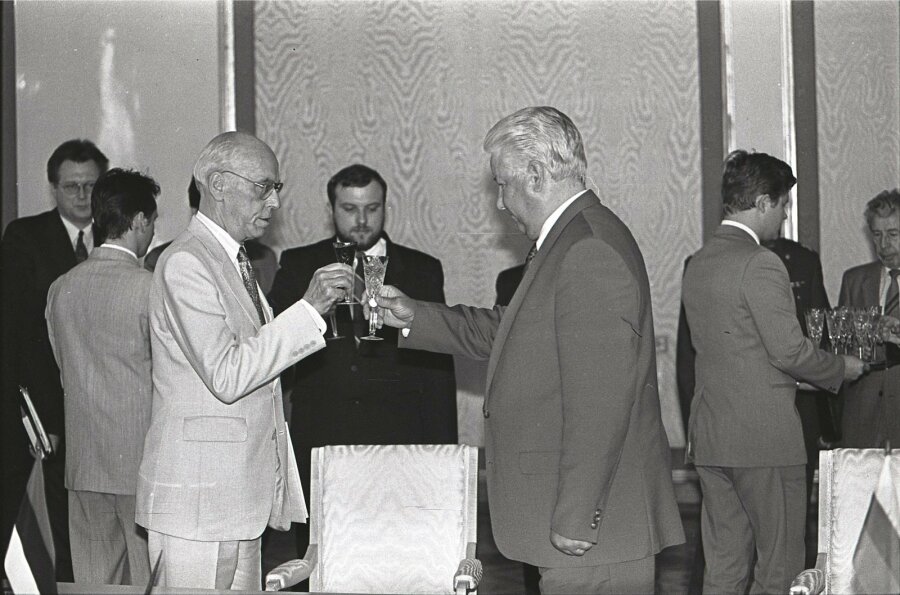 The late Estonian president Lennart Meri (left) and the late Russian president Boris Yeltsin raising a toast in Moscow on 26 July 1994, after Yeltsin signed an agreement to withdraw the Russian troops from Estonia. Photo by the National Archives of Estonia.
Meri was no great drinker, but his country’s future was at stake, so he accepted. Presented with a long list, he chose Absolut Vodka – so that, as the story has it, things between them would be absolute.
Yeltsin approved of the choice and began drinking. Meri, meanwhile, is said to have discreetly emptied his shots into the pot of a palm tree beside his chair.
Whatever role the vodka played, Meri and Yeltsin signed an agreement that day on the withdrawal of Russian forces from Estonia and the conditions governing their temporary presence. Russia had 36 days to meet the deadline of 31 August 1994.
A controversial settlement
Alongside the troop-withdrawal agreement, the two countries signed an accord on social guarantees for retired members of the Russian armed forces living in Estonia. A further agreement, signed on 30 July, covered the neutralisation of the former Soviet nuclear facility at Paldiski.
The Paldiski site was to be transferred to Estonia by 30 September 1995. Under the agreement, however, it was no longer treated as a military base during the intervening period.
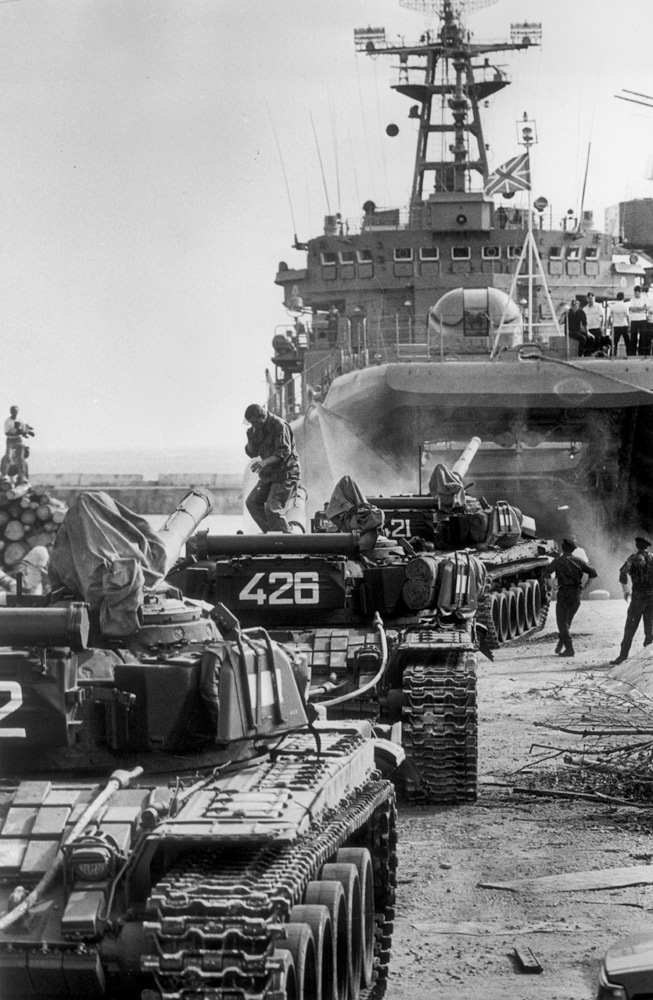 Russian troops leaving Estonia in 1994. Photo by Albert Truuväärt/Postimees.
Russian troops left Estonia by the deadline. On 31 August, Moscow submitted the list of military pensioners covered by the social-guarantees agreement, and the relevant Estonian government committee began work the following day. The Paldiski facility was handed over to Estonia in full on 30 September 1995.
At home, the July treaties attracted fierce political criticism, above all over the rights granted to retired members of the Russian armed forces. Yet, despite approaching elections, there was broad agreement on Estonia’s strategic course: integration with the West and constructive engagement with Russia.
The troop-withdrawal agreement was Estonia’s first major diplomatic achievement in close cooperation with its Western allies. It was also an early test of whether the restored state could remain both resolute and pragmatic under extraordinary pressure. The Russian troops left on schedule; the nuclear facility at Paldiski was transferred to Estonian control the following year.
This article was first published on 31 August 2024 and republished in an edited form on 31 August 2026.