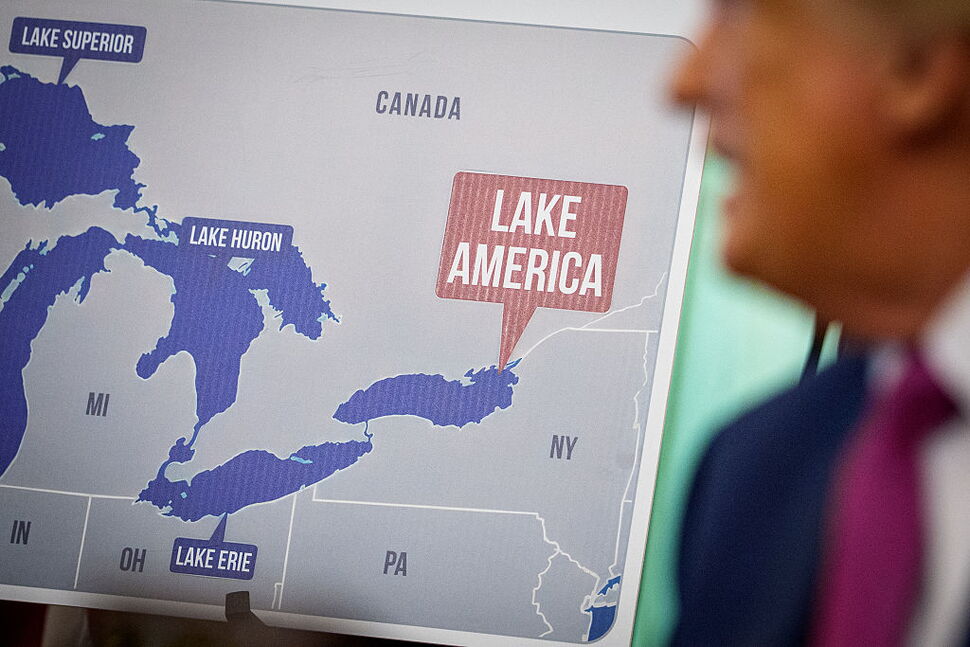
Last week, in the middle of another trade spat with Canada, President Donald Trump signed an executive order directing Interior Secretary Doug Burgum to start the process of identifying Lake Ontario as “Lake America.” Beyond the weird trolling – the body of water was not named for the Canadian province – this raises a bunch of questions.
As a student of how American places get their names, I’m going to try to answer some of the more obvious ones.

Sign Up for U.S. News Decision Points
Your trusted source for breaking down the latest news from Washington and beyond, delivered weekdays.
By clicking “Sign Up”, you will receive the latest updates, including emails, from U.S. News & World Report and our trusted partners and sponsors, and you agree to our Terms and Conditions & Privacy Policy.
Can He Do That?
Way back in 1890, President Benjamin Harrison created the U.S. Board on Geographic Names to standardize how places were identified on federal maps. Congress established the board in its current form in 1947 – not as a federal agency, but as a body that groups officials from many agencies that develop or use maps – and gave the new entity the job of working with the interior secretary to standardize American place names across the federal government.
It doesn’t hurt that the lake isn’t strictly an American place. As when he decided the Gulf of Mexico would henceforth be the Gulf of America, Trump picked a place that is effectively under shared custody with a foreign country. The Supreme Court has consistently said foreign policy is the president’s domain. This probably qualifies.
Whom Does This Bind?
In theory, the order gives Burgum 30 days to make “Lake Ontario” disappear from federal maps, signs, contracts, communications and the like. But that really only binds federal agencies.
State governments are not bound by the decision. Neither is the private sector, though federal contractors will feel pressure to accept the new name. And, of course, Canada can ignore the attempted change.
The federal government, however, can pressure or cajole or even threaten those entities to adopt the name change, much like China punishes corporations that identify Taiwan as an independent nation.
Google Maps changed its labeling on the smallest Great Lake to Lake America, but as of midday, Apple Maps and Bing Maps still labeled it as Lake Ontario.
Is There Precedent for This?
Sort of. Back in 2015, President Barack Obama replaced the name Mount McKinley in Alaska – the country’s tallest peak – with the locally preferred Denali. (Trump changed it back.)
Obama’s interior secretary, Sally Jewell, ordered the change because the 1947 statute said she could do so if the board, when debating a name change, “does not act within a reasonable time.”
Alaskan elected officials had pushed for the name change since the mid-1970s, but Ohio lawmakers had blocked the removal of McKinley, a favorite son of Niles, Ohio. The Interior Department assessed that four decades met the “reasonable time” part of the law.
We’ll see if there’s any pushback on the renaming of Lake Ontario, the name of which comes not from the Canadian province but from the Indigenous Iroquoian word “oniatarí:io,” which means “lake of shining waters.” The Canadian province gets its name from a similar Iroquoian word, “kanadario”, which translates into “sparkling” water. The name for both the lake and the region was referenced in maps and writings starting in the 1600s.
Will Trump Keep Renaming Things?
Getting his name on more buildings and airports? He seems inclined to do so. Renaming geographic features? That’s a lot more work.
The board has historically required evidence of broad local support to change what a place is called.
There are exceptions, as I wrote when I tackled the 2015 decision. Some changes reflect broader social change and evolving attitudes.
In 1967, the board changed the N-word in 143 place names to “Negro.” It followed that up in 1971, changing “Jap” to “Japanese” on federal maps.
Over the years, some changes have been pretty funny. In 1949, the board transformed a small West Virginia town from Mole Hill into Mountain. A touch literal, this “making a mountain out of a molehill,” but cute.
A year later, the town of Hot Springs, New Mexico, opted to change its name to Truth or Consequences, after a popular radio show at the time. There’s also a Ben Hur, Texas, named after the book. The board approved both.
The organization has some quirks. It has just a handful of exceptions to its ban on apostrophes. (Can you name two?) Commemorative names are possible, but the board typically requires the person to have been dead at least five years.
So Hell, Michigan, and Accident, Maryland – real places, I swear – are unlikely to become Donaldville anytime soon.