
This year, Czechia and Slovakia are commemorating the 100th anniversary of the creation of independent Czechoslovakia. Over the past century, the present-day Czech Republic has gone through many periods. Czech energy has undergone a similar evolution, with its beginnings dating primarily to the First Republic period.
While 100 years ago the ability to light one’s home with an electric bulb was a privilege, today few people can imagine a full life without electricity, natural gas or other energy commodities.
First Republic: Electrification of Czechoslovakia
While today we are surrounded by electrically powered devices almost everywhere we go, the situation was diametrically different a century ago. What we now take for granted was a privilege – after the end of World War I in 1918, only one in three Czechoslovak residents had access to electricity. Electricity consumption was also markedly different – a household with access to electricity consumed an average of 100 kilowatt-hours per year in 1918, which would not be enough for even two weeks for today’s average Czech household. Overall, approximately 1000 GWh was consumed in 1918 in the territory of today’s Czech Republic.
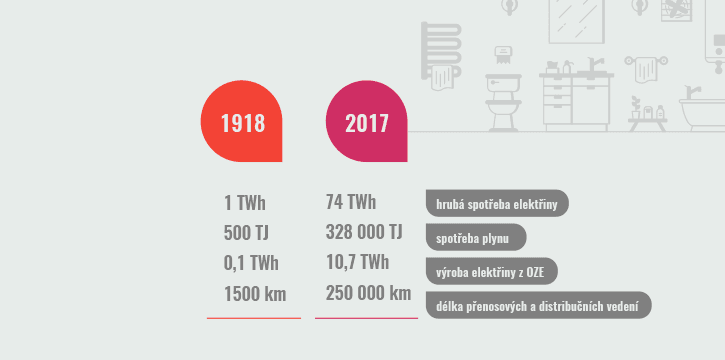 Over the past century, electricity consumption in the Czech Republic has increased more than 70-fold and gas consumption more than 600-fold. Electricity generation from renewable sources has also risen significantly
In the early days of the First Republic, the main driver of electrification was primarily agriculture, as industrial enterprises had their own electricity sources. Labour shortages forced farmers at the time to seek to replace human labour with machines. Small power plants with local distribution networks thus began to emerge. The growing appetite for electricity inevitably led to the construction of new generation sources.
1930s: The beginnings of hydropower on the Vltava
As humanity did not have nuclear power plants or modern renewable sources such as wind or photovoltaic plants at the beginning of the last century, most electricity generation was provided by fossil fuel-fired power plants or hydropower plants.
The first plans to modify the Vltava River to make it navigable from České Budějovice to Mělník date back to the end of the 19th century. The Vltava received greater attention in the period after World War I, when interest in electricity generation emerged. The first power plant in the Vltava Cascade was the hydropower plant at the Vrané reservoir, now the final stage of this system.
The Vltava Cascade now comprises nine waterworks spread along a stretch of the Vltava River more than 250 km long. In addition to generating electricity, the reservoirs primarily serve to store water, improve flow in the river’s lower reaches, support recreational activities and, last but not least, provide flood protection. The cascade’s hydropower plants were commissioned over a period of more than 50 years, with the first of them, Vrané, supplying electricity since 1936.
1940s: Gasification begins
Although natural gas was discovered in Czechia at the start of the 20th century, it was not used to any significant extent until the second half of the last century. Initially, gas – not yet natural gas at that time – was used mainly in lighting lamps. So-called town gas, a mixture of hydrogen, carbon monoxide, methane and other gases, was produced in Czechia as early as the 19th century.
By the end of the 19th century and throughout the 20th century, gas in lamps was gradually displaced by electricity. However, gas quickly found applications in other areas, especially industry, for example to power engines, and also for heating.
A further era in the development of natural gas use began in the early 1940s with the construction of the first pressurised gasworks in Záluží near Most, which used pressurised gasification of lignite with oxygen and steam. The first high-pressure gas pipelines were also built, transporting gas from the gasworks to Děčín and later to Most, Teplice, Ústí nad Labem and other cities in north-western Bohemia.
Natural gas began to be used more intensively in Czechoslovakia only at the end of the 1960s, with the commissioning of the first international Brotherhood gas pipeline, which brought natural gas from the Soviet Union via Ukraine and Slovakia to southern Moravia. Intensive gasification of Czech households then took place relatively recently, in the 1990s, when gas served as a more environmentally friendly substitute for coal.
Post-war period
The post-war economic recovery supported growth in electricity demand, and power plant capacity more than doubled in the 1950s. Electricity consumption continued to grow as electricity penetrated further industrial sectors as well as Czechoslovak households.
As the number of power plants and consumers grew, distribution networks also expanded. Smaller, isolated transmission networks were eventually connected in the 1950s, creating a centrally managed system.
1950s–1960s: The birth and development of the Czech transmission system
The beginning of the unified Czechoslovak electricity system can be traced to the early 1950s, when the two largest networks – the Czech and Moravian-Silesian networks – were connected. New 220 kV transmission lines linked north-western Bohemia with southern Moravia. In 1953, the Czech and Moravian-Slovak systems were interconnected by two 100 kV lines.
The 400 kV system then developed rapidly in the 1960s and has served as the backbone network for electricity transmission ever since. The first 400 kV line, 346 kilometres long, was commissioned in September 1965 from Hradec near Kadaň to Prosenice.
The backbone transmission network was virtually completed in the 1980s. It currently consists primarily of 400 kV lines. The 220 kV lines, construction of which ended in the early 1970s, now serve mainly as backup and supplementary lines and for evacuating power from large power plants.
1970s: The golden era of coal power
Although the Czech Republic has a diverse mix of electricity sources, coal-fired power plants still play the largest role in electricity generation. Coal power developed in Czechia in several waves. The greatest increase in new coal-fired power plants came immediately after the creation of independent Czechoslovakia, thanks to the high level of First Republic engineering and steelmaking. The post-war period was characterised by a transition to unit-based coal power plant configurations, followed by a sharp increase in unit capacity from the 1960s to the 1980s.
By the end of 1970, 20 units of 32 MW, 26 units of 50 to 55 MW, 21 units of 100 and 110 MW, and three 200 MW units were in operation. Between 1970 and 1989, new sources with a total capacity of 8 640 MW were built. These were mainly 110 MW or 200 MW units; an exception was, for example, the Mělník III power plant with one 500 MW unit.
 With the construction of a large number of generation units, electricity generation in the Czech Republic also grew1980s: Taming the atom
In the second half of the last century, humanity succeeded in bringing nuclear fission under control, opening up another option for electricity generation. The beginnings of nuclear energy in Czechoslovakia date back to 1970, when the then Czechoslovak Socialist Republic and the Soviet Union signed an agreement to build two nuclear power plants (Dukovany and Jaslovské Bohunice) with a capacity of 1760 MW.
The decision to build four units at the Dukovany site was made in 1975 and, after construction was suspended and the project reassessed, construction of the plant began in 1978. The A1 plant at Jaslovské Bohunice was the first nuclear power plant to operate in the former Czechoslovak Socialist Republic. However, the first Czech nuclear power plant was Dukovany, whose first unit began supplying electricity to the grid in 1985.
After 2000, the plant continued its gradual development, and in 2009 the first upgraded unit was restarted after an outage, with electrical capacity newly reaching 510 MW. In May 2012, the final unit also underwent the final stage of modernisation, and Dukovany thus generates up to 2040 MW instead of its original electrical capacity of 1760 MW.
Post-revolution period marked by the environmental upgrade of coal-fired sources
The massive use of coal-fired sources in the second half of the 20th century took a toll on the environment not only in socialist Czechoslovakia but also in many other countries. Acid rain caused by the combustion of fossil fuels, including coal in coal-fired power plants, had particularly serious impacts.
One of the most significant steps in the post-revolution history of the Czech power sector was therefore the environmental upgrade of coal-fired power plants – modifying all coal-fired energy sources in a way that significantly reduced their environmental impacts.
Thanks to the desulphurisation programme, compared with conditions in the early 1990s, sulphur dioxide and fly ash particulate emissions were gradually almost eliminated, while nitrogen oxide and carbon monoxide emissions were also significantly reduced.
21st century: Temelín NPP commissioning, electricity and gas market liberalisation, solar boom and more
The new millennium brought a number of changes to Czech energy, notably the opening of the electricity and natural gas markets, which gradually gave electricity and gas customers the option to choose their supplier.
On 1 January 2001, the Energy Regulatory Office was also established. Its role is to regulate prices, support the use of renewable and secondary energy sources and cogeneration, protect the interests of consumers and licence holders, promote and, where appropriate, investigate competition conditions, and supervise energy markets.
The second Czech nuclear power plant, Temelín NPP, was also completed at the beginning of this millennium. Construction of a nuclear power plant at the Temelín site, originally planned for four VVER 1000 units, was approved in 1980. Construction of the operational facilities began in February 1987; however, after 1989 the project was reassessed and, under a 1993 government resolution, completion of Temelín NPP was approved on the basis of two units. The Czech Republic’s largest power plant is approximately halfway through its planned lifetime and will most likely operate for longer than the originally planned 30 years.
 The Czech Republic generates half of its electricity from coal-fired sources, nuclear covers one third and the remainder comes mainly from renewable sourcesOpening of the electricity and gas markets
Until relatively recently, electricity and natural gas customers could not choose their supplier. Change came in 2002, when the electricity market began to open gradually. Large consumers with annual consumption in the tens, and later even single-digit, GWh were the first to be able to change supplier; this option became available to Czech households at the beginning of 2006.
The natural gas market followed three years later, when large consumers with annual consumption above 15 million m3 could choose their supplier from 1 January 2005. In the second phase, from 1 January 2006, the market opened to all other customers except households, which gained this option on 1 January 2007, completing the effective process of market liberalisation.
Photovoltaic boom
As part of its support for renewable energy sources, the Czech Republic committed to meeting 13 % of the country’s gross final energy consumption from these sources by 2020. As renewable sources were not profitable without financial support, a subsidy system had to be created.
However, this system was set up very poorly for photovoltaic power plants in the Czech Republic, and the entire situation led to an enormous expansion of large solar power plants. The solar boom in Czechia was triggered in 2008 by excessively high feed-in tariffs for electricity from photovoltaic plants and the inability to reduce them more significantly in subsequent years, which would have been a necessary response to falling costs.
 The Czech energy sector has recorded a number of significant milestones since 2001.
The full-resolution infographic on 100 years of Czech energy is available here.