
The Petermann Glacier in northwest Greenland lost one of its largest ice tongues on August 4, 2026. A block of 76 km², similar to the size of Manhattan, broke off and formed a new tabular iceberg up to 150 meters thick.
This is the largest loss of floating ice from Petermann since 2012 and the most significant event recorded in the Arctic since 2020.
The technology behind the discovery
The detachment was confirmed by the Copernicus Sentinel-1 mission, whose radars allow observation day and night and can penetrate cloud cover.
Images from August 3 already showed cracks in the ice tongue.
On August 4, the iceberg separated from the eastern flank.
Radar interferometry allowed tracking the propagation of fractures almost in real-time.
The scientific work
The monitoring is part of the ARCTEX project of the European Space Agency (ESA), with participation from universities in Canada and the United Kingdom.
In April, observations already revealed deformations in the ice tongue.
Researchers like Adam Garbo (University of Ottawa) and Anna Crawford (University of Stirling) highlight the rarity of the phenomenon in the Arctic, where tabular icebergs are less common than in Antarctica.
Molly Hammond (University of Leeds) emphasized the importance of near real-time monitoring to understand the dynamics of the cracks.
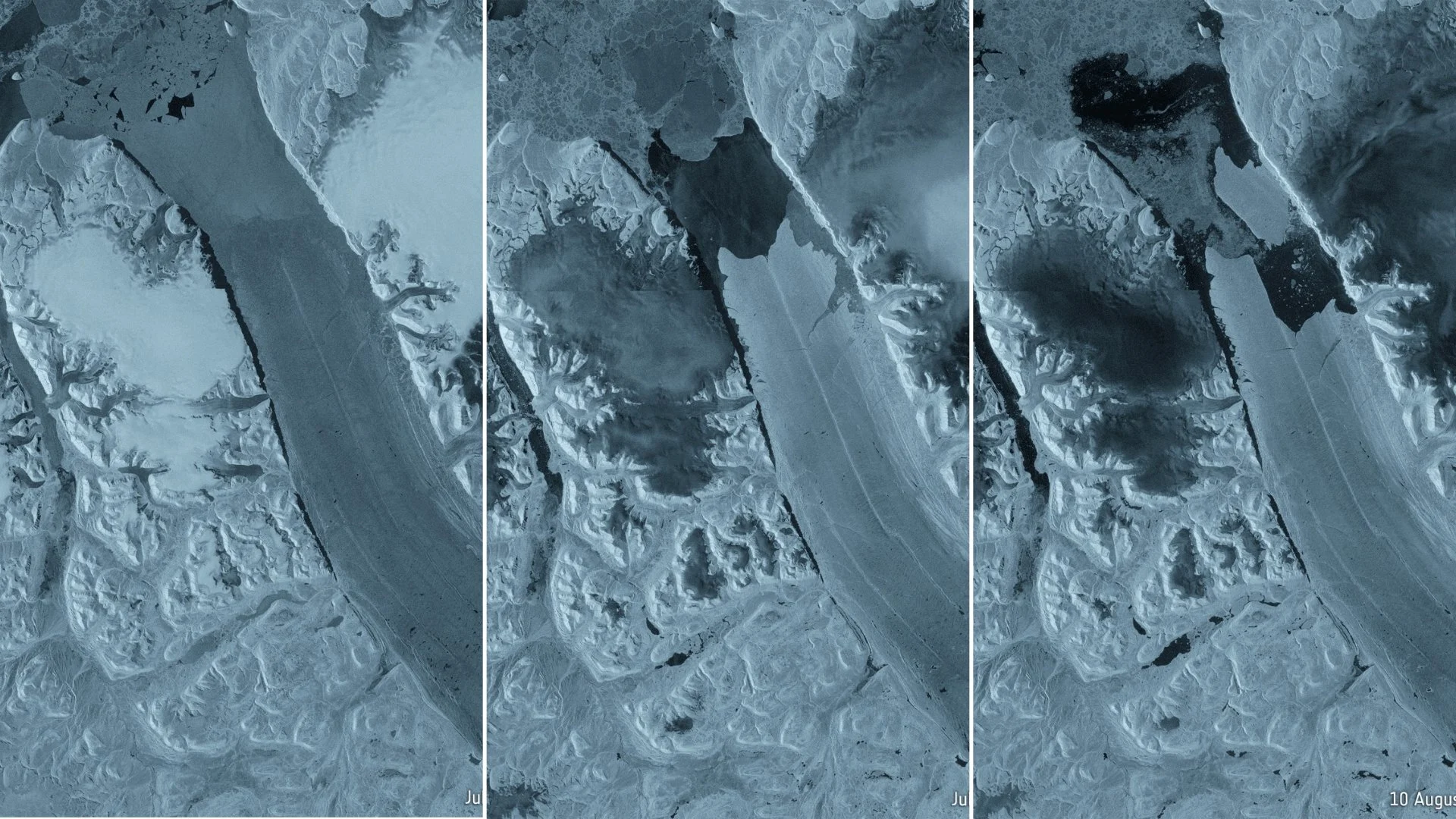 The Petermann Glacier lost a massive ice tongue in 2026, creating an iceberg that impacts the Arctic.
Background and projections
Petermann had already recorded detachments in 2008, 2010, and 2012. Although it remained stable in the last decade, scientists warn that two other large ice islands could break off in the coming months.
Martin Wearing (ESA) considers this iceberg a unique opportunity to study how such a large mass of ice moves and fragments.
Practical implications
The detachment is not only of scientific value:
Environment and Climate Change Canada monitors the iceberg’s trajectory due to the risks it poses to shipping routes.
These masses can remain in the ocean for years, slowly fragmenting.
Connection with Antarctica
The tandem observation technique of Sentinel-1 was also applied in Antarctica, allowing the measurement of glacier movement and the contact line, key to projecting the rise in sea level.
Comparisons with data from the 1990s show that ice flow in areas like the Leppard Glacier and the Evans current has accelerated, moving up to 3-4 meters daily.
The detachment of the iceberg from the Petermann Glacier is a reminder of the speed at which polar systems are changing. Beyond its spectacular nature, it offers crucial data to understand the impact of global warming in Greenland and Antarctica, and its consequences on sea level and international navigation.