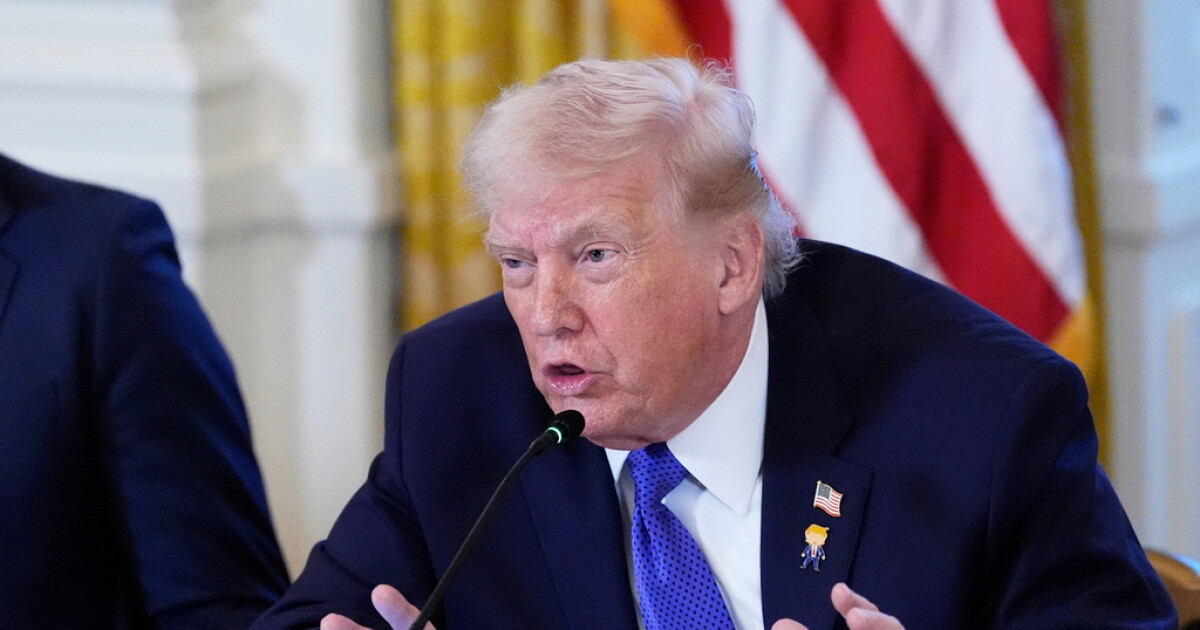
While Americans grapple with prices at the pump, President Trump convened refiners and distributors Tuesday at the White House to discuss ways to expand U.S. refining capacity as the administration focuses on cutting costs.
“We are unleashing American Energy Dominance!” Trump wrote on Truth Social.
Trump met with nearly a dozen small, mid-sized and large refiners and distributors, according to a White House official, during which he made clear he wants to see prices fall at the pump. Discussion included “concrete ways to expand capacity, including regulation changes, faster permitting and additional investments,” according to the official.
The refiners were in line with the President’s commitment to lower costs and wanted to increase capacity according to the official, who also said “they expressed their appreciation to the President for reversing the Biden Administration’s disastrous energy policies and unleashing American energy.”
“President Trump is laser-focused on ensuring his successful energy dominance agenda translates into the most cost savings possible at the pump for consumers,” White House spokeswoman Taylor Rogers said ahead of the meeting.
It’s not clear what immediate steps refiners may take, though, according to an official President Trump is prioritizing near term steps to increase capacity.
RELATED STORY | Fed report finds rising gas prices have lasting effect on inflation expectations
“U.S. refineries are operating at some of their highest rates that we’ve ever seen. A lot of that is in light of Russian oil refineries that have been knocked offline. Supply and demand have tightened to the point where refineries are heavily incentivized to run as hard as possible to bridge the gap. There is very little spare capacity that has remained in the U.S.,” said Patrick De Haan, the head of petroleum analysis at GasBuddy.
However, some note translating expanded refining capacity to cost savings for consumers could take time.
“Even if they do announce any increase in capacity, it would take likely months, if not years, depending on the scope of that work, to really have a meaningful impact on what consumers are paying at the pump,” said De Haan.
It comes as the national average for gasoline remains above $4 a gallon, and as crude oil continued to climb Tuesday. U.S. crude prices topped $90 a barrel as the U.S. renewed military strikes against Iran amidst conflict over the Strait of Hormuz and as Ukraine has struck deeper into Russian territory.
“It’s likely to be the most expensive Labor Day we’ve ever seen, though gas prices are modestly lower than June of 2022. Looking specifically at this, the summer’s last holiday, it is going to be the most expensive Labor Day on record, and probably by at least 15 cents a gallon,” said De Haan.
RELATED STORY | US strikes Iran as retaliation raises fears over gas prices, Strait of Hormuz
This week the Trump administration announced a significant energy deal between the U.S. and Venezuela, which President Trump said he intends to use to help refill the strategic reserve.
The U.S. government is taking an equity stake in the corporate parent of North American Blue Energy Partners, which the White House said was given concessions for oil fields worth around 65 billion barrels. The agreement also gives the U.S. government the right to purchase and a right of first refusal. President Trump said he is seeking to refill strategic reserves through the deal.
“It’s very simple: Do we want Russia and Chinese companies controlling the the wealth of a country in our hemisphere, or do we want the United States in combination and partnership with the Venezuelan people, having influence over those resources so that they benefit the Venezuelan people, which is in our interest,” said a U.S. official.
Chevron is expected to announce plans to expand operations in Venezuela, according to the U.S. official, as Energy Sec. Christ Wright and other officials are expected to visit the country this week. The official said that they “continue to push very hard to have additional private sector American investment.”
“This deal in the years ahead is absolutely very monumental and very significant, subject to legal risks and potentially regime shift in Venezuela. But it will not have major impacts on what consumers are paying anytime soon,” De Haan said of the agreement between countries.
While some analysts note it could take time for impacts to be realized for American consumers, President Trump said “It’s actually trillions of dollars we’re talking about trillions, and it’ll come out as fast as possible.”
The President has frequently touted refineries in Texas and Louisiana as benefiting from crude oil from Venezuela.
“That at cost oil hit the market in November and if things go as planned, we can expect to see millions of barrels hit by the beginning of next year,” Rogers told NewsNation during an interview Tuesday evening.