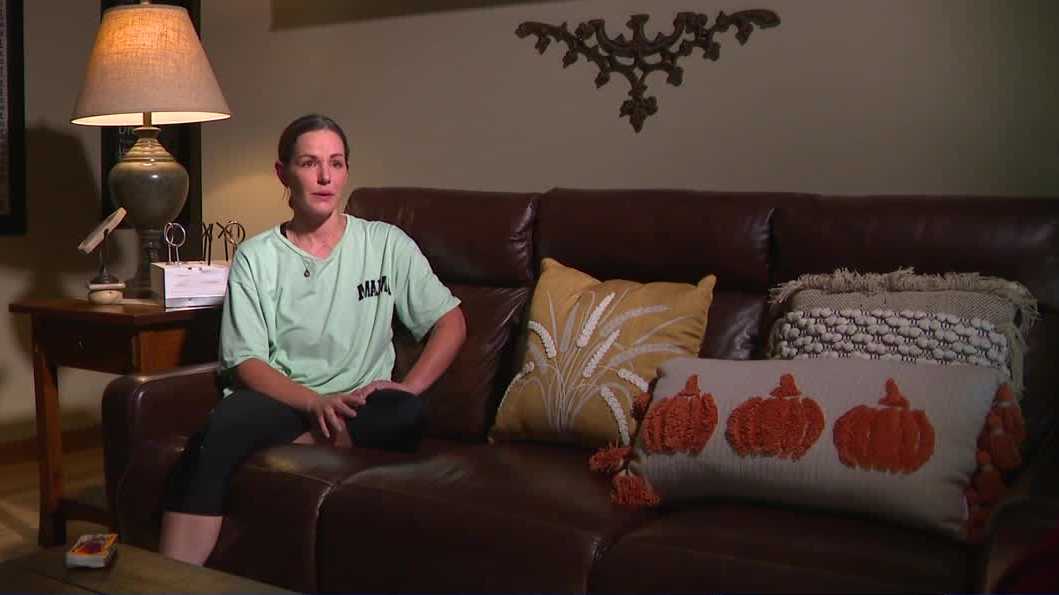
New investment into perinatal care could help Iowa mothers with mental health concerns

COALVILLE, Iowa —
In the peaceful community of Coalville, Iowa, about 10 minutes south of Fort Dodge, Megan Thies watches her three children play in their backyard.
Griffin, the oldest, boasts about how high he can push his younger siblings, twins London and Beckham, on the swing, before leading them to look for buried treasure in the nearby pumpkin patch.
Megan Thies watches on with a smile, the word “Mama” written in bold letters across the back of her shirt.
It isn’t until the kids’ grandparents take them out for a surprise visit to a nearby ice cream shop that she explains that in the early days of being a mom of three, it rarely looked like it does now.
“I remember just sitting in my shower almost every night bawling because I hated them,” she said, holding back tears. “I mean, in my mind, I hated them, and I knew that wasn’t right.”
Thies had struggled with anxiety and depression before she got pregnant. But this time, it was different.
She reached out to her OB-GYN, her primary care physician, and relied on her friends and family to help care for her children when things got to be too much, but it didn’t solve the problem.
Eventually, that depression evolved into psychosis.
“I went to go pick up the twins, and right when I walked in the door, they were crying, and it just set me to 100,” she told KCCI. “I got them in the car, and they just kept crying, and then all of a sudden they stopped and I blacked out.”
The next thing she remembers is standing in front of an Algona cemetery with her young twins.
“I don’t remember driving there. I don’t remember getting there. And that scared me,” she said.
It’s a struggle millions of other women like her know well – about one in 5 mothers will experience a perinatal health disorder at some point, according to the Iowa chapter of Postpartum Support International, an organization dedicated to raising awareness and education for perinatal mental health disorders.
Brittany Haskins, president of PSI’s Iowa chapter, says many women like Thies struggle to get the help they need.
“Access is huge, especially in rural parts of the state. We know there’s an OBGYN shortage in the state, and that’s really the first place we send a person,” Haskins told KCCI.
It wasn’t until Megan checked herself into a psychiatric hospital that she got the care she needed.
But a new investment into Iowa’s perinatal care is hoping to bridge that gap.
Iowa was awarded over two hundred million in federal grant funding, most of which will be allocated to creating a hotline to connect doctors with the state’s seven perinatal psychiatrists.
“A psychiatric access line creates a literal telephone number that they can call; they can talk to a perinatal psychiatrist in the state to get answers and get consult on that patient’s care,” Haskins said.
It’s not a cure-all; Iowa is still experiencing an OB-GYN and mental health provider shortage.
But for moms like Megan, that one phone call can mean the difference between silent suffering and watching her children swing in the backyard.
“It’s easy to not ask for help. It’s easy to get quiet. It’s easy to keep to yourself. It’s easy to go to your O.B. appointments. And when they ask you those depression screening questions, it’s easy to lie because moms are made to feel like it’s supposed to be great,” she said. “I think that for me, had there been something there, I wouldn’t have gotten where I was.”
If you or someone you know is struggling with perinatal mental health, there are resources available. You can contact Postpartum Support International here or by calling 1-800-944-4773. You can also text 800-944-4773 in English or 971-203-7773 in Spanish.
Iowa Health and Human Services also offers resources for perinatal depression. You can find more information here.