

The Federal Reserve’s annual symposium in Wyoming last week produced a sweeping policy reset that will reshape the cost of capital for green infrastructure for years. For Canada’s environmental industry, the implications are concrete and close to home.
Every August, the world’s central bankers retreat to a lodge at the foot of the Grand Tetons in Wyoming to think out loud about the global economy. The conversations that happen there shape the cost of money for the year ahead and, through that cost, the economic viability of every long-duration infrastructure project on the planet, including the green infrastructure Canada’s environmental industry depends on.
This year, the Jackson Hole Economic Policy Symposium took place August 27–29, under the theme “Financial Innovation: Implications for Payments and Policy”—resulting in something more consequential than a typical rate signal. New Federal Reserve Chairman Kevin Warsh, 100 days into the job, announced a structural reset in how the central bank operates.

“In my term as Chairman, my colleagues and I will endeavor to construct more reliable models and more robust rules to guide policy decisions. We’ll do this knowing that accuracy in economic forecasting is still just an aspiration. With so much changing so fast in geopolitics, global supply chains, and technology, it’s wise to be modest about what we can and cannot know,” stated Warsh.
Some key topics covered in Jackson Hole, as well as the G20 meeting held in Asheville, North Carolina, on August 30 – September 1, compound each other in ways the environmental industry should understand.
U.S. rates are staying higher, and green capital will pay the price
Warsh reported that the Fed’s preferred inflation gauge stands at 3.7 per cent against a two per cent target. He disaggregated all 199 components of the inflation basket: 54 percent of goods and services are still showing price increases above three per cent, well above the pre-pandemic norm. Markets currently predict a further rate hike at the September 15-16 FOMC meeting.
For Canada’s environmental industry, elevated rates are not an abstract concern. Green infrastructure, whether wind farms, solar installations, grid modernization programs, or wastewater treatment facilities, is long-duration capital financed over 20 to 30 years. Project economics that currently work at two per cent rates may not automatically work at 3.75 per cent. Today, the Bank of Canada kept the key interest rate at 2.25 per cent.
Infrastructure investment decisions requiring 20-year financing commitments are now being made against a central bank that has explicitly refused to signal where rates will be in six months.
 Scenic View of Grand Teton National Park in Wyoming. Credit: Getty Images
The turmoil of the tariff tax on the Canada-U.S. partnership
The United States and Canada traded nearly $880 billion in goods and services in 2025. The new Section 338 tariffs imposed by the U.S. at 50 per cent on Canadian goods, effective August 19, apply even to USMCA-compliant products. Canada has responded with retaliatory measures.
Tariffs between two deeply integrated economies are not a tax on trade. They are a tax on the shared supply chain, and the bill lands on consumers on both sides of the border in the form of higher prices across cars, food, auto part just to mentioned a few. Every tariff-driven price increase feeds the same inflation the Fed is fighting. A central bank keeping rates elevated to combat tariff-driven inflation is simultaneously making it more expensive to finance the green infrastructure projects both countries need. The environmental industry is paying for a trade dispute it had nothing to do with.
The energy crisis that makes the case
Warsh’s inflation picture cannot be separated from the global energy shock driving prices throughout 2026. The Strait of Hormuz has been partially closed by conflict. 8.3 million barrels per day of Gulf output remain shut in as of August. The International Energy Agency (IEA) forecasts global oil demand to decline by 1.6 million barrels per day for the full year. Brent crude swung between $69 and $105 per barrel within a single month this summer.
For the environmental industry, this shock carries a specific argument. The case for accelerating the energy transition is increasingly a risk management argument rather than an ideological one. The fossil fuel premium, the gap between what oil costs when supply routes are open and what it costs when they are not, is a risk that transition investment eliminates from an economy’s cost structure permanently. The arithmetic does not require ideology; it requires a spreadsheet.
AI Infrastructure: Canada’s clean energy opportunity
Artificial intelligence has been flagged as a new economic variable the Fed must model, according to Warsh. Token sales for the two leading AI labs have reached an annualized rate above $100 billion, up more than 500 per cent year over year. More than half of current U.S. business investment growth is attributable to AI infrastructure buildout. AI data centres are among the most energy-intensive industrial facilities in the modern economy.
Canada, with its renewable energy capacity, cold climate, and available land, is a natural location for that infrastructure. The decision about whether it is powered by hydropower and wind or by natural gas peakers is being made now. Environmental industry advocates, utilities, and provincial governments have a compelling economic argument to make to AI developers: clean power in Canada is cheaper, more reliable, and more stable than fossil-fuel alternatives. The Jackson Hole data quantifies the scale of the opportunity. The environmental industry should be making that argument actively.
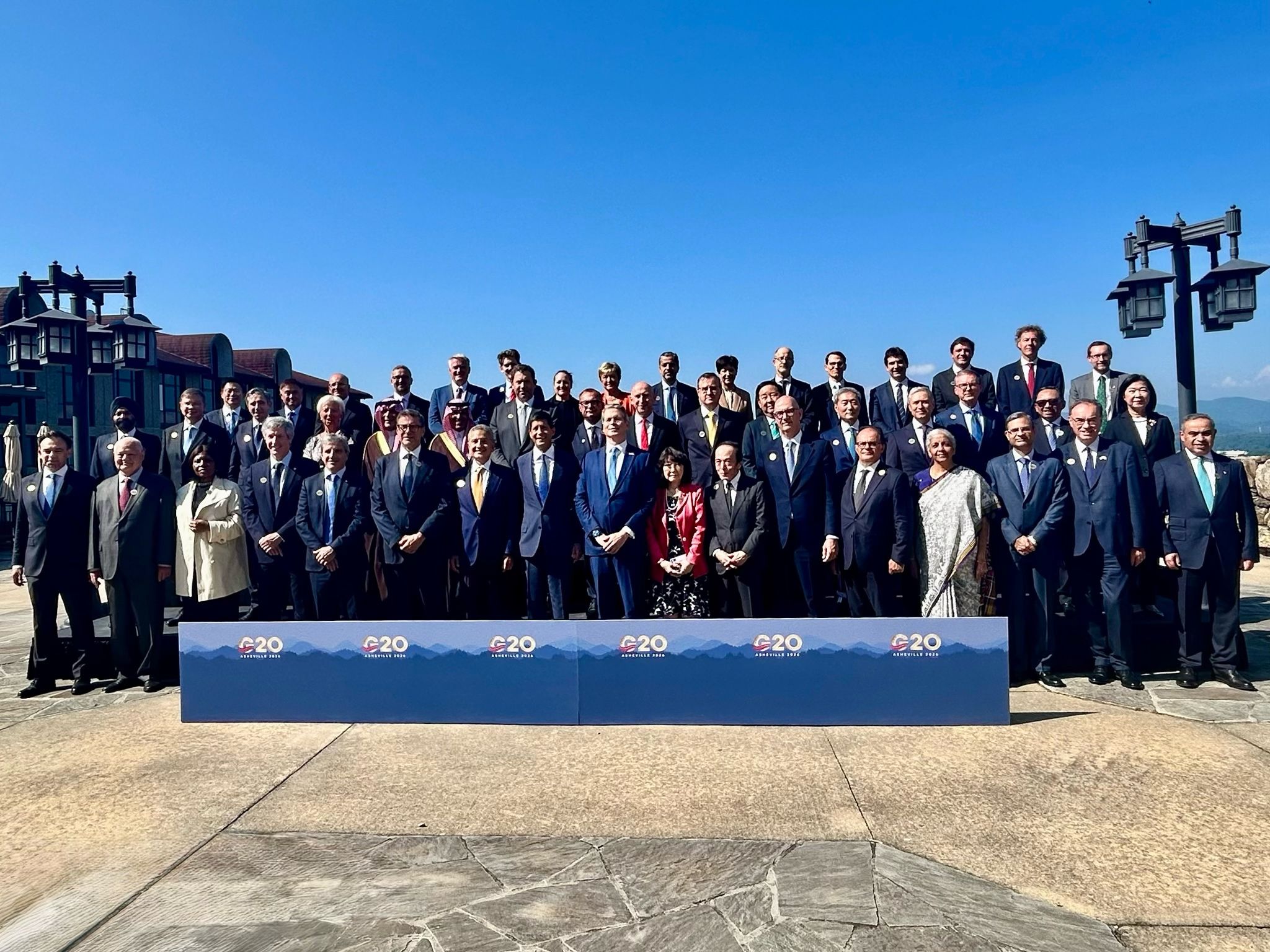
The G20 Finance Ministers meeting on the global economy, economic growth, and the challenges facing economies around the world. Credit: Government of Canada.
The G20 climate finance gap
Simultaneously with Jackson Hole, G20 Finance Ministers met in Asheville, North Carolina, concluding September 1. The ministers concluded that the global economy has remained resilient in the face of multiple shocks, including ongoing wars and conflicts. Ensuring the efficient and smooth functioning of key value chains, such as energy, food, fertilizer, and critical minerals, is essential to supporting global growth. They cited concern about continued disruptions to energy trade and stress that the free, safe, and predictable navigation through the Strait of Hormuz and worldwide, and the resolution of ongoing wars and conflicts are essential to sustaining durable growth.
The US G20 presidency agenda prioritized digital assets, regulatory modernization, and pro-growth policies. Climate finance did not appear as a headline item. The meeting ended without a joint communique: China’s singular opposition created a 19-to-1 split, forcing the US to release a chair statement rather than a consensus declaration. For Canadian environmental industry observers, that split confirms that the multilateral climate finance architecture is not just stalled. It is actively fracturing.
Finance Minister François-Philippe Champagne and Bank of Canada Governor Tiff Macklem represented Canada at G20.
“Canada has what the world wants and increasingly needs, whether it’s critical minerals, conventional and clean energy, or the potash that helps feed the world,” said Minister Champagne. “Our plan has always been clear: strengthening our economy at home and expanding our trade relationships abroad. In Asheville, I met with partners from around the globe to deepen economic cooperation, advance shared priorities, and create new opportunities for Canadian businesses and workers. These discussions support the trade diversification Canadians are seeking and reinforce Canada’s role as a reliable partner in an increasingly uncertain global economy.”
The number to watch
September 15-16 is the Federal Open Market Committee (FOMC) meeting date. August employment and inflation data arrive the week before. If those readings come in elevated, including from tariff-driven price increases and energy market pressure, the probability of a rate hike rises and the financing environment for green infrastructure tightens further.
Canada’s environmental industry is caught between compounding pressures: inflation partly caused by fossil fuel shocks, a multilateral framework that has sidelined climate finance, and a Canada-US trade confrontation that is adding inflationary pressure. The investment case for green infrastructure has never been stronger on risk management grounds. The financing environment has rarely been more challenging. Making that case, loudly and in economic language, is the work of this moment.

Andrea Zanon is an Environment, Social and Governance (ESG) strategy and resiliency advisor who has advised ministers of finance and several global corporations on how to develop more resilient countries and societies.
🌱 Don’t miss updates from Environment Journal. Sign up for your free subscription here.
Featured image credits: Getty Images