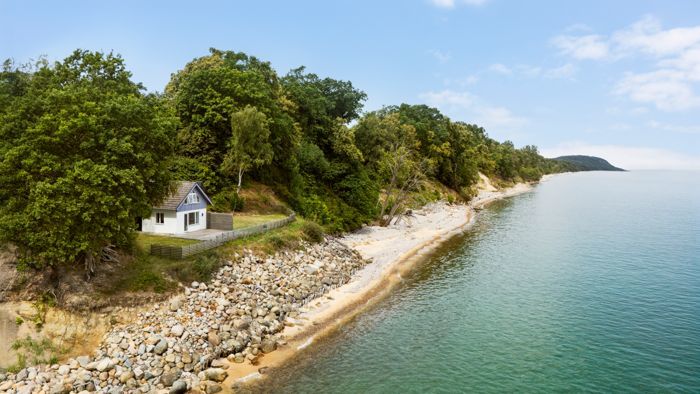
A free trip to Sweden sounds tempting enough. Add a private beachfront cabin, meals, outdoor activities, and travel expenses for two, and it starts sounding suspiciously generous.
There is, naturally, a catch.
Visit Skåne is inviting selected pairs to spend three nights in a secluded cabin on the eastern coast of Sweden’s southernmost region. During the stay, guests must keep the sound inside the cabin below 45 decibels, roughly the volume of a soft whisper.
A sound monitor will continuously measure the noise level. It will not record conversations or audio, but it will notice if you and your travel companion get a little too enthusiastic over dinner.
What happens if guests get too loud?
The official rules are slightly more forgiving than the campaign’s dramatic premise makes them sound.
A single sneeze or accidentally dropped coffee mug will not end the trip. If the sound remains above 45 decibels for an extended period, guests will first receive a reminder to lower the volume.
If the noise continues, the stay will end, and they will be asked to leave the following morning.
Guests are allowed to talk, although Visit Skåne suggests keeping conversations around the volume you would use in a library. Music, loud conversations, and other unnecessary noise are discouraged.
Phones and other digital devices must also be put away for the duration of the experience. An emergency phone will remain available, but scrolling quietly through TikTok apparently does not fit the spirit of the trip.

Eastern coastline of Skåne, southern Sweden, overlooking the Baltic Sea
What does the free trip include?
Selected applicants will receive three nights in a private cabin for two adults. Travel to and from Skåne, accommodations, selected meals, activities, and local transportation are included.
The cabin sits between apple orchards and the Baltic Sea. The planned itinerary includes electric biking, a guided nature-awareness walk through Stenshuvud National Park, an outdoor picnic, a hammock experience, and meals made with local ingredients.
There will also be time without scheduled activities, cameras, or interviews. Parts of the experience will be documented by Visit Skåne for marketing purposes, and participants must be comfortable completing short interviews in English before and after the stay.
The exact dates will be shared with the selected applicants, but the trips will take place between the end of September and early October 2026.
The quiet challenge has a more serious purpose
This is clearly a tourism campaign, not a scientific experiment. Still, the concern behind it is legitimate.
According to the European Environment Agency’s 2025 report, more than one in five Europeans are exposed to harmful levels of transportation noise. Road traffic is the largest source.
A 2025 systematic review and meta-analysis published in the Journal of Environmental Psychology also found that exposure to natural environments may support attention and working memory. The largest observed cognitive benefits occurred after about 30 minutes of exposure.
Visit Skåne has been leaning into quiet travel for several years. In 2024, it created a “Map of Quietude” featuring some of the region’s most peaceful natural places, complete with average decibel readings and hourlong recordings of each soundscape.
Sweden keeps finding unusual ways to tempt travelers
This is not the first Swedish tourism campaign to turn peace and solitude into a prize.
Earlier this year, Madison, Wisconsin, resident Eric Holmer and his family were selected for Visit Sweden’s “Your Swedish Island” initiative. Holmer was the only American among five winners chosen from more than 2,200 entries representing 100 countries.
His family received a one-year right to use Skötbådan, a tiny granite outpost in the Stockholm Archipelago. They did not technically win ownership of the island, but becoming its official custodians was still a fairly wild prize. I wrote about the Wisconsin family’s win when it was announced.
The emphasis on nature and slowing down also tracks with what I experienced in Småland as part of “The Swedish Prescription.” The Visit Sweden initiative presented time in nature, cultural experiences, and traditional Swedish practices as ways to support physical and mental well-being.
I got to try my own version of the Swedish Prescription, and I loved this campaign. Sweden is very good at making time outside feel like part of everyday life, which is probably why the whole “doctor-prescribed travel” idea works there.
The Stay Quiet challenge pushes that idea quite a bit further. Spending three days beside the Baltic Sea without phones sounds restorative. Keeping two people below 45 decibels the entire time sounds like the part that could get interesting.
How to apply for the free stay
Applications are open internationally, but participants must apply in pairs. Both travelers must be at least 18, comfortable speaking English, and capable of light hiking and biking.
Children and pets cannot join the trip.
To enter, applicants must send a short video through Instagram to @visit_skane. The video should explain who the applicants are, where they live, and why they need the Stay Quiet challenge.
Applications close Sept. 6 at 8 p.m. Central European Summer Time. That is 1 p.m. Central Time in the United States.
Complete eligibility requirements and application instructions are available on the official Stay Quiet website.