
Seoul plans to merge major energy and port agencies and split LH, but debt, regional opposition and shareholder concerns could delay the process.
Prime Minister Han Seong-sook, center, announces a plan to consolidate 109 public institutions during a briefing at the Government Complex Seoul in Jongno District, central Seoul, on Sept. 3.
YONHAP
The government plans to reduce the number of public institutions by 109, or about 20 percent, in a sweeping overhaul of mergers and splits. However, regional opposition and debt-related complications could stand in the way.
Five power generation subsidiaries of Korea Electric Power Corporation will be consolidated into a single company, while Korea National Oil Corporation (KNOC) and Korea Gas Corporation (Kogas) will be merged.
The restructuring plan was announced Thursday following a meeting of the Public Institutions Management Committee.
The number of public institutions has grown from 298 in 2007, when the Act on the Management of Public Institutions took effect, to 342 this year. Their combined debt stood at 769 trillion won ($566.6 billion) at the end of 2025.
“There are so many public institutions that I can’t even keep count,” President Lee Jae Myung said in August last year, calling for sweeping consolidation.
The restructuring will proceed along three tracks: reforming 15 major public institutions, consolidating 11 institutions with similar or overlapping functions and integrating 83 subsidiaries and smaller institutions.
“We will reduce the number of public institutions by 109, the largest reduction ever,” said Prime Minister Han Seong-sook. “For institutions that do not require legal amendments or other measures [to restructure], we will begin implementation immediately.”
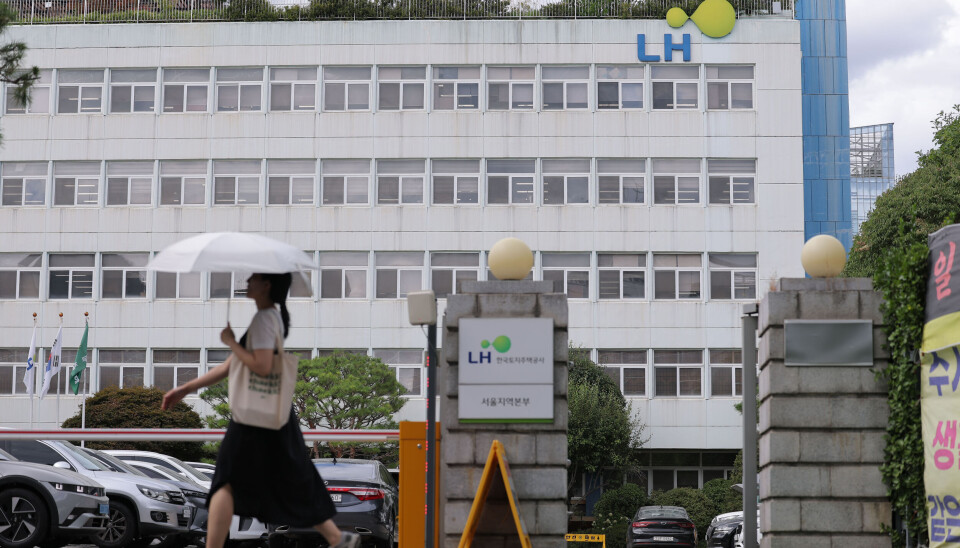
The Korea Land & Housing Corporation’s Seoul office in Gangnam District, southern Seoul, on Aug. 13.
YONHAP
Major institutions face mergers, split
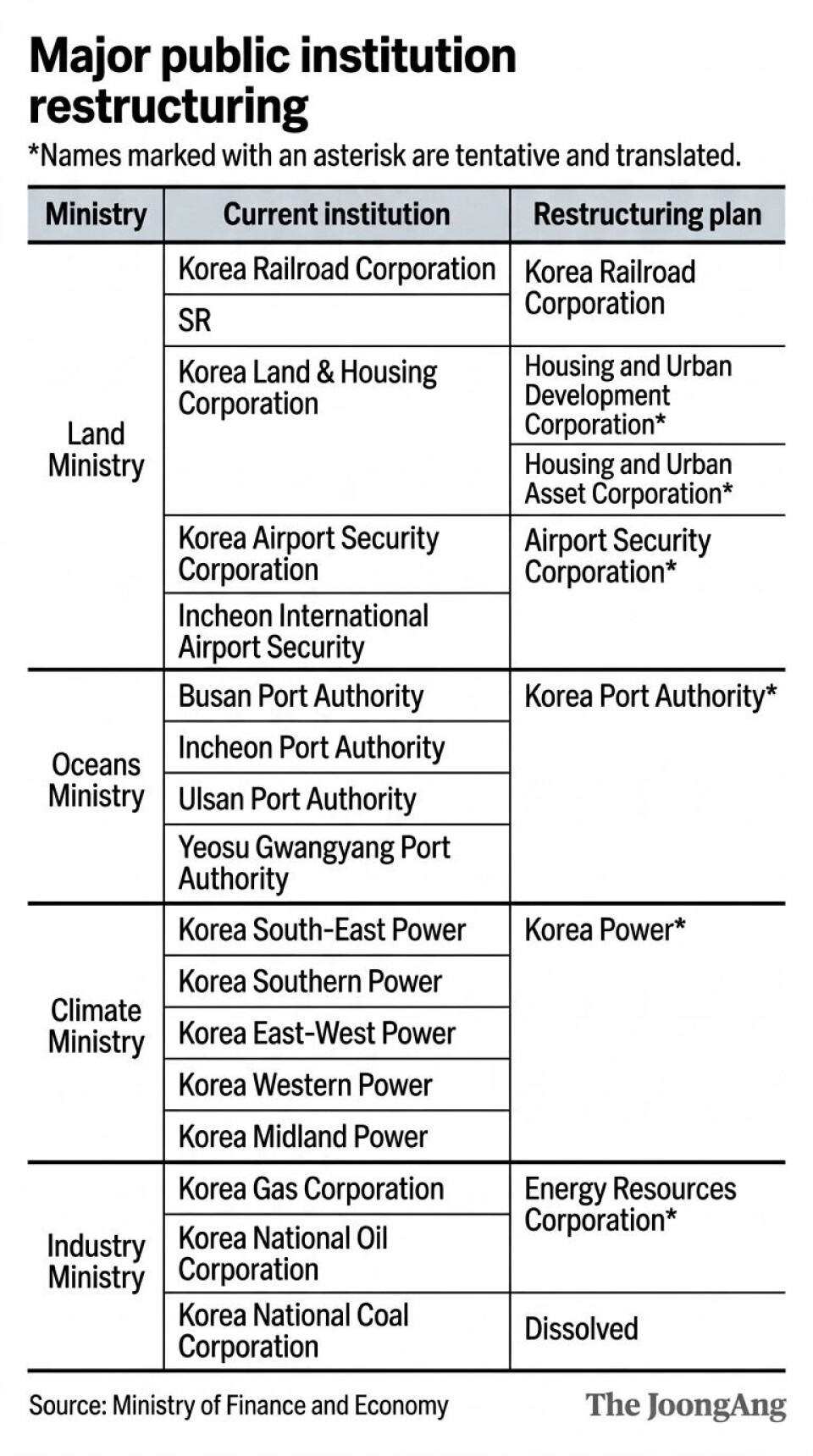
While most of the restructuring involves mergers, Korea Land & Housing Corporation (LH) is the only institution slated to be split. LH, which carries more than 170 trillion won in debt, will be broken down into two state-run companies.
A tentatively named Housing and Urban Development Corporation will tackle land development and housing construction. The Housing and Urban Asset Corporation, also a tentative name, will oversee housing welfare and asset reserves.
A portion of the development corporation’s profits will be placed in a separate account under the National Housing and Urban Fund and used to finance the asset corporation’s housing welfare programs.
KNOC and Kogas will be merged into a tentatively named Energy Resources Corporation.
The government plans to bring together their oil and gas exploration, development and resource acquisition operations to strengthen bargaining power against multinational energy companies. The move also reflects the overlap between the two companies’ businesses, as oil and gas are often discovered and produced from the same fields.
Japan similarly provides integrated support for oil and gas development and the acquisition of metal and mineral resources through the Japan Organization for Metals and Energy Security.
Korea National Coal Corporation will be dissolved after closing all its mines. Its debt stood at 2.59 trillion won at the end of last year. It also incurs more than 75 billion won in annual interest expenses despite no longer operating any mines and handling only remaining administrative work.
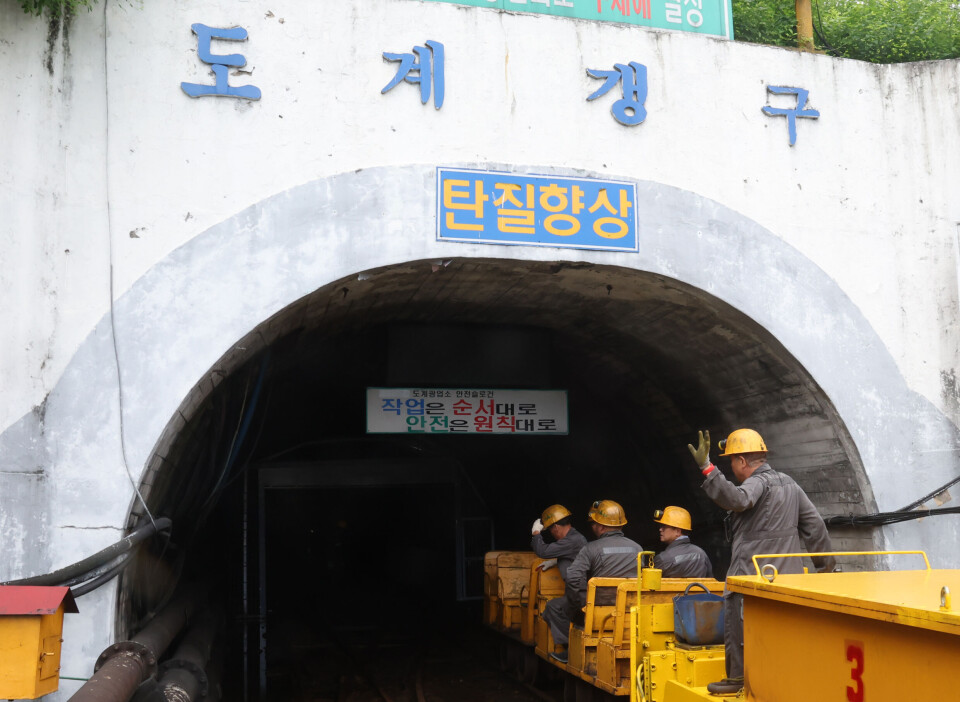
Miners prepare to enter Dogye Mine in Samcheok, Gangwon, on June 27, 2025, ahead of the mine’s closure. Dogye Mine was the last operating mine run by Korea National Coal Corporation.
YONHAP
The five power generation companies created in 2001 to introduce competition into the electricity industry — Korea South-East Power, Korea Southern Power, Korea East-West Power, Korea Western Power and Korea Midland Power — will be merged into a single company after 25 years. The new institution will be tentatively named Korea Power.
The government plans to consolidate fuel purchases and maintenance materials, research and development and renewable energy investment to achieve economies of scale.
The port authorities of Busan, Incheon, Ulsan and Yeosu-Gwangyang will also be merged into a tentatively named Korea Port Authority. Policy and planning functions will be centralized, while the four port authorities will be converted into regional branches.
A proposed merger of the Incheon International Airport Corporation and the Korea Airports Corporation has been put on hold. The government will first establish an airport strategy council to pursue measures to revitalize regional airports before reconsidering the merger.
Institutions and smaller subsidiaries with similar functions in areas including broadcasting and media, employment and labor education, advanced medical care and small-business distribution will also be consolidated by function.
Debt, headquarters pose hurdles
The mergers and consolidations, however, face a number of hurdles before they can be carried out. The locations of the headquarters for the newly merged public corporations are a key issue of discussion.
The five power generators currently have their headquarters in Jinju in South Gyeongsang, Boryeong and Taean in South Chungcheong, Busan and Ulsan. Their current host cities are expected to oppose any relocation because losing a headquarters could reduce local tax revenue and the resident population.
“The matter is under discussion,” Second Vice Finance Minister Huh Chang said of the headquarters issue.
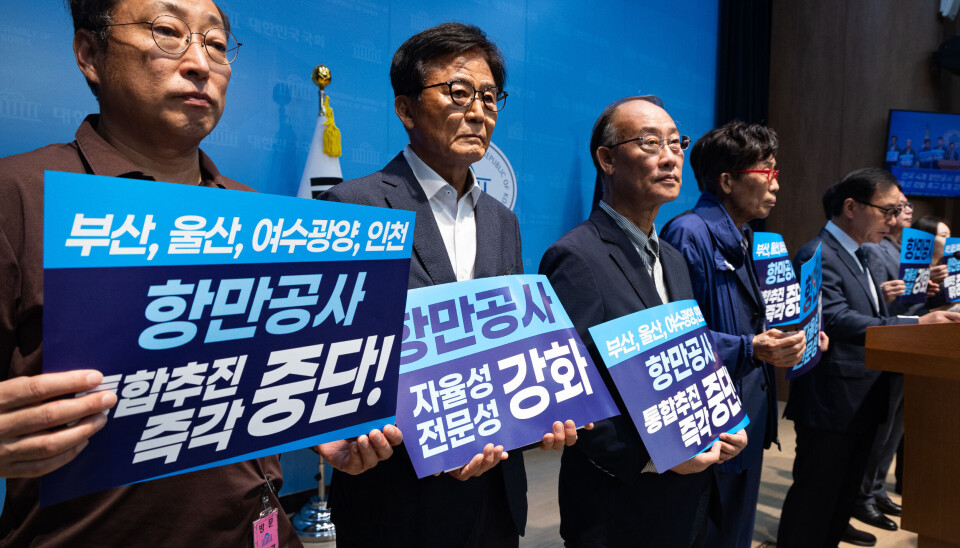
Civic group members hold signs at a press conference in Seoul calling for the planned merger of four regional port authorities to be halted at the National Assembly in Yeungdeungpo District, western Seoul, on July 20.
NEWS1
North Jeolla and the integrated Gwangju-South Jeolla special city have also entered the race to host the headquarters of the merged power company, citing links with their renewable energy industries.
“The five power generators are companies that have a significant impact on tax revenue in the regions where they are based,” said Yoo Seung-hoon, a professor in the Department of Future Energy Convergence at Seoul National University of Science and Technology. “If their headquarters are relocated to another region during the merger, the resulting loss of tax revenue will inevitably lead to considerable opposition from their current host communities.”
Another challenge is how to handle existing debt. LH’s debt reached 173.7 trillion won at the end of 2025, up 13.6 trillion won from a year earlier. Its debt ratio stood at 230.8 percent.
The government’s announcement, however, did not specify how LH’s existing assets and liabilities would be divided between the two new corporations. LH’s housing welfare business alone posted an operating loss of 3.19 trillion won from rental housing last year.
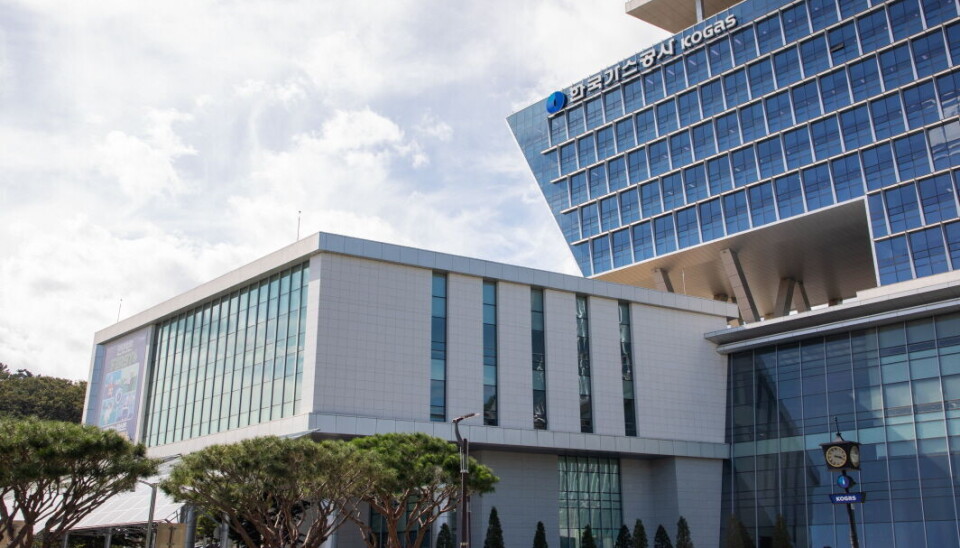
The Korea Gas Corporation’s headquarters in Dong District, Daegu.
KOREA GAS CORPORATION
Beyond governance concerns, the proposed KNOC-Kogas merger faces a serious financial hurdle: KNOC finished last year in complete capital impairment, with total equity falling to negative 2.53 trillion won. Kogas’ financial position has been improving, but its debt still exceeds 42 trillion won.
Kogas’ status as a publicly listed company adds another complication. Private shareholders hold a 45 percent stake in the company and could oppose the deal depending on how the merger is structured.
The government is considering separating KNOC’s distressed assets and debt into a separate subsidiary. Opposition from labor unions could also pose a challenge during the merger process.
BY AHN HYO-SEONG [lee.taehee2@joongang.co.kr]
This article was originally written in Korean and translated by a bilingual reporter with the help of generative AI tools. It was then edited by a native English-speaking editor. All AI-assisted translations are reviewed and refined by our newsroom.