
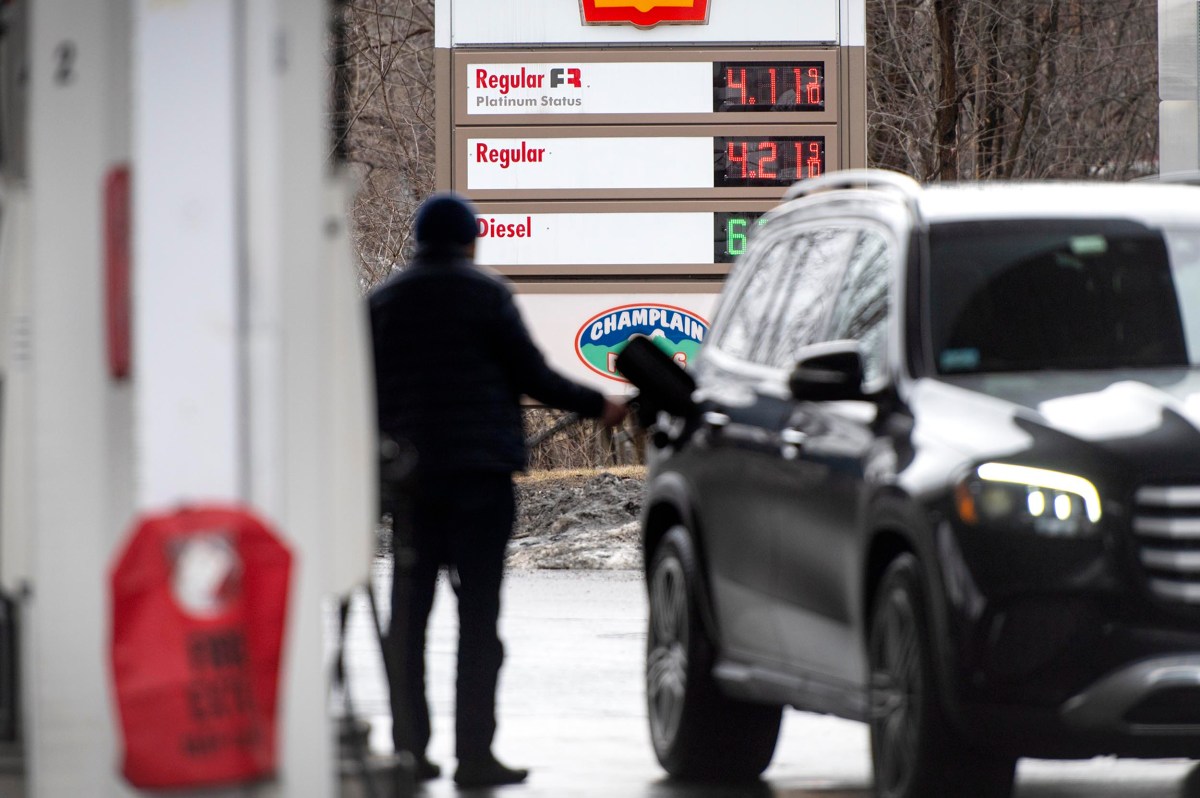
 A motorist pumps gas in Montpelier in April 2026. File photo by Glenn Russell/VTDigger
Gas prices have hit an average of $4.29 per gallon in Vermont, putting the state on track to have a record-breaking Labor Day weekend for gas prices, according to data from the American Automobile Association.
“We need to lower that price as best we can and save as much as we can,” said Suzanne Grace, a spokesperson for AAA Northern New England.
After a slight lull in higher gas prices in June and early July, the cost of a regular-grade gallon of gasoline in Vermont has surged back upward. At a national level, this August hit a record for the most expensive fuel prices since at least 2000, when AAA began tracking the data.
Yet the key culprit is a conflict distant from the Green Mountain State — the U.S.-Iran war and the blockade of the Strait of Hormuz have caused the price of a barrel of crude oil to soar to over $90, according to the U.S. Energy Information Administration. About half the cost of regular gasoline at the pump comes directly from the cost of crude oil, the agency said.
Vermont’s highest-ever price for a gallon was in June 2022, when the price briefly topped $5 per gallon, which was likely tied to the invasion of Ukraine, Grace said, showing just how much international affairs can shape the cost of everyday life.
There’s also a “double whammy” this summer due to seasonal requirements for a blend of gasoline that reduces smog, which is more expensive to produce, she said.
“We always see a slight increase in the summertime, anyways,” she said. “But this year, because of the crude oil price, we saw that secondary impact of higher gas prices.”
Vermont has higher gas prices than the rest of the nation on average, AAA said. Grace pinpointed two potential causes: the state’s rurality and relative scarcity of stations, and the gas tax.
“In areas where gas stations are more spread out, less competition means they can price them a little higher,” she said. And, “the further we are from the refineries, the more transportation costs are involved with transporting that fuel to those remote areas.”
But Vermont also has a higher gas tax, at 35 cents per gallon, than its rural neighbors of Maine and New Hampshire, which may be part of the reason gas is more expensive here than in those two states.
Grace said that the good news for businesses that depend on Labor Day travelers is that while “people certainly pay close attention to” gas prices, “they also have usually made their vacation plans months and even a year in advance.”
“They tend to adjust their budget on other discretionary spending, such as eating out, going to restaurants, shopping — ways that they can cut back, but they don’t typically cut back on their travel,” she said.
Brian Maggiotto, executive director of the Vermont Lodging Association, said Vermont tends to be a destination for car-based travelers, making it potentially more sensitive to the cost of a road trip. Top sources for Vermont vacationers include New York, Massachusetts and Vermont itself, according to the Vermont Department of Tourism and Marketing.
But the state might end up benefitting from the sky-high cost of airplane tickets, as people opt for a vacation closer to home, Maggiotto said.
It’s hard to tease the impact of the summer-long gas surge from other factors affecting tourism, like the decline in Canadian visitors due to the souring of U.S.-Canadian relations. Data through June of this year shows that Canadian credit card spending is higher this year than in 2025, but lower than 2023 or 2024, according to the tourism department.
Beyond travel and tourism, what research shows is that gas prices tend to affect lower-income Americans more, since it’s one of the least discretionary parts of their budgets, according to Stanford economists.
“Oftentimes, especially in Vermont, there’s not a lot of public transportation or rideshare options, so they have to commute to work, into school, into doctor’s appointments,” Grace said.
Lower-income households cut back their gas spending more than higher-income households in early 2026, yet still spent a higher percentage of their income on gas, according to a report from the Federal Reserve Bank of New York.
“What they’ve found (people) do is that they consolidate their trips, so that while they’re out at an appointment, they might do their grocery shopping or try to do a few errands at the same time to limit the number of times they need to be out on the road,” Grace said.
The more gas prices rise, the more people will likely be affected. Grace said that one AAA survey found that at $4 per gallon, about half of respondents said they’d make changes to their lifestyle to save gas. At $5 per gallon, three-quarters of respondents said they’d adjust their lifestyle to offset that spike at the pump.
She shared a few tried-and-true tips for lowering gas mileage: Check your car’s tire pressure, avoid higher speeds and turn your car off instead of idling.
“Every little bit helps,” she said.