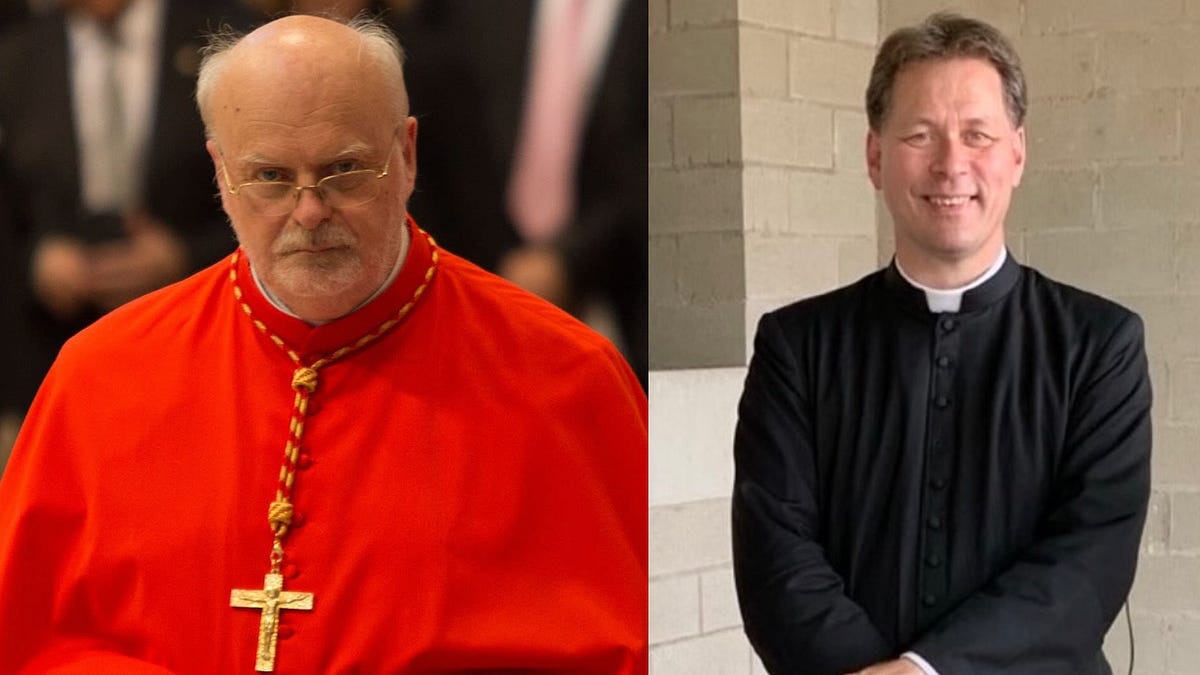
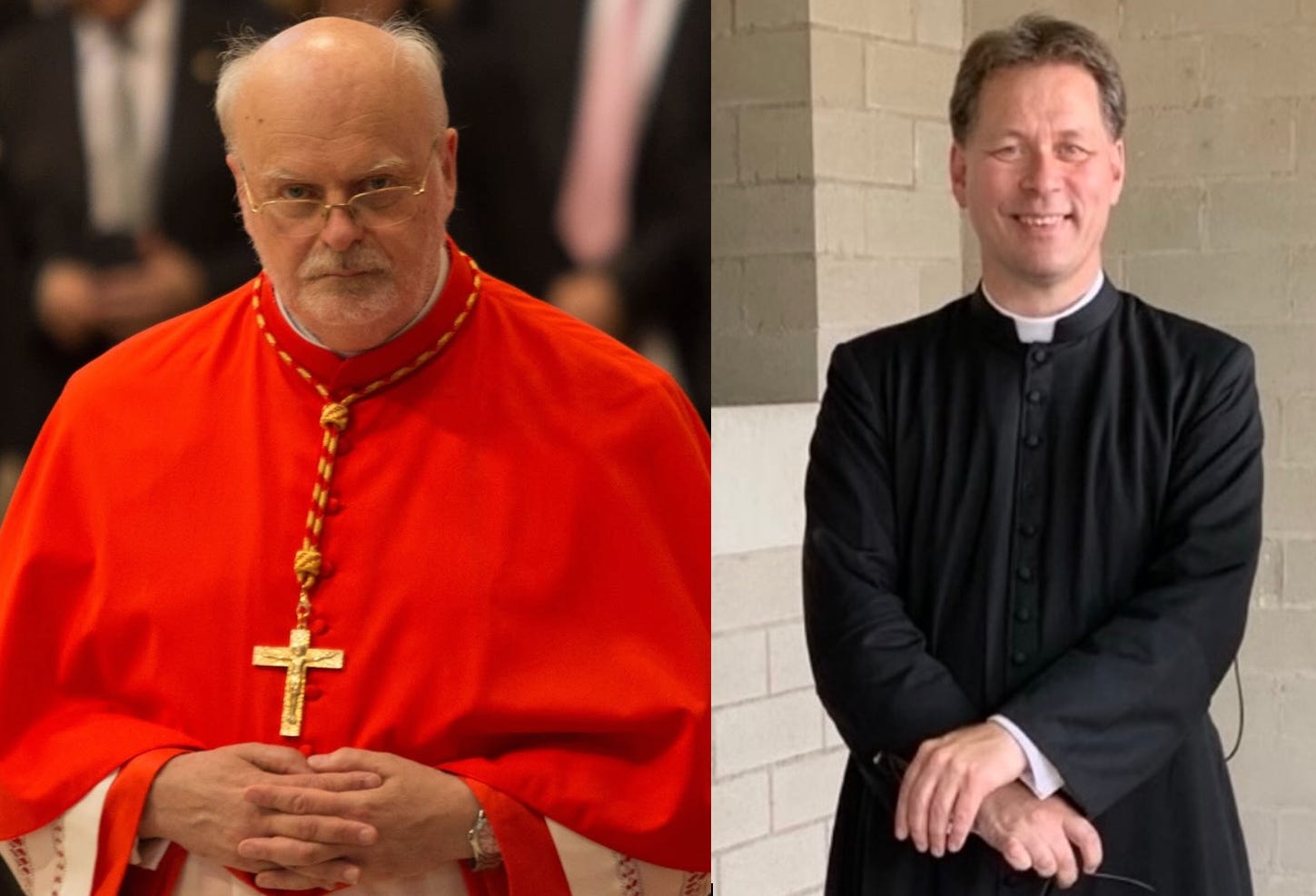
ROME, 4 September 2026 — What happens when a ruling from Rome reaches a diocesan chancery declaring that its suspension of a priest was “invalid,” and chancery officials choose not to tell its clergy and faithful what Rome has decided?
In Sweden’s only Catholic diocese, officials have acknowledged in writing that they do not intend to announce that the Vatican’s Dicastery for Clergy found the 2024 suspension of Father Tobias Unnerstål, a Gothenburg parish priest, “invalid” — until a further, potentially lengthy canonical process has been resolved. Nor does the diocese intend, until then, to inform its clergy and faithful that the priest, according to the Vatican’s decree, may administer certain sacraments and publicly celebrate Mass with the local Ordinary, Cardinal Anders Arborelius.
New evidence has emerged showing that, to date, the diocese has also failed to comply with the decree’s requirement that it provide for the priest’s livelihood.
A June 2026 investigative report titled “Something Is Rotten in the Church in Sweden” first detailed his case. He was interrogated by the Vicar General, Fr. Pascal-René Lung, in April 2021 over a single complaint — not sexual in nature — filed by Joseph Rizk, then a seminarian who is now a priest of the diocese. Fr. Unnerstål was never shown the complaint. A former parish assistant later wrote that she had spent years shaping Rizk’s view of the relationship and that she also felt she had to stop a project Fr. Unnerstål was establishing. He was removed without warning as parish priest of Christ the King Church in January 2022 and suspended by Cardinal Arborelius in November 2024.
Although the diocese did not name Fr. Unnerstål in its Nov. 11 suspension announcement — issued by the Vicar General — or in subsequent postings, the announcement referred to an unnamed priest who had, since 2022, been “relieved of his ordinary pastoral duties” — the same language the diocese had used on Oct. 19, 2022, when it announced that “Fr. Tobias Unnerstål was relieved of his ordinary pastoral duties in the Catholic Diocese of Stockholm on Oct. 1, 2022.”
In a decree dated May 5, 2026, the Vatican’s Dicastery for Clergy found the suspension procedurally defective and ruled it “invalid.” The decree nevertheless imposed restrictions on Fr. Unnerstål’s ministry for three years, citing undisclosed “documentation at hand,” including concerns raised by Cardinal Arborelius about the priest’s “behavior with men.” To date, that documentation has not been disclosed to Fr. Unnerstål. The restrictions thus rest on material he has never seen and therefore cannot meaningfully challenge — the same fundamental procedural problem that has marked his case from the outset.
The decree specified, however, that he may publicly celebrate Mass when concelebrating with the Cardinal; administer sacraments that do not require the faculties from the local Ordinary, including baptism, marriage, and the anointing of the sick; and ordered the diocese to provide financially for his livelihood.
Nearly four months after the Dicastery’s ruling, the diocese has communicated none of this to its clergy and faithful. Its website would lead them to the opposite conclusion.
A written exchange with the diocese makes clear that this silence is not an oversight. It is deliberate.
On Thursday, Aug. 27, this journalist sent five written questions to Kristina Hellner, communications officer for the Diocese of Stockholm, copying Msgr. Jorge de Salas, Episcopal Vicar for Juridical Affairs, and Fr. Lung, the Vicar General. Both officials have played roles in Fr. Unnerstål’s case. As reported in June, Fr. Lung has been a central figure from the outset: he interrogated Fr. Unnerstål about the allegations in 2021, in the Cardinal’s absence, without showing him the complaint, participated in key meetings with the Cardinal concerning his status, and issued the announcement of his suspension. The June reporting also established that Msgr. de Salas had already confirmed by phone the substance of the Dicastery’s ruling. Fr. Unnerstål was “not suspended, strictly,” Msgr. de Salas said, “but he’s not in good standing.”Given their roles in the case and the canonical issues involved, both officials would ordinarily be among those consulted on the diocese’s response.
The first two questions were narrow: Why had the diocese not informed its clergy and faithful that the Dicastery had ruled the suspension invalid? And why had it not informed them that Fr. Unnerstål may administer certain sacraments?
Hellner replied by the requested deadline. The diocese, she said, had “waited until the decree had become final and legally effective.” She confirmed that Fr. Unnerstål had filed a recourse with the Apostolic Signatura, adding that the diocese “believe[s] it’s appropriate to respect the canonical process and allow the competent ecclesiastical authorities to complete their consideration of the matter.” Once that process concluded, she said, “we will communicate the outcome accordingly.” A source close to the Apostolic Signatura confirmed that the process could take up to two years.
Pressed on whether the diocese considered the Dicastery’s decree to have legal force in the meantime, Hellner clarified: “We didn’t want to publish the decree before we were certain that there would not be an appeal (= final and legally effective).”
This journalist replied that the question was not why the diocese had failed to publish the decree, but why it had failed to communicate two specific facts: that Fr. Unnerstål’s suspension had been ruled invalid and that he may administer certain sacraments. It was pointed out that neither of these points was under appeal.
The decree itself, moreover, states that it took effect on the date of its issuance — May 5, 2026. “Does the Cardinal not have a responsibility to communicate this information to the clergy and faithful, both for their sake and in justice to the priest in question?” this journalist asked. To withhold it, this journalist continued, was effectively to continue treating Fr. Unnerstål as a suspended priest.
Hellner responded: “Our position is that we considered it more appropriate to wait until the appeal period had expired before communicating the decree or any selected part of it.” Because the diocese had “not seen the appeal submitted to the Apostolic Signatura,” she added, it did “not know which parts of the decree are or are not the subject of the appeal.” It therefore did “not consider it appropriate to make separate statements regarding individual aspects of the decree while the canonical process is ongoing.”
Hellner subsequently confirmed that the diocese itself had filed no appeal or recourse against the decree, “either to the Apostolic Signatura or to the Dicastery for the Clergy.” Fr. Unnerstål is therefore the only party to have filed recourse against the decree.
This journalist also asked about the Dicastery’s order that the diocese provide Fr. Unnerstål with an adequate livelihood, at a level equivalent to that of a retired priest, and noted that, to date, he appeared to have received nothing. Hellner declined to address the substance of the question: “Our policy is not to comment on financial support to individual priests.”
The diocese’s position raises a significant question. Recourse to the Apostolic Signatura, the Catholic Church’s highest court, exists to challenge decisions or provisions a party considers unfavorable. It would be a striking proposition to suggest that Fr. Unnerstål is contesting the findings that his suspension was invalid, that he may administer certain sacraments, or that the diocese must provide for his livelihood. The diocese’s professed uncertainty about “which parts” of the decree Fr. Unnerstål is contesting therefore rests on the possibility that he is challenging the very provisions that favor him.
Moreover, new evidence calls the diocese’s professed uncertainty into question. According to a Sept. 3 letter from Fr. Unnerstål to friends and benefactors, obtained by this journalist, he met with Cardinal Arborelius about the decree at the end of May. The Cardinal, he writes, told him he would pray for guidance and get back to him — but never did. On July 31, Fr. Unnerstål informed the Cardinal directly that he had filed recourse with the Apostolic Signatura and took the opportunity to “draw his attention” to the diocese’s non-compliance: no financial support had been provided, and the diocese had communicated neither that his suspension had been ruled invalid nor that he might administer certain sacraments — baptism, marriage, and the anointing of the sick — and concelebrate Mass publicly with the Cardinal.
Fr. Unnerstål writes:
“When no response or reaction came from the Cardinal, I was compelled to bring the matter to the attention of the Holy See. This was done by means of a ‘Non-Compliance with Decree Prot. N. 2026 0530,’ which was sent on 26 August by email, with a copy to the Cardinal and the Nuncio. I later also sent the original to Rome. The [Dicastery for] Clergy has confirmed that they received it on 28 August.”
In the letter, he also notes that he has not heard anything from the diocese since July 2025.
The Cardinal had therefore been informed by the priest himself of “which parts” were and were not part of the appeal — a month before this journalist’s Aug. 27-30 email exchange with Hellner and two days before Rome formally logged his complaint of non-compliance.
On Sept. 1, this journalist put the exchange with the diocese to Fr. Gerald Murray, a canon lawyer and priest of the Archdiocese of New York. Asked whether, in his view, the diocese is obliged to communicate to its clergy and faithful that Fr. Unnerstål’s suspension is ruled invalid, and that he may administer certain sacraments, Fr. Murray noted that “while the diocese did not identify Fr. Tobias Unnerstål as the priest who was suspended when it publicized the suspension, it became common public knowledge” that he was in fact that priest.
Citing Canon 220 of the Code of Canon Law, which states: “No one is permitted to harm illegitimately the good reputation which a person possesses nor to injure the right of any person to protect his or her own privacy,” Fr. Murray argued that since Fr. Unnerstål is widely known to have incurred suspension, “it is a matter of justice” for the Diocese of Stockholm to make known that he is no longer under suspension, “thus ensuring that his good reputation is not harmed from this point on by any further even indirect wrongful identification of him by the diocese as a suspended priest.”
Asked whether the diocese is also obliged, from the date the decree took effect, to provide financially for Fr. Unnerstål’s adequate livelihood, Fr. Murray said plainly: “I would argue that the obligation to provide financially for Fr. Unnerstål is retroactive to the date of his suspension, if he was in fact not financially supported from that date onward.”
In the initial email to the diocese, this journalist included a direct link to the report, “Something Is Rotten in the Church in Sweden,” and asked whether the diocese wished to comment on its contents. Across the full exchange, the diocese did not contest the report: it did not deny a single claim, correct a single detail, or offer any competing account.
The final question concerned a matter raised in that report, namely the conduct and standing of Fr. Pär-Anders Feltenheim, the priest Cardinal Arborelius appointed to succeed Fr. Unnerstål at Christ the King in 2022. As reported in June, complaints about Fr. Feltenheim’s conduct toward young people had accumulated over the course of his career, from his years as a political activist before ordination through successive parish assignments and his assignment to the Stockholm Cathedral. A formal investigation in 2013–14, led by Msgr. Jorge de Salas, resulted in his transfer to Stockholm Cathedral and an express prohibition on working with children and young people. Despite that prohibition, he subsequently became responsible for the Cathedral’s altar-server group, which included boys in their early teens.
In the same telephone conversation in which Msgr. de Salas confirmed to this journalist the substance of the Dicastery’s ruling on Fr. Unnerstål, saying he was “not suspended, strictly” but remained subject to restrictions, he also described Fr. Feltenheim as “a priest in good standing.”
Following that telephone conversation, sources within the diocese told this journalist that Fr. Feltenheim had been removed from his duties as parish priest of Christ the King over internet activity the diocese judged not criminal, but incompatible with his continuing in parish ministry. This was reported in the June 26 article.
Asked about Fr. Feltenheim’s status again in August, Hellner answered simply that she had “no further information other than that he is in good standing.”
As reported in June, the Stockholm Chancery’s handling of the cases of these two priests, as well as others, has led Swedish Catholics to call on Rome to investigate what they describe as corruption at the heart of the diocese. They describe a “power vacuum” opened by a lack of leadership that has allowed an “axis of power” to emerge in the Chancery — one, they allege, that has moved against those it perceives as disloyal or threatening while protecting those whom it favors.
Those calls come as Cardinal Anders Arborelius, 76, approaches retirement and the diocese awaits the appointment of his successor, which some sources expect as early as the end of this month. Much will depend on who succeeds him. The two-part report Swedish Catholics published online this year identified Fr. Lung, the vicar general, as part of the “axis of power” its authors described — an identification others have since confirmed to this journalist privately. He could be appointed permanent successor or serve as apostolic administrator until a new bishop is named. Sources argue that either arrangement could perpetuate the pattern.
A third article will examine two further cases within the diocese, and the climate of fear this pattern of governance has left in its wake, particularly among the clergy.
What happens when a decision from Rome reaches a diocesan chancery and rules that its suspension of a priest was “invalid,” and chancery officials choose not to tell their clergy and faithful what Rome has decided? In the Diocese of Stockholm, nearly four months later, the clergy and faithful have yet to be told. Whether that changes — and when — remains to be seen.
My Substack is sustained entirely by you, its readers. Your support doesn’t just keep it going — it makes possible the kind of reporting, analysis and independence that would be difficult to maintain otherwise. I’m deeply grateful to those who choose to become paid subscribers (below) or support this work by donating here: