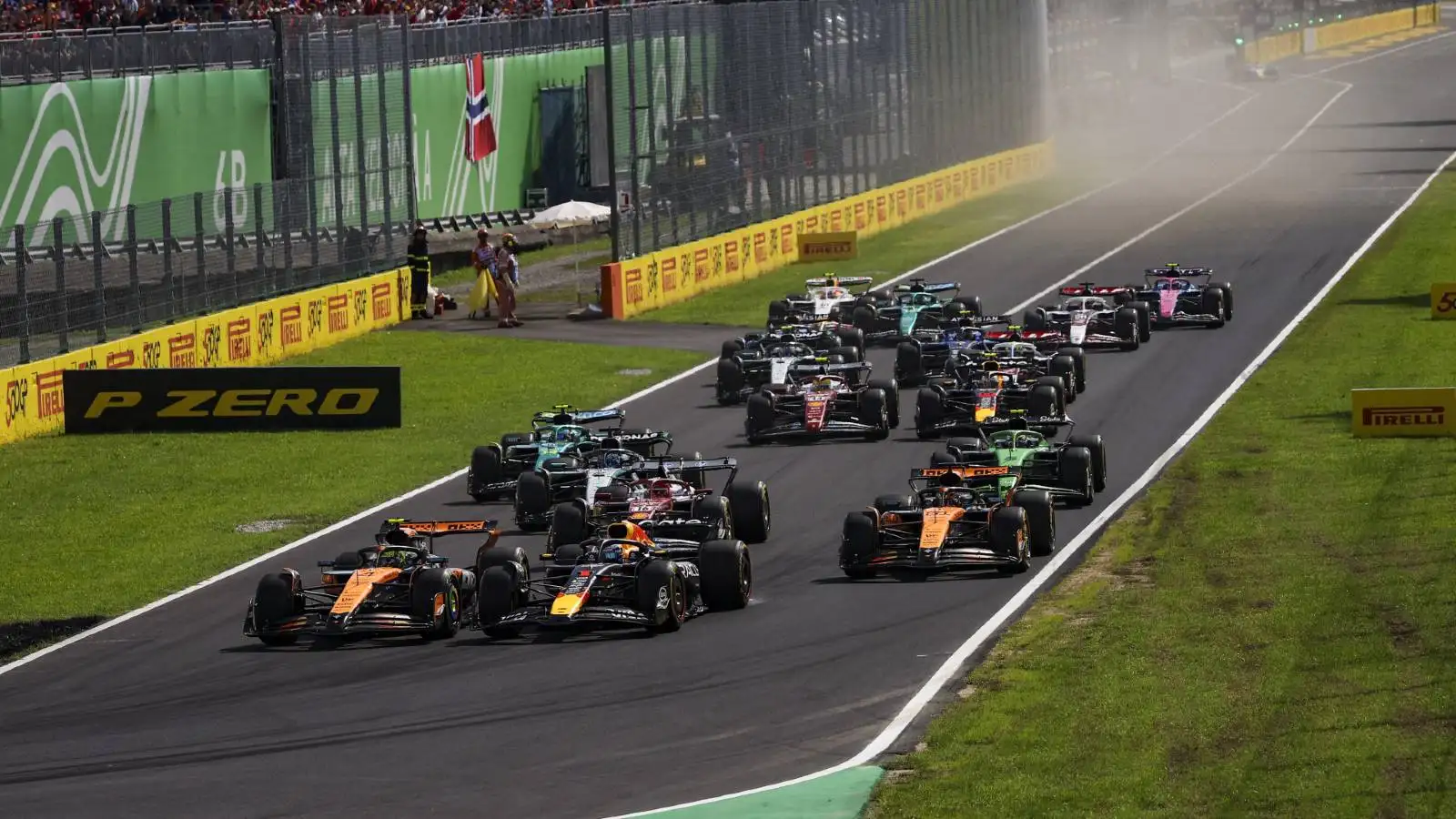
The usual blistering pace of a Monza weekend won’t be evident this year, with the new power unit regulations being at their most exposed around the Temple of Speed.
Monza usually sees some of the highest top speeds of the year, as the teams peel off the downforce and tear down the long straights of the historic Milan circuit, but the venue will host a different type of race weekend this season.
2026 Formula 1 power units create a new Monza challenge
The vagaries of this year’s energy-starved power units have been written about, copiously, since the start of this season, with some of the faster tracks, such as Suzuka, Silverstone, and Spa-Francorchamps highlighting the weaknesses of the new regulations.
But Monza has long been identified as perhaps the circuit upon which the 2026 vintage will be most exposed, thanks to the characteristics of the layout: the long blasts through Milan parkland, interspersed only by a handful of braking ones, offer the drivers almost no chance to harvest any energy and, as a result, the electrical output of the batteries is depleted early in the lap.
Without any battery power, the cars coast along using only the internal combustion engine [ICE], effectively halving the car’s total power; depending on the power unit, this is somewhere in the 400-450 horsepower range.
Contrast that with previous engine regulations, such as the 1000 horsepower V6s of the last cycle, and it’s clear why the F1 drivers are not salivating over the thoughts of a far less challenging and edgy Monza, where they danced their low-downforce rockets around on the knife-edge of considerably reduced adhesion.
Of course, the realities of the real-world experience is yet to be revealed but, on Thursday, those who had tried out Monza in their team’s simulators spoke about what is set to play out.
“There’s just not much battery, so we don’t actually go slower on the straights. We don’t use any. It’s quite slow,” said Racing Bulls’ Arvid Lindblad, one of those to offer some detailed insight into what he encountered in what he dubbed one of his most “confusing” sim sessions so far.
The rookie had initially said he didn’t want to talk too much about the regulations before trying out the real deal but, clearly enthused by the topic, offered assembled media, including PlanetF1.com, his thoughts on what he’d encountered.
“It is a bit sad, and we’ll see what it’s like on track. But, the way I had to drive on the sim, there’s things that we’ve already done a little bit which have been a little bit unnatural, but you’ve kind of got away with it,” he said.
“Whereas, here, it’s extreme, and it’s not Monza. There’ll be no 350 [km/h]. So, if you have any bets on breaking any speed trap records, don’t, because it’s not very fast.
With the FIA confirming reduced harvesting limits of 5.0mJ for qualifying, and 7.0mJ for the race (7.5mJ for overtake mode), this reduces the impetus on the drivers to concentrate on harvesting, as was the case early in the year, in favour of more natural driving, at the cost of outright performance.
Given the limited battery power, the slipstreaming effect will be more pertinent than ever – not only will there be the aerodynamic benefit, but also offers the drivers the chance to save some vital battery energy as less will be used to build and maintain velocity down the straights.
This does have some element of risk, given that drivers latching on to slipstreams could find themselves entering deployment and harvesting modes at different times, which could create rapidly changing speed deltas.
But the small amounts of energy available will reduce this risk, as Lindblad smiled in explanation.
“I don’t think there’s going to be much speed delta because no one’s going to have any power,” he said.
” It’s not like on other tracks where you have power, so then it depends where you spend it. We just have no power.
“I think the difference at Spa was that you had two big straights, but you had lots of corners in between that you could charge up and then deploy everything.
“Unfortunately, here, you’ve basically got two long straights back to back, but even between them, it’s not really any corners.
“In theory, it’s almost four long straights, somewhat back to back. So there’s just no energy. There’s just no power. You don’t have an ability to charge, so it’s just slow.”
Unfortunately, given the constraints of the power unit architecture and physics, there is no way to compensate for the energy deficiency at a circuit such as Monza – not without changing the circuit itself.
“At a circuit like this, you’ve got a problem no matter which direction you go,” Oscar Piastri said.
“If the harvest limit was higher, we would be super clipping everywhere, and probably losing 30 or 40 km/h at the end of each straight.
“But they’ve dropped the harvest, which means the super clipping is a normal-ish amount, a reasonable amount.
“It’s still there, but obviously you then don’t have as much energy to spend on the straights, so the actual top speed is quite low.”
Indeed, despite the vastly different layouts, F1 2026 might now see lower top speeds at Monza than at the traditionally high-downforce, tight and twisty Hungaroring – thanks to the Budapest venue allowing the drivers to harvest energy almost at will.
“In our sim running, I think we were actually quicker on the front straight in Hungary than we were here, which doesn’t make a whole lot of sense, but it’s more we just don’t have the energy to spend,” the Australian said.
“But again, if you gave us the energy to spend, we then don’t have anywhere to harvest this – you run into a problem no matter which way you go. And for me, I think this is the the correct direction to go in.”
With top speeds neutered at the Temple of Speed, Aston Martin team boss Mike Krack admitted that one of the main questions facing teams ahead of the weekend that of just where to deploy the limited battery power around the lap in order to best optimise for lap time.
“I think Monza is a bit of a new game this year that we need to learn how to handle because, due to the large amount of straight mode, you also have the corner mode more,” he said.
“I think all the teams will have to learn that maybe what we know about Monza is not necessarily true anymore.”
While the approach to a single lap will be different, the effect on the on-track action could be very noticeable: expect ‘yo-yo racing’ to be the name of the game on Sunday as the drivers deploy energy at different points around the track.
It’s impossible for the drivers to be able to hold onto enough energy to defend down the straights into the four main braking points, meaning a driver using their energy in the first sector to pass an opponent will struggle to keep position in the second and third sector, meaning there is likely to be quite a bit of passing and repassing in straight lines – think of it more as motorway driving, as opposed to actual battle.
Purist racing it certainly isn’t, but battles are likely to be protracted, if superficial: Piastri’s perspective on it is that it will be “extraordinary, chaotic, or exciting – whatever perspective you want to put on it”.
However, there’s not much point in condemning the regulations too much, given a timeline for their demise has already been outlined, even if four years of this banality is still too long.
“It’s pretty painful,” Max Verstappen said of what the racing spectacle is likely to be like at Monza this season.
“Yeah, just very energy inefficient. But I also don’t want to be too negative about it all. It is what it is. I accepted it mentally.”
For the next few years, until these abominable power units are rightfully abandoned, the Temple of Speed is set to be anything but, for F1 at least, and it’s time for a new marketing slogan. The Synagogue of Superclipping? The Asthmatic Arena? The Enclave of Entropy?
Want to be the first to know exclusive information from the F1 paddock? Join our broadcast channel on WhatsApp to get the scoop on the latest developments from our team of accredited journalists.
You can also subscribe to the PlanetF1 YouTube channel for exclusive features, hear from our paddock journalists with stories from the heart of Formula 1 and much more!
Read Next: FIA makes key Monza decision for Italian Grand Prix