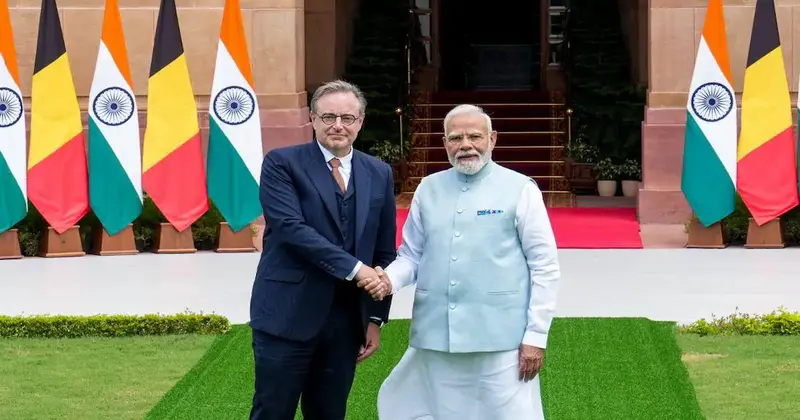
New Delhi/Mumbai: Belgium Prime Minister Bart De Wever acknowledged that Europe ignored India’s early warnings about the dangers of excessive economic dependence. As an impact, the continent is now undergoing a “rude awakening”, he further asserted. During his two-day India visit, PM De Wever also praised Prime Minister Narendra Modi as a “wise” and “inspiring” world leader, while placing India at the top of Belgium’s list of strategic partners amid deepening cooperation in defence, trade, technology and critical supply chains.
PM Modi warned Europe about excessive economic dependence, but was ignored
Speaking at a Confederation of Indian Industry (CII) event in New Delhi, Prime Minister De Wever said, Europe had for years allowed economic dependencies to grow unchecked, leaving its industrial base vulnerable and creating unbalanced opportunities for external powers to use trade relationships as disproportionate leverage.
“For too long, Europe looked on as overcapacity was dumped below cost on our markets, as its industrial base was undermined and as dependencies were deliberately built up so that they could be used as leverage”, he said. Without initially naming China, PM De Wever made it clear that Beijing was at the centre of Europe’s concerns. He said the country that had benefited most from these practices was a neighbour that everyone knew.
“India saw this earlier than we did. And they warned us. And we didn’t listen”, PM De Wever further acknowledged. “We do not like dependencies becoming weaponised against us,” he further added.
De Wever also credited PM Modi with warning European countries about the risks of strategic economic dependence well before the issue became a major concern in Brussels. “Your Prime Minister warned Europe about this a long time ago. But he was ignored. He was not listened to. But we are listening now,” he said.
The Belgian leader described Europe’s realisation as somewhat delayed but said the continent was now having the “right debates” about economic resilience, diversification and reliable partnerships.
India is No.1 in the list of strategic partners; Belgium is gateway to Europe
PM De Wever made an emphatic case for India as Europe’s preferred strategic partner in a rapidly changing global order. “India is No.1 on our list. If India is not on your list, then you are missing something fundamental,” he said.
He argued that countries could no longer afford to build critical economic relationships solely around low-cost imports or short-term commercial interests. Instead, partnerships need to be founded on trust, predictability and shared strategic interests.
“Who else can cooperate with us on the basis of trust?” he asked. De Wever said Belgium wanted to take its relationship with India to “another level — economically, politically, but also strategically”. He highlighted India’s scale, talent and ambition, while describing Belgium as a gateway to the European market with strengths in technology, specialisation and industrial expertise. “India brings extraordinary scale, talent, ambition. Belgium can bring technology, specialisation, experience, and access to Europe,” he said.
PM De Wever calls PM Modi as “Wise” and “Inspiring Leader”
The Belgian Prime Minister also showered praise on PM Modi while addressing the India-Belgium High-Level Dialogue on the India-EU Free Trade Agreement in Mumbai. Recalling his meeting with PM Modi in Delhi, De Wever described the Indian Prime Minister as “one of the most inspiring world leaders we have” and a “wise leader”.
“For me, ladies and gentlemen, it is a great honour to be here. Finally, I’m in India. The previous trip had to be cancelled due to COVID. Now, I am here. And what an honour to meet your Prime Minister, Prime Minister Modi, in Delhi yesterday,” he said. PM De Wever said that PM Modi’s words provided a sense of direction rather than fear.
“If you hear many world leaders, you feel afraid, disturbed, threatened. But when Mr. Modi speaks, you think, ‘we should do what he says’,” PM De Wever reiterated. He described India as the world’s largest democracy, a fast-growing major economy, an economic and technological powerhouse and a major geopolitical force whose voice extends far beyond the region.
India-Belgium deepen strategic partnership; Brussels assures no military supply to Pakistan
The strong political messaging comes alongside a significant expansion in India-Belgium cooperation.
During the PM Modi-PM De Wever talks, the two countries firmed up 10 agreements including defence industrial cooperation. The agreements are expected to facilitate greater industrial cooperation, including potential joint production of military equipment and rockets in India using Belgian technology.
The two sides also agreed to expand military exchanges and training while strengthening intelligence-sharing and cooperation between relevant agencies. India and Belgium signed a Letter of Intent on Defence Cooperation, while a separate Memorandum of Understanding was concluded between the Belgian Security and Defence Industry Association and the Society of Indian Defence Manufacturers.
PM Modi described defence and security cooperation as a “key pillar” of the broader bilateral relationship. The deepening defence engagement also assumes significance amid India’s security concerns, with Belgium conveyed that it would not supply critical military hardware to Pakistan.
India and Belgium are also seeking to move beyond their traditional economic relationship, particularly their long-standing diamond trade. The two countries have set a target of doubling bilateral trade over the next five years, with technology, defence, pharmaceuticals, clean energy, semiconductors, critical minerals and strategic supply chains emerging as priority areas.
The partnership fits into India’s broader strategy of diversifying trade and supply chains amid growing geopolitical uncertainty. PM De Wever argued that India and Europe face many of the same challenges, particularly as economic dependencies increasingly risk becoming instruments of political pressure.
PM De Wever takes a jibe at President Trump
PM De Wever also took an apparent swipe at rapidly shifting tariff and trade policies, warning against an international environment where governments impose barriers unpredictably. “Some do this entirely arbitrarily. They decide something on Monday, they revoke it on Wednesday and they reinstall it on Saturday,” he said.
De Wever said that India and Europe could build a durable relationship based on multilateralism, respect and predictable rules rather than coercion. “India is a major democratic power, a leader in innovation, a voice that cannot be missing when a free and prosperous world is shaped,” he said.
He added that Europe’s single market, industrial capacity and technological strengths could complement India’s scale and rapidly expanding capabilities. “In a world where too many countries are being asked to choose a camp, India and Europe choose partnership decisively,” De Wever said.
The Belgian Prime Minister arrived in New Delhi on September 2, accompanied by Defence and Foreign Trade Minister Theo Francken and a high-level delegation. His visit was the first official India visit by a Belgian Prime Minister in 20 years.
With defence ties expanding alongside trade, technology and strategic supply-chain cooperation, De Wever’s visit signals a significant recalibration of Belgium’s India policy — and a growing European recognition that New Delhi is no longer merely an emerging economic partner, but an increasingly indispensable strategic power.