![No one chooses a product just because it’s “good for the environment.” Lessons in circular business from disposable vinyl umbrellas and Kyoto’s traditional crafts [CBDS Kyoto Report] | Circular Economy Hub](https://www.europesays.com/wp-content/uploads/2026/09/CBDSKyotoCircularDeck-eyecatch.jpg)
※ This article is reprinted from “Ideas for Good.”
【Kyoto Circular Economy Special Feature】
This special feature is a collaborative project between IDEAS FOR GOOD and the City of Kyoto, exploring the present and future of the circular economy in Kyoto. The city has nurtured a spirit of “shimatsu no kokoro” (the traditional Kyoto ethic of careful, waste-free living), a circular way of life, and a culture of craftsmanship over a thousand years. This series asks how those qualities can be developed into innovations that shape the Kyoto of tomorrow—and how circular businesses can be created to carry the city through the next thousand years. Together with the City of Kyoto, local businesses, and Akihiro Yasui, a policy advisory consultant to the City of Kyoto, we explore the value and potential of Kyoto as seen through the lens of the circular economy. (Kyoto Circular Economy Special Feature Top Page)
The circular economy is often said to draw much of its inspiration from culture, tradition, and nature. Yet translating those lessons into a viable business model requires a strategic approach. One tool that helps bridge that gap is a workshop built around the Circularity DECK, a card-based design toolkit developed in the Netherlands.
The “Circular Business Design School Kyoto” (CBDS Kyoto)—a hands-on circular business development programme organised by the City of Kyoto and operated by Harch Inc.—has been drawing circular economy insights from Kyoto’s urban landscape, rich natural environment, and living traditions. Participants challenged themselves to integrate those insights from nature and practitioners into circular business models and strategies using the Circularity DECK.
▶︎ Details of previous programme sessions are available here.
The venue was Impact Hub Kyoto, a renovated building that originally served as the Nishijin Telephone Exchange when it was constructed in 1921. In a space layered with history, participants tackled the challenge of implementing the circular economy through the lens of design. This report covers the workshop’s journey from inputs on circular business model creation to hands-on outputs using the cards.
 Yu Kato founded Harch Inc. in 2015. In addition to operating digital media platforms—including IDEAS FOR GOOD, a global ideas magazine for a better society, and Circular Economy Hub, a specialist circular economy media outlet—he works with corporations, local governments, and educational institutions to advance the circular economy through initiatives such as Circular Yokohama, a platform for Yokohama’s transition to a circular city, and CIRCULAR STARTUP TOKYO in Tokyo. Harch Inc. obtained B Corp certification in April 2023. Kato holds a degree from the Faculty of Education, University of Tokyo.
 Born in Nara Prefecture. From an early age, Kitabayashi set his life’s theme as “building a society where people can live with smiles amid a beautiful natural environment.” During his university years he studied public policy and participated in a Cabinet Office international youth exchange programme as a member of the delegation to Finland. After working in energy facility sales at Osaka Gas (Kyoto) and as a human resources development consultant at GLOBIS (Tokyo), he researched “cultural business” at the Graduate School of Business, Doshisha University. In 2013 he established COS KYOTO Co., Ltd., developing businesses in regional revitalisation, human resource development, and cultural exchange, centred on “cultural business coordination”—unpacking the wisdom cultivated by local climate and history, and updating it for contemporary society through immersive inputs and experiences. Since 2016 he has organised DESIGN WEEK KYOTO. [https://cos-kyoto.com/edonomy]
Broadening the scope of circular design
“Around 80% of the environmental impact of a product, service, or piece of infrastructure is determined at the design stage,” said Yu Kato of Harch Inc. as he opened the session. Guiding that design practice are five circular strategies:
“Narrow” (reduce resource use), “Slow” (extend product life), “Close” (close the loop), “Regenerate” (restore natural systems), and—of growing importance today—”Inform” (leverage data). Achieving these goals requires more than simply swapping out materials. What is needed is “systemic design”: expanding the field of view beyond the product itself to encompass the business model and the broader ecosystem around it, and aligning all of these elements coherently.
Central to this is the question of how to design not only for physical durability, but also for “emotional durability”—ensuring that users maintain a lasting attachment to what they own. The object of design is expanding from the form of a product to the relationship between people and things.
Isao Kitabayashi of COS KYOTO Co., Ltd. then took the floor to unpack the circular essences embedded in Kyoto’s traditional industries.
Take the kimono. A single bolt of fabric (tan) is cut using only straight lines—no complex curves—so no waste is generated in the tailoring process. The garment can be adjusted to accommodate changes in body shape, and after being re-tailored and re-dyed multiple times, it can ultimately be used right down to the last fibre—as futon padding, cleaning cloths, and finally ash. Or consider urushi lacquer. The wood from trees after their sap has been harvested becomes chips used as dye, and the hides of deer culled as pests during that process are also put to use. Different industries were once linked in a chain, and an ecosystem in which nothing became waste—everything became a resource for the next stage—existed as a matter of course.

“This urushi-tapper (lacquer craftsperson) is at once an artisan, a chef, and a hunter—handling many different things. You don’t necessarily have to make a living from a single occupation; there is potential in combining several. This kind of ‘hyakusho-style’ (literally ‘farmer-style,’ meaning multi-skilled) way of working is, I think, actually very important when we think about sustainability and circularity.
Today, people around the world are no longer just looking for the cheapest option—they want things that carry ‘meaning.’ Because global procurement standards are shifting, properly communicating the story behind a product is increasingly being rewarded.”
What Kyoto has cultivated is not merely technique, but the kinds of relationships that generate new value and meaning.

The “Circularity DECK” question cards and Kyoto’s traditional techniques
Now let’s experience how to establish a circular business strategy—one that encompasses those inter-industry connections. The core tool for this workshop was the Circularity DECK. Its 51 cards each describe a circular design strategy and a real-world example. Using them, participants could experience translating a given product into a more circular business.
The workshop theme chosen was “the umbrella.” In the DISCOVER phase—understanding the current situation—a disposable vinyl umbrella was placed in front of each participant for careful observation. They began articulating what they saw: the ribs, which on a conventional umbrella would be metal, are made of plastic; the stitching is remarkably simple; and so on.
A distinctive addition to this workshop was the introduction of “Kyoto Traditional Craft Cards.” Alongside the standard circular design strategy cards, these cards abstracted the wisdom and techniques passed down by Kyoto’s craftspeople into “design patterns,” serving as a source of inspiration for participants to connect global strategies with local context.


The cheap, convenient vinyl umbrella is made from a complex mix of materials that makes recycling difficult. And it is not only vinyl umbrellas—Western-style umbrellas in general have a hook-shaped handle that, while convenient, makes them easy to put down and leave behind, contributing to the problem of forgotten umbrellas.
By contrast, the traditional Japanese wagasa umbrella—made from bamboo, washi paper, and plant-based oil—can be repaired and will ultimately return to the earth. Its structure is particularly interesting. A Western umbrella has its centre of gravity at the handle end, whereas the wagasa’s structure places the centre of gravity at the top, meaning it is naturally held near the tip (the apex when open). The properties of the materials determine the product’s form, which in turn shapes how it is held, the gestures associated with using it, and ultimately even the mindset of “treating it with care.”
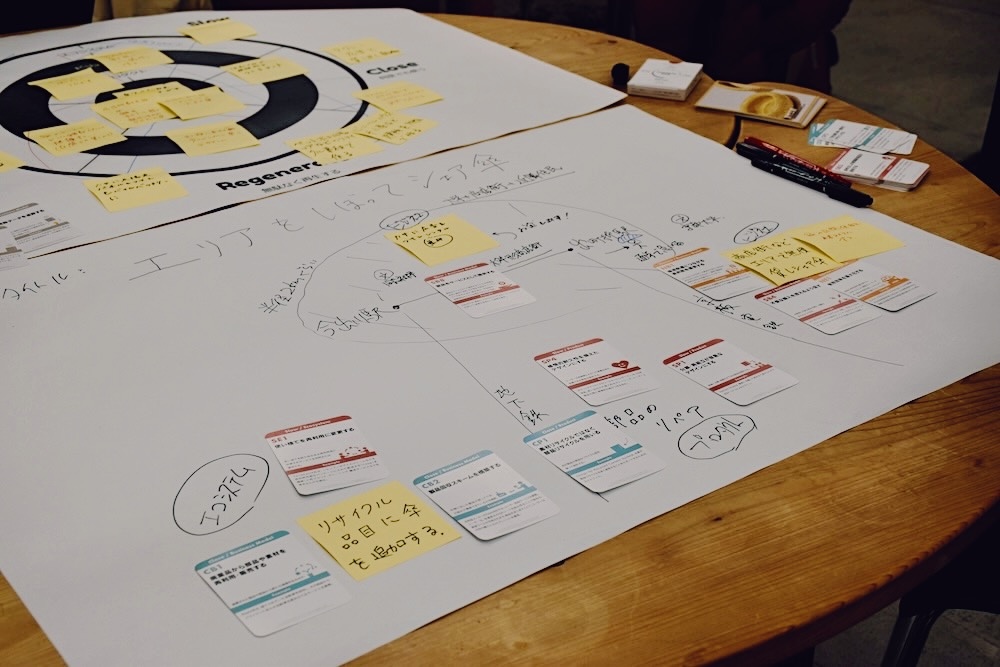
In the DEFINE (identify the challenge) and DEVELOP (diverge on solutions) phases, participants selected the strategy cards they considered most important for a circular umbrella business, laid them out on the table, and explored ideal models. Here they encountered the question of compatibility between strategies. “Slowing” (increasing durability) and “Closing” (making recycling easier) can sometimes pull in opposite directions: adding composite materials for strength makes recycling harder, while using a single material may reduce strength. On the other hand, “Product as a Service (PaaS)” and “durability improvement” create strong synergies, because the business operator’s financial interest and the goal of reducing environmental impact align.
Participants drew red lines (conflicts) and blue lines (synergies) between the strategy cards on the table, working out ideas to overcome the contradictions.


Circular design that generates “Want”
The ideas presented as final outputs were wide-ranging. “My Umbrella”—a concept that cultivates deep personal attachment through a customisation service and GPS tracking. “Everyone’s Umbrella”—a model that reimagines the umbrella as a shared commons (a community resource) grounded in local trust networks. Or a high-tech approach that adds power-generation capability, giving the umbrella value beyond simply keeping off the rain.
The feedback session emphasised a key perspective: “design for Want, not for obligation.” Not “I use it because it’s good for the environment,” but “I use it because I want to” and “I participate because I want to.” Designing systems in which circularity emerges as a natural consequence of desire is precisely what is needed in a society with growing environmental awareness.
Discussion also extended well beyond product improvement, touching on fundamental questions such as “Is the umbrella even the optimal form for the purpose of staying dry?” and biotechnology-based solutions harnessing the power of plants.


Kyoto’s long historical time horizon, combined with the circular economy as a new economic model: what emerges from that combination is not a nostalgic longing for the circular landscapes of the past, but a vision of society that reconstructs them with contemporary technology and context. So how should individual businesses position themselves within that society? The next CBDS Kyoto report will cover a workshop focused on the transition to circularity at the level of individual businesses.
Kyoto holds assets that shine across the ages—cultivated over 1,200 years of history—including the spirit of “shimatsu no kokoro” (careful, waste-free living), a circular way of life, and a culture of craftsmanship. Realising the circular future demanded by pressing global challenges such as climate change and biodiversity loss requires the creativity to bring that wisdom into the present and pass it on to the future. With that in mind, Harch Inc.—the operator of IDEAS FOR GOOD—launched a learning programme in October 2025 that combines the circular wisdom rooted in the city of Kyoto with a forward-looking perspective grounded in cutting-edge circular economy knowledge, enabling participants to co-create and realise the future they want. “Decode Culture, Design Future”—a circular future that extends beyond tradition, from Kyoto to the world.
Website: https://cbdskyoto.jp/