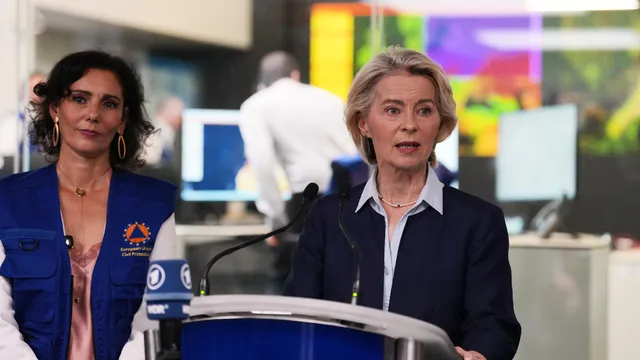
On Monday, September 7, she is expected to sign a joint declaration between the European Union and Greenland.
European Commission President Ursula von der Leyen is arriving in Greenland on September 6 for a two-day visit aimed at reaffirming the European Union’s support for the autonomous territory of Denmark, which has attracted the interest of U.S. President Donald Trump, AFP reported.
On Monday, September 7, she is expected to sign a joint declaration between the European Union and Greenland.
“Greenland is becoming increasingly important to the EU as a gateway to the Arctic because of its geopolitical location, critical raw materials, and its role in Arctic security,” Mark Jacobsen, a researcher at the Royal Danish Defense College, told AFP.
Earlier this year, Trump categorically stated that Washington must establish control over the vast Arctic island for national security reasons, although he subsequently ruled out the possibility of annexing it by force.
Since then, a Danish-Greenlandic-American working group has been meeting regularly in an effort to reach an agreement on future cooperation.
Following Trump’s threats, European countries generally rallied behind Denmark and Greenland, and in January, von der Leyen promised “massive” EU investments in Greenland to strengthen security in the Arctic.
Greenland is not a member of the EU, unlike Denmark.
Brussels also proposed doubling direct financial aid to Greenland to 530 million euros ($616 million) as part of the next EU budget for the period 2028–2034.
According to the *Financial Times*, von der Leyen is expected to offer an additional 200 million euros in support during her visit on Sunday and Monday.
Her visit coincides with the start of NATO’s “Arctic Shield” military exercise, in which military personnel from 10 countries are participating.
Mikaa Blujon-Mered, a geopolitics researcher at the University of Quebec, described the timing as “not insignificant.”
The Trump administration has repeatedly accused Denmark of neglecting Greenland and Arctic security.
Since then, Copenhagen has increased its investment in the region, as has NATO, which launched the “Arctic Sentinel” mission earlier this year.
“The EU cannot provide Greenland with a military security guarantee in the same way that NATO can, but it can offer something politically significant: a clear signal that Greenland is not alone,” Jacobsen said.
This message is even more important as the U.S. continues to exert pressure on Greenland, even though Trump has become less active on the issue since the May visit by his special envoy, Jeff Landry.
“Every month we receive ‘postcards’ from Trump or from people close to him, showing that they haven’t forgotten about Greenland,” noted Blujon-Mered.
In one of these photos, posted by Trump on his social media platform Truth Social in May, he is gazing out over the island, and the caption reads: “Hello, Greenland!”
In August, media reports about a U.S. oil company’s preparatory activities in a remote area of East Greenland once again sparked concern on the island.
The project is managed by a Texas-based company whose licenses were issued before the 2021 moratorium on oil and gas exploration and production took effect. However, the activities have caused concern among local residents and authorities.
So far, the authorities have not allowed the company to conduct exploratory drilling, citing procedural reasons.
Greenland is also facing challenges in developing its mining industry, which could help finance its independence from Denmark.
In this area, Greenland’s and Europe’s interests are “highly complementary,” Jacobsen noted.
“Greenland needs investment, infrastructure, and markets if it is to realize its mining potential, while the EU is seeking more secure and diversified access to critical raw materials,” he said.
However, turning Greenland’s geological potential into reality is proving more difficult than expected.
About 135 mining permits are held by more than 60 companies, but only two mines are currently in operation.
“The question is whether the current geopolitical momentum will ultimately prove to be a game-changer,” Jacobsen said.
Blujon-Mered noted that von der Leyen’s second visit to Greenland in the past two years sends a strong signal that European investments are long-term.
During his visit, the President of the European Commission is expected to hold talks with Greenland’s Prime Minister Jens-Frederik Nielsen, Danish Prime Minister Mette Frederiksen, and the head of government of Denmark’s other self-governing territory—the Faroe Islands. | BGNES