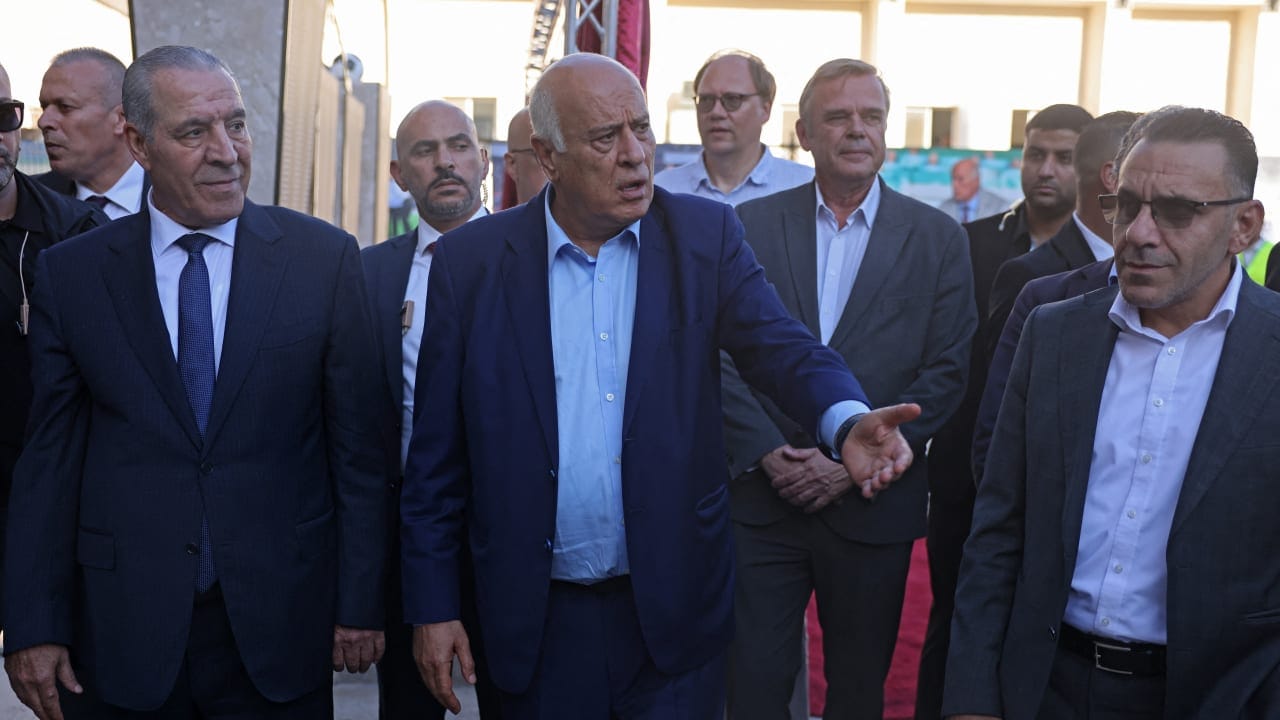
Jibril Rajoub met with Hamas leaders Khalil al-Hayya and Zaher Jabarin in Turkey two weeks ago, the secretary-general of the Fatah Central Committee confirmed to the Hamas-affiliated Quds News Network on Friday.
According to a source who spoke with the Palestinian Press Network, Rajoub also met with mukhtars, or clan leaders, from the Gaza Strip in an effort to potentially create his own alliance ahead of the election.
Rajoub told Quds that he doubted the Palestinian Legislative Council elections scheduled for November would go ahead, though he called for a meeting of all Palestinian factions to develop a roadmap for national dialogue and reform with Egyptian support.
Rajoub said such a meeting would renew legitimacy for the Palestinian political system, arguing that Palestinians are currently facing an impasse that has evolved into an existential threat. Renewed Palestinian unity, he said, would be an essential step toward establishing a Palestinian state.
Hamas meets with multiple Fatah officials
Yoni Ben Menachem, a senior researcher at the Jerusalem Center for Security and Foreign Affairs, told The Jerusalem Post that Hamas has met with several Fatah officials in recent weeks and has found a foothold among those disappointed by Palestinian Authority President Mahmoud Abbas’s attempts to position his son as his successor.

The officials, who reject Yasser Abbas as a potential new president, are considering new alliances with Hamas and Palestinian Islamic Jihad as a way to signal their disappointment with Abbas and pressure him to prioritize Palestinian interests over his personal aspirations, Menachem continued.
Menachem also agreed with Rajoub’s assessment that Abbas would again postpone the long-delayed elections, saying he had been warned that doing so would be a “dangerous gamble” for Fatah, given that Hamas won a majority of the seats in the last PLC election in 2006, securing 74 seats. Hamas has since mounted a new campaign to win over Abbas’s critics, Menachem said.
Beyond unity, Rajoub said the Palestinian political focus should be on addressing the refugee crisis, unifying the Palestinian approach toward Israel and defining a pluralistic and democratic national identity.
That unified approach toward Israel, he argued, should center on confrontation rather than normalization, with “popular resistance” representing the most effective way to handle the conflict with Israel.
However, opposing factions that have engaged with Hamas recently told The Post that it was becoming more widely understood that violent campaigns against Israel had not been successful and that it was more effective to focus on combating “the occupation” through diplomacy.
Rajoub also advocated for political, judicial, security, administrative and financial reforms, as well as changes to the Palestinian curriculum. He said it was also necessary to address the “issue” of payments to Palestinian prisoners and their families, who receive financial assistance from the Palestinian Authority under a system that critics have long said ties payments to the length of a prisoner’s sentence in an Israeli prison.
The PA has struggled to maintain the payments in recent months amid US pressure and Israel’s withholding of tax revenues. Palestinian Media Watch has reported that Palestinians who carried out attacks against Israeli and American citizens and now live outside the territories have continued to receive payments, while recipients inside the territories have reported delays.
Rajoub advocates for PLO strength
Rajoub also said that the Palestinian Liberation Organization must remain the sole legitimate representative of the Palestinian people. He argued that the biggest mistake made by the Palestinian political system was allowing the PA to become dominant over the PLO.
His comments come as the FDR faction appears to be gaining influence within Fatah. Rajoub rejected the possibility of former Fatah leader and current FDR leader Mohammed Dahlan returning to the Palestinian political sphere, though Dahlan also met with Hamas’s leadership only weeks ago and has been pushing for renewed Palestinian unity across the factions.
Menachem explained that Hamas was building support with as many high-profile players as possible, seeing the PLC elections as an opportunity to “rehabilitate themselves” from the military failure in Gaza through a democratic success.