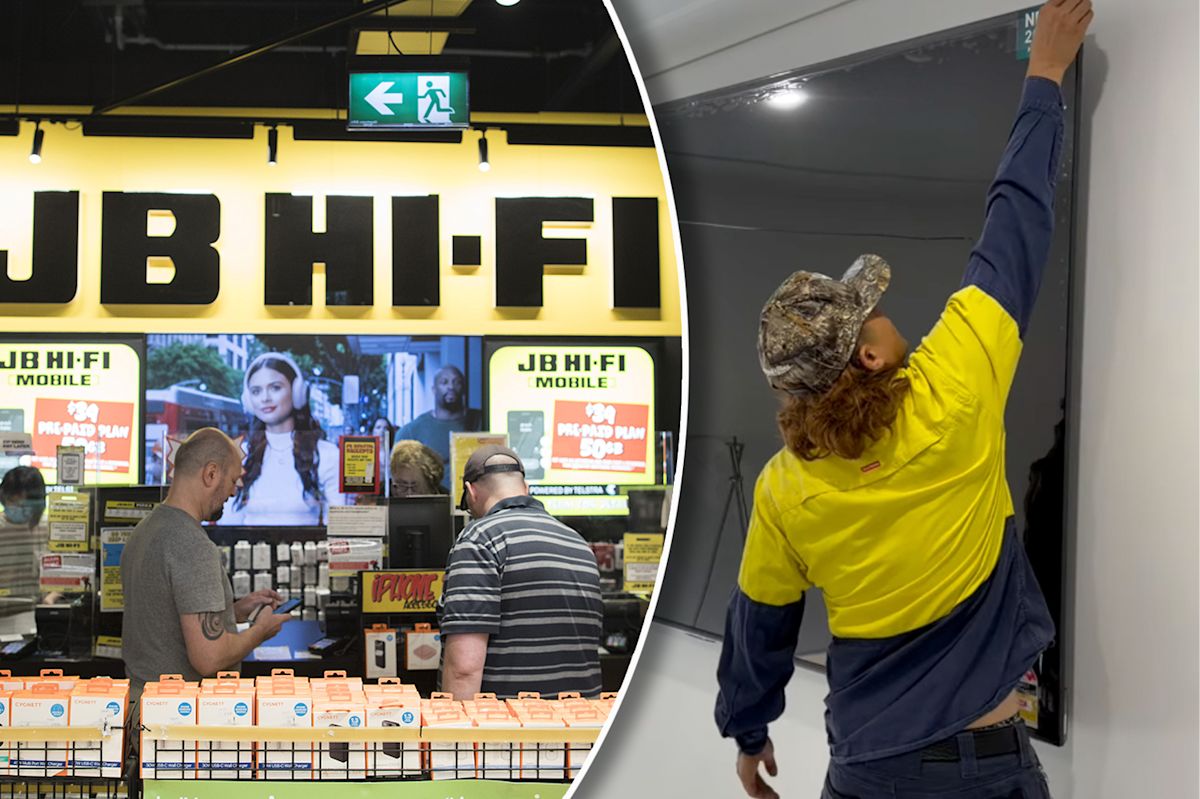
Australians are watching their wallets, but apparently not when it comes to one increasingly enormous household purchase.
Australia has emerged as the big-screen TV capital of the Southern Hemisphere and one of the biggest markets globally, as televisions measuring 98 inches or more increasingly find their way into Aussie living rooms.
Samsung, one of Australia’s biggest television brands, says TVs measuring 98 inches and above are now its fastest-growing size category locally, with the value of sales jumping 31 per cent in a year.
“Over the past two years, particularly, Australians haven’t just gone bigger, they’ve gone ultra-large,” Samsung Australia Head of Product Audio/Visual, Maxime Dupont, told Yahoo News Australia
TCL Australia is seeing the same shift in the size of televisions Australians are buying, with huge screens increasingly moving onto mainstream retail floors.
“Australians are not treating a 98-inch as a novelty,” Managing Director Hawke Zhang told Yahoo News Australia.
Zhang believes cost of living pressures changed where some Australians choose to spend their entertainment dollars.
“Cost of living has not killed the night in. It has moved it,” Zhang said.
“People are keeping the entertainment they used to go out for — a final, a film, a grand final replay — inside the house.”
Samsung agreed Australia’s habit of turning the living room into a venue of its own is helping drive the appetite for bigger screens.
And apparently, 98 inches is just the beginning.
Samsung expects to offer as many as 10 televisions measuring 98 inches and above by the end of 2026, with screens stretching all the way to 130 inches.
TCL already sells a mammoth 115-inch television in Australia, while Hisense has carved out an entire local category dedicated to televisions measuring 100 inches and above.
LG and Sony have joined the supersized race too, with TVs stretching to 115 inches.
Do you have a cost of living story? Contact newsroomau@yahoonews.com

Samsung says TVs measuring 98 inches and above are now its fastest-growing size category in Australia, with the sales value jumping 31 per cent in a year.
Why are Aussies buying enormous TVs during a cost-of-living crisis?
Australians may be gloomy about the cost of living, but official figures show they’re still spending.
ABS data shows household spending rose 7 per cent in the year to July, while discretionary spending surged 7.8 per cent. Recreation and culture spending also jumped 1.5 per cent in July alone.
Economist Neha Sharma said spending had remained surprisingly resilient despite cost-of-living pressures.
“We are seeing evidence of a disconnect between consumer sentiment and spending,” she told Yahoo News Australia.
e61 Institute Research Director and Economist Gianni La Cava told Yahoo News Australia falling prices were likely a major driver, with supersized screens moving from the “ultra-luxury market” into the reach of a much larger audience.
The shift has been dramatic. Samsung’s first 98-inch TV launched for $99,999 in 2019; today, its cheapest starts at $3,799, while the wider market average is around $5,000.
But that spending power is far from universal. La Cava said lower-income households and renters had “smaller financial buffers”, while wealthier Australians and some retirees still had enough money left after paying the bills to spend on big-ticket purchases.
RELATED:
When did 75 inches become normal?
The idea of a 100-inch television becoming a regular sight in Australian homes might sound far-fetched, but it wasn’t long ago that a 75-inch screen seemed enormous.
Now, Samsung internal sales data shows Australia ranks fourth globally for the proportion of its televisions sold at 75 inches and above, and number one in the Southern Hemisphere.
TCL says its own sales mix tells a similar story, with TVs measuring 75 inches and above punching above their weight in Australia compared with other markets.
You can also follow us on Facebook, Instagram, TikTok, X and YouTube.