Key Takeaways:
The 7 August 2026 Mecca Pact (Türkiye, Saudi Arabia, Pakistan) treats an attack on one as an attack on all and adds exercises, intel, tech, and defence industry—building on the 2025 Saudi–Pakistan deal. The author calls it an emerging mix of Saudi money/energy, Turkish arms and NATO know-how, and Pakistani manpower plus a declared nuclear capability—not a second NATO. The three do not share one threat map (India vs Greece/Cyprus/Israel/Iran vs Gulf/Iran).
For Albania and Kosovo the point is Ankara’s “strategic depth”: the Balkans as a corridor from the Eastern Mediterranean to Central Europe, not a side story. Turkish aims (influence, markets, corridors, arms exports) overlap with Albanian aims (sovereignty, NATO/EU, holding off Serbia) but are not the same. Friendship and religion are not a security doctrine.
Prescription: keep Euro-Atlantic integration as the spine; treat Türkiye as a partner on drones, air defence, cyber, and training—not a substitute for the U.S., NATO, or the EU. Build an Albania–Kosovo defence ecosystem so the two republics produce security instead of only consuming it. Serbia will watch Turkish weight; interests, not “natural alliance,” should set the terms.
Turkish Interests and Strategic Dilemmas for Albania and Kosovo
From the perspective of the two Albanian republics, Albania and Kosovo, the Mecca Pact is not a peripheral development. It is a signal of a changing power architecture in the space stretching from the Persian Gulf to the Eastern Mediterranean and, consequently, of the way Ankara may conceptualize its role in the Balkans.
Introduction
On 7 August 2026, Türkiye, Saudi Arabia, and Pakistan signed in Mecca the Joint Defence Agreement, which stipulates that an armed attack against any one of the three states will be considered an attack against all of them. The agreement provides for mechanisms of political and military coordination, joint exercises on land, at sea, in the air, and in cyberspace, as well as cooperation in emerging technologies, unmanned systems, and the defence industry.
Although Ankara and Islamabad have described the pact as defensive and not directed against any particular state, the very structure of the agreement places it at the centre of a broader process: regional powers are seeking to build autonomous security capabilities at a time when the credibility of traditional security guarantees is increasingly being called into question.
This is what makes the Mecca Pact relevant to the Balkans as well.
The political essence of the Mecca Pact is clear: an armed attack against any one of the three parties will be considered an attack against all of them.
At this point, the agreement goes beyond an ordinary declaration of defence cooperation. It establishes a principle of mutual defence and institutionalizes a new level of strategic coordination among Ankara, Riyadh, and Islamabad. The pact builds upon the bilateral Strategic Mutual Defence Agreement signed by Saudi Arabia and Pakistan in September 2025 and expands it through joint exercises, intelligence sharing, technological cooperation, and defence-industry collaboration.
However, the political formulation of the agreement must be distinguished from its actual strategic capacity.
At present, the Mecca Pact does not constitute a comprehensive alliance comparable to NATO. Rather, it is an emerging coalition built around the combination of different but complementary capabilities. Saudi Arabia brings financial capital, energy resources, and a geographical position astride some of the world’s most important energy corridors; Türkiye brings a developed defence industry, military capabilities, and extensive experience within NATO; while Pakistan brings a substantial manpower base, extensive military experience and, above all, its declared nuclear capability. [Murray Hunter: 2026]
It is precisely this combination of three forms of power — Saudi capital and energy, Turkish military-industrial power, and Pakistani nuclear capability — that gives the Pact a weight exceeding the formal dimension of the agreement. Each of these states possesses resources that the other two do not possess to the same degree. If these capabilities can be integrated through sustained mechanisms of coordination, technology transfer, joint production, and military interoperability, a new regional security and defence ecosystem could gradually emerge.
But this is precisely where the first limitation of the project becomes apparent. Complementary capabilities do not automatically imply identical strategic interests. Pakistan continues to perceive India as its primary threat; Türkiye must simultaneously manage its relations with NATO, Greece, Cyprus, Israel, and Iran; while Saudi Arabia regards Gulf security, Iran, and the protection of energy corridors as fundamental priorities. Thus, the three states may combine capabilities without necessarily sharing the same threat map.
This makes the Mecca Pact more interesting as a project of regional strategic autonomy than as a classical military alliance. It does not replace the existing security architecture and, at least at this stage, does not necessarily seek to do so. But it demonstrates that regional powers are preparing for an international system in which traditional security guarantees are no longer considered sufficient and in which the capacity to produce security autonomously is becoming an increasingly important component of state power.
For this reason, the significance of the Mecca Pact should not be measured solely by asking whether it will become an “Islamic NATO.” The more relevant question is whether this model will succeed in transforming the dispersed capabilities of the three powers into a sustainable instrument of deterrence and joint action.
If that happens, the Pact would represent an important step in the reconfiguration of the balance of power from the Persian Gulf to the Eastern Mediterranean — and this is precisely where its significance for Türkiye, the Balkans, and the Albanian space begins.
I. From Alliances of Dependence to Coalitions of Power
For decades, the security architecture of the Middle East and the Balkans was built upon a similar premise: regional power was intertwined with the security guarantees of a greater power, above all the United States.
The Mecca Pact does not overturn this order, but it adds a new dimension to it. It represents an effort by three powers to create a regional deterrent capability by combining three different types of power: Saudi capital and financial weight, Turkish military-industrial capacity, and Pakistani nuclear power. Initial analyses of the agreement have also emphasized the creation of a common ecosystem encompassing the defence industry, investment, technology transfer, and joint production.
Thus, what is emerging is not necessarily an “Islamic NATO,” as it has been described in certain circles. Institutionally and operationally, the gap with NATO remains substantial. But it is a step toward a different concept: regional strategic autonomy.
And this is precisely where the importance of Türkiye begins.
II. Türkiye: From Regional Power to a Power with a Spatial Project
2.1 Davutoğlu’s Strategic Depth and the Balkans
To understand contemporary Turkish policy more deeply, including the role Ankara seeks to play through the Mecca Pact, it is necessary to return to Ahmet Davutoğlu’s concept of “Strategic Depth: Turkey’s International Position.” Systematically articulated in his work Stratejik Derinlik: Türkiye’nin Uluslararası Konumu (2001), this concept represents one of the most significant theoretical attempts to reconsider Türkiye’s position in the international system.
At its core, Davutoğlu argues that a state’s power is determined not only by its territory, economy, or military capability, but also by its historical, geographical, cultural, and civilizational depth. According to him, Türkiye occupies an exceptional position because it lies at the intersection of several strategic spaces: Europe and Asia, the Balkans and the Middle East, the Black Sea and the Mediterranean. Moreover, the Ottoman legacy has left Ankara with historical, social, and cultural ties extending far beyond the borders of the Republic of Türkiye.
Therefore, Türkiye should not behave as a peripheral state merely waiting for developments in the surrounding regions, but as a central power, capable of building relationships and exercising influence across several regions simultaneously.
2.2 The Balkans as Part of Strategic Depth
Within this conceptual framework, the Balkans occupy a special place. Davutoğlu does not treat the region merely as Türkiye’s neighbouring space, but as one of the areas that shape its international position. The Balkans, the Middle East, and the Caucasus constitute, to a considerable extent, three principal spaces in which Türkiye’s historical and geographical position can be transformed into strategic capital.
For Davutoğlu, a weakening of Turkish influence in one of these spaces would also have consequences for Türkiye’s position in the others. This explains why Turkish foreign policy cannot be understood solely through Ankara–Brussels or Ankara–Washington relations. It must also be viewed through Türkiye’s relations with the Balkans, the Caucasus, the Middle East, Central Asia, and Africa.
In this sense, the Balkans are not merely a “neighbourhood” for Türkiye. They are part of its space of strategic projection.
Davutoğlu also links this position to the Ottoman legacy. Yet the significance of this legacy, in his logic, should not be understood simply as nostalgia for the Ottoman Empire. It represents a historical capital that Türkiye can transform into diplomatic, economic, cultural, and political relations.
Thus, Turkish policy toward the Balkans assumes a multidimensional character: investment and trade are complemented by cultural diplomacy, education, religious institutions, infrastructure and, increasingly, cooperation in the fields of security and defence.
2.3 From “Depth” to “Networks” of Power
Contemporary Turkish policy is not identical to Davutoğlu’s doctrine, and it would be incorrect to reduce every action undertaken by Ankara to that doctrine. Nevertheless, there is an important continuity in the way Türkiye is conceived as a power that should not be confined to a single geopolitical space.
In this respect, we can speak of an evolution from “Strategic Depth” toward what may be called strategic networking.
If Davutoğlu viewed geography, history, and civilizational heritage as sources of power, contemporary Türkiye is attempting to transform these resources into concrete networks of influence: political agreements, economic partnerships, military cooperation, defence-industry exports, diplomatic and military presence, and infrastructure links.
The Mecca Pact can be viewed in this context. It connects Türkiye with Saudi Arabia and Pakistan and, potentially, creates a new platform for cooperation extending beyond the boundaries of the Middle East. At the same time, Ankara is maintaining and expanding its presence in the Caucasus, Central Asia, Africa, and the Balkans.
Thus, strategic depth is being transformed into a networked geography of power.
2.4 The Balkans and the Albanian Space
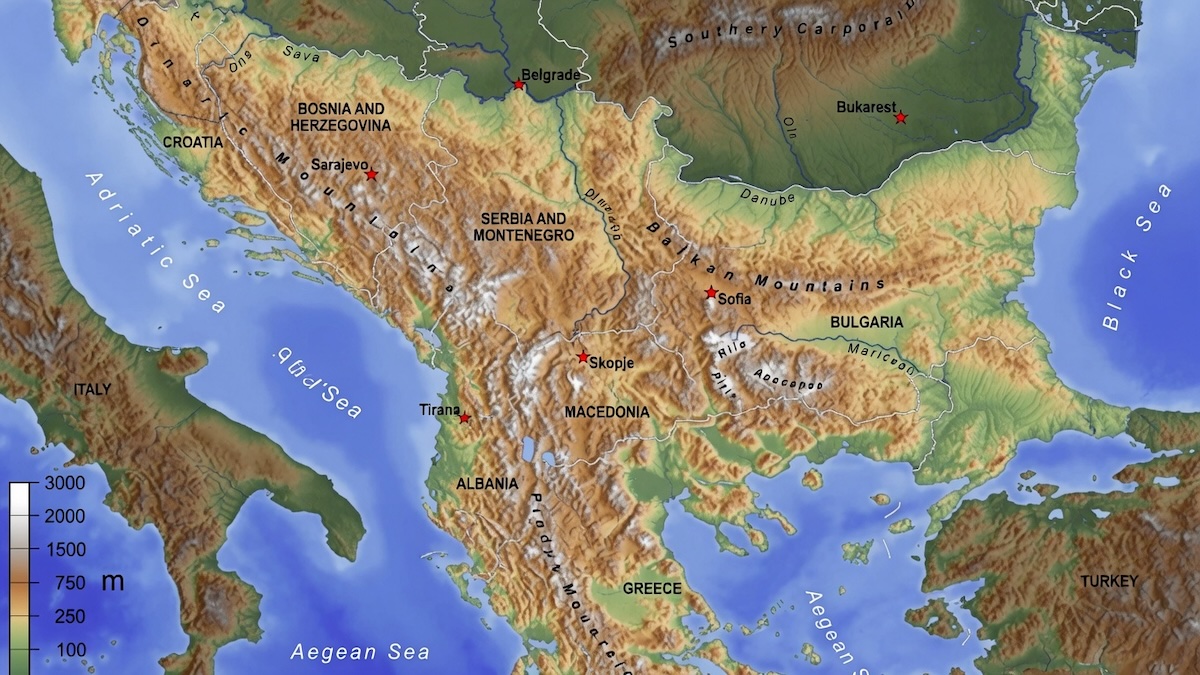
This perspective is particularly important for Albania and Kosovo, but also for the Albanian space in the region more generally. On the map of Turkish strategic depth, the Albanian space is not insignificant. Albania, with its access to the Adriatic, and Kosovo, with its position at the centre of the Balkans, constitute two points connected to much broader strategic corridors.
This does not mean that Türkiye views the Albanian space exclusively through a centralized geopolitical project. But it does mean that Ankara has enduring interests in a Balkans open to Turkish presence and influence.
This is precisely where the distinction between Turkish interests and Albanian interests must be made.
Türkiye’s interest is to preserve and expand its own room for manoeuvre. The interests of Albania and Kosovo are to consolidate their sovereignty, security, and international subjectivity, and to advance Euro-Atlantic integration.
These interests may coincide in many instances, but they are not identical. Therefore, the relationship with Türkiye should be built as a strategic partnership, not strategic dependence.
This is also the most important conclusion that can be drawn from a reading of Davutoğlu: a power capable of thinking in terms of “strategic depth” does not operate only within its formal borders. It seeks spaces in which it can project power and create networks of influence.
This should encourage Albania and Kosovo to think beyond their narrow state borders and build their own strategic depth through the Albania–Kosovo connection, the Adriatic, NATO, the EU, partnership with the United States, and strategic relations with Türkiye.
Because, in an international order in which middle powers are gaining increasing room for manoeuvre, it is not enough to be part of someone else’s strategic space; one must also have the capacity to produce one’s own strategic space.
III. The Balkans Are Not Peripheral to the Turkish Project
For Ankara, the Balkans are not merely a historical or cultural space. They are a strategic corridor linking the Eastern Mediterranean with Central Europe.
Therefore, Albania and Kosovo are of particular importance.
Albania offers Türkiye an important outlet to the Adriatic, while Kosovo represents a key point in the interior of the Western Balkans. If these two spaces are viewed together, their significance increases considerably.
But here a fundamental distinction must be made.
Turkish and Albanian interests may coincide in many areas, but they are not identical.
This distinction is essential for a mature state policy.
Türkiye seeks influence, markets, strategic corridors, military presence, defence-industry exports, and diplomatic capital. Albania and Kosovo, meanwhile, have other fundamental interests: consolidating sovereignty, Euro-Atlantic integration, regional stability, preventing Serbian expansionism, and preserving the Albanian strategic space.
Therefore, relations with Ankara should be built upon strategic partnership, not strategic dependence.
IV. The Risk of Misreading: Friendship Is Not a Security Doctrine
Here lies one of the most important dilemmas.
Albania and Kosovo have historical and political reasons to cultivate good relations with Türkiye. Ankara has been an important supporter of Kosovo, while military cooperation with both republics has expanded over the years.
But a serious state should not build its security doctrine upon emotional, historical, or religious affinities.
Neither Albania nor Kosovo should become part of any broader Turkish confrontational project in the Middle East.
This is particularly important now that the Mecca Pact may evolve into a broader structure. If its expansion continues, Türkiye will gain a new platform for projecting its power beyond its borders. This is not necessarily negative for Albanians; on the contrary, it could create new opportunities for cooperation. But it could also generate dilemmas if Turkish interests in a particular crisis clash with NATO or EU priorities.
This is why the Euro-Atlantic orientation must remain the backbone of Albania’s and Kosovo’s foreign and security policy.
Türkiye can be a strategic partner. But it cannot replace the Euro-Atlantic security architecture.
V. What Does This Mean for Kosovo?
For Kosovo, the implications are even more direct.
The Republic of Kosovo is situated in a space where the interests of the EU, NATO, the United States, and regional powers intersect. Within this configuration, Türkiye can play an important role both as a NATO power and as an actor with special relations with the Muslim world.
But precisely this dual position of Ankara must be utilized with caution.
Kosovo does not need a single “protector.” It needs a network of strategic support.
This means that Pristina should simultaneously deepen its relations with Washington, London, Berlin, Brussels, Ankara, Paris, Rome, and other NATO partners.
Instead of a policy of dependence on a single power, Kosovo needs a policy of strategic diversification.
In this sense, the relationship with Türkiye should also be redefined: from a relationship based primarily on political and military affinity toward a structured partnership in defence industry, intelligence, technology, cybersecurity, drones, air defence, and training.
VI. Albania: The Adriatic as a Strategic Counterweight
For political Albania, the most important development may be the transformation of its geographical position into strategic capability.
At a time when Türkiye is increasing its presence in the Eastern Mediterranean and surrounding spaces, Albania needs to understand more clearly the significance of the Adriatic.
Ports, energy corridors, maritime infrastructure, airspace, and connections with Italy, Croatia, and, above all, access to Kosovo and North Macedonia are not merely economic matters.
They are geopolitical infrastructure.
Albania can become an important node of Euro-Atlantic security in the Adriatic. But this requires investment in maritime capabilities, air defence, intelligence, surveillance, drones, electronic warfare, and cybersecurity.
In this sense, relations with Türkiye should be used to enhance Albanian capabilities, not to create a new dependency.
VII. From Security Consumer to Security Producer
This is the greatest lesson that Albania and Kosovo can draw from current developments.
The Mecca Pact combines capital, technology, and military power. This is precisely the logic that should also be taken seriously in the Albanian space.
The two Albanian republics cannot remain merely consumers of security. They must build a joint Albanian security and defence ecosystem.
Albania has the advantage of NATO membership and its geostrategic position. Kosovo needs to further develop its own defence capabilities and gradually integrate into the Euro-Atlantic architecture.
Cooperation could include:
defence industry;
production and maintenance of drones;
cybersecurity;
intelligence and strategic analysis;
secure communications;
civil protection;
maritime and border surveillance;
technological research and development;
joint training;
standardization of capabilities according to NATO standards.
Here, Türkiye can be a very important partner.
But the partnership must be triangular: Albanian–Turkish–Euro-Atlantic, rather than one serving as a substitute for another.
VIII. The Serbian and Russian Dimension
Serbia cannot be left out of any analysis of developments in the Balkans.
Belgrade will closely monitor any expansion of Turkish influence in the Balkans. Serbia has developed important relations with Türkiye, including in the economic and defence fields. This creates a paradox: the same Türkiye can be a partner of Serbia and, at the same time, a strategic partner of Kosovo.
This is clear evidence that international relations do not operate on the basis of absolute friendships. They operate on the basis of interests.
Therefore, Pristina and Tirana should do the same. Rather than viewing Türkiye as a “natural ally” under every circumstance, they should see it as a partnering power with whom interests must be negotiated.
This approach is healthier and more sustainable.
IX. The Mecca Pact and the Possibility of a New Regional Order
Another element that should not be underestimated is the possibility of an expansion of the Mecca Pact.
Pakistan has declared the agreement open to other countries in the region, while Ankara has mentioned the possibility of Egypt joining.
If this process were to develop, a new configuration of power would emerge from the Gulf to the Mediterranean.
In such a case, Türkiye would be not only a NATO power on Europe’s southeastern flank, but also one of the centres of a new security architecture outside Europe.
This would increase Ankara’s weight. And the greater Turkish weight becomes, the more important the Balkans will become as well. For Albania and Kosovo, this means one thing: they must begin to think of the Balkans not as a peripheral space, but as a node within a broader Euro-Mediterranean system.
X. The Two Albanian Republics in the Face of a Multipolar World
The Mecca Pact is also a warning for Europe.
If regional powers begin building autonomous security capabilities, while the United States calls for a greater distribution of the defence burden among allies, Europe too will be compelled to increase its own capabilities.
In this reality, Albania and Kosovo cannot wait passively. They must develop an Albanian security doctrine in Europe. This doctrine should not be directed against Türkiye, Russia, Serbia, or any other actor. It should serve the Albanian national interest and Euro-Atlantic integration.
Its core should be:
EU + NATO + partnership with the United States + strategic relations with Türkiye + deepened Albania–Kosovo cooperation.
This formula gives the Albanian space flexibility without losing its strategic orientation.
Conclusion: Partnership, Not Dependence
The Mecca Pact may still prove to have significant limitations. It does not possess NATO’s institutional structure and remains to be tested in a real crisis. Initial assessments also warn that the absence of an integrated command and common structures limits its ability to function as a classical collective alliance.
But its significance should not be measured solely by whether it will function as an “Islamic NATO.” Its real significance lies in its geopolitical message.
Regions are increasingly seeking their own deterrence capabilities. Middle powers are seeking strategic space. Alliances are becoming more flexible. And states are preparing for a world in which no external guarantee can any longer be taken for granted.
In this world, Türkiye will be one of the powers that gains greater weight.
Therefore, Albania and Kosovo should view the rise of Turkish power realistically: neither as a threat nor as a substitute for their Euro-Atlantic architecture.
Ankara can be an important partner in building Albanian defence capabilities. It can be a technological, economic, and diplomatic partner. But the Albanian interest requires this partnership to be placed within a broader strategic framework.
Ultimately, the issue is not whether Albania and Kosovo should choose between Türkiye and the West. The issue is whether they will have the strategic capacity to be valuable partners to both, without becoming instruments of either.
This is the true challenge facing the two Albanian republics in the new era of geopolitics.
And this is precisely where the central lesson of the Mecca Pact lies: states that do not produce their own strategic capabilities ultimately become part of the strategic calculations of others.

About Dr. Sadri Ramabaja
Dr. Sadri Ramabaja was born on October 4th, 1961 in the Village of Gollak, in the town of Dardania, Republic of Kosovo. Dr. Ramabaja has been an active member of the National Albanian Union Party for over fifteen years (1990-2005) until this political party ceased to exist and later on actively participated in the Social Democratic Party of Kosovo.
Since 2010 has emerged as one of the leaders of the Self Determination Movement while promoting the main principles of this alliance and is a member of the National Assembly of Prishtina for two terms.
In 1983 he was arrested by the Serbian Secret Service for his active role in Kosovo’s quest for independence. Thereafter Dr. Ramabaja was jailed as a political disident for three years in the penitentiary of Vraja.
During his residence in Switzerland (1987-2002) he continued his University studies in Tirana, and his postgraduate studies in the University of Basel, in the European Studies Institute. For three years in a row (1987-1990) Dr. Ramabaja was the editor of VOICE OF KOSOVO, a newspaper published in Switezerland.
During the years 2001-2004 he was the professional collaborator for Communications Media at the OST Institute-West in Bern, Switzerland. In 2002 returned to Kosovo and continued with his post-graduate studies at the College of Law and International Relations, where he graduated with a Masters Degree in International Law Sciences.
In 2004-2006 Dr. Ramabaja served as a Senior Political Adviser in the Office of the Prime Minister of Kosovo.
In November 2008 was a PHD Student of Political Sciences and International Relations, in the European Center for Peace and Development (ECPD) at the Peace University of the United Nations.
In 2012 was transferred at the Graduate School of the European University of Tirana, to continue with his postgraduate degree defended through the presentation of his dissertation: “Albanian Federation-Cohesion of a Nation-State and the European Union”
Dr. Ramabaja, has been published abroad in many renowned newspapers and magazines; has published eleven scientific and research papers in the field of international affairs and geopolitical studies. He is a Fellow of the International Political Studies Institute of Skopie, Macedonia.
Dr. Ramabaja is the author of four Books in Albanian Language: “Realizmi politik dhe çështja kombëtare” (Tiranë, 1998); “UE-ja shpresë apo ringjallje utopish” (Prishtinë, 2003); “Gazetaria” (one of four co-authors of this university text book- Tiranë,2002); “Feniksit ia gjeta çerdhen”(Poetry – Tiranë, 1993); “Federata Shqiptare – Kohezioni i shteti-komb në BE”(Ph.D. Dissertation).
View all posts by Dr. Sadri Ramabaja →