
“The biggest theme for Hesai so far has been the digitization of the physical world.”
On April 17, 2026, when Li Yifan, CEO of Hesai Technology, said these words at the technology open day, the company had just released a quite impressive annual report three weeks prior: revenue reached 3.028 billion yuan, a year-on-year increase of 45.8%; net profit hit 436 million yuan, making it the first enterprise in the LiDAR industry to achieve full-year GAAP profitability.
The capital market did not respond enthusiastically — in the following months, Hesai’s share price remained sluggish, falling by about 34% within the year on a pre-adjustment basis, with its market capitalization hovering around 20 billion Hong Kong dollars.
This contrast reveals an industry reality: LiDAR is evolving from a “technological scarce product” to a “common component” — for Hesai, this is both an achievement and the starting point of new challenges.
While Hesai has driven down the price of LiDAR, it has also pushed itself into the valuation framework of the “manufacturing industry”, losing its room for market imagination.
Li Yifan has a clear judgment on this.
During the Davos World Economic Forum Annual Meeting in January 2026, he stated in his speech that humanoid robots are the core track of physical AI, and the core of Chinese technology enterprises’ breakthrough lies in the dual advantages of the supply chain and the demand side.
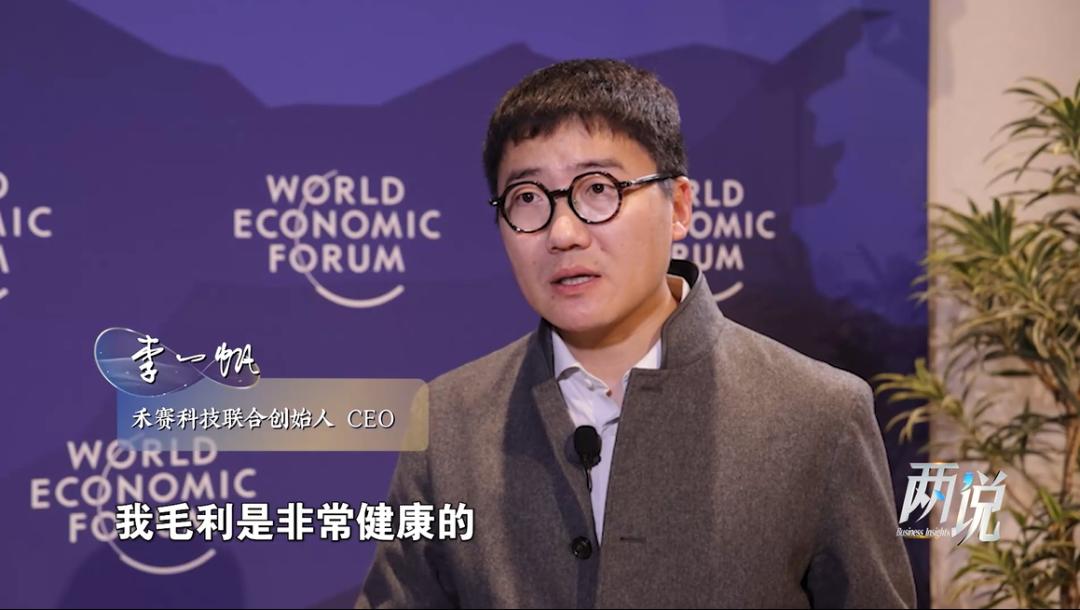
Li Yifan, CEO of Hesai Technology
Four months later, Hesai announced a brand new strategic direction: upgrading from “spatial perception” to “spatial intelligence”, evolving from a single sensor supplier to a physical AI infrastructure provider.
Another four months later, Li Yifan specially created a viral event for the Sharpa robot that swept across social media.
This is not an easy strategic transformation, it involves the expansion of technical boundaries, the reconstruction of business models, and the pre-emptive layout of a market that has not yet fully matured.
01
Unfair Market Capitalization Game
Let’s first look at a set of data.
Horizon Robotics, which is also in the intelligent driving industry chain, recorded a revenue of 3.76 billion yuan in 2025 and is not yet profitable, with a Hong Kong stock market capitalization of about 55 billion Hong Kong dollars (as of early September 2026).
Pony.ai, an L4 autonomous driving operator, has a much smaller revenue scale than Hesai, and its market capitalization reached 51 billion Hong Kong dollars on the first day of its Hong Kong stock listing in November 2025.
Momenta, listed on the Hong Kong stock market in July 2026 as a physical AI company, had a market capitalization of about 70 billion Hong Kong dollars on its first trading day.
Looking at the embodied intelligence track again.
Unitree Technology was listed on the Sci-Tech Innovation Board on August 19, 2026, with an offering market capitalization of about 61 billion yuan, and its intraday market capitalization once exceeded 440 billion yuan on the first day of listing; Galaxy Universal and Agibot are not yet listed, but their latest valuations have reached about 20 billion yuan.
What about Hesai?
With a revenue of 3.028 billion yuan, a net profit of 436 million yuan, and a 43% global market share ranking first in ADAS main LiDAR shipments, as an absolute industry giant, its market capitalization is only around 20 billion Hong Kong dollars.

Hesai Technology 2025 Financial Report
In the core link of intelligent driving perception, Hesai’s position is almost unarguable: it has obtained mass production designated orders from 40 global automotive brands and more than 160 vehicle models, covering all top 10 best-selling automotive brands in China — in March 2026, its installation share in China’s domestic passenger car main LiDAR market reached 55%, exceeding the sum of all other suppliers, ranking first for 14 consecutive months.
This set of comparisons reveals an awkward reality: Hesai’s financial performance far exceeds most of the above companies, but its market capitalization is much lower than theirs.
The reason is straightforward — the capital market labels LiDAR as “automotive components”, and labels intelligent driving solutions and embodied intelligence as “AI/physical AI”.
In the manufacturing industry valuation framework, Hesai has already reached its ceiling: the price-to-sales ratio is about 5 times, and the price-to-earnings ratio calculated based on 2026 profit expectations is about 17 times. But in the technology platform valuation framework, this figure is far from enough: Unitree’s offering P/E ratio is as high as 219 times, and the P/S ratios of Momenta and UBTECH are also several times that of Hesai.
A sentence from Fan Peng, CFO of Hesai, expresses the company’s unwillingness: “There is a misunderstanding of Hesai from the outside world, people always think Hesai is just a LiDAR company. In fact, Hesai’s strategy has been upgraded at the beginning of this year — from ‘core automotive perception’ to ‘physical AI infrastructure’.”

To put it another way: LiDAR has brought Hesai to the top of the industry, but the top is not the end. To open up new growth space, it must jump out of the single definition of LiDAR and complete the transformation to a physical AI company.
02
Transforming into a Physical AI Company: A Well-Prepared Strategic Turn
To understand Hesai’s physical AI strategy, we need to grasp three people and three sentences.
CEO Li Yifan sets the direction: “In the physical AI era, the real bottleneck has never been the model, but high-quality real-world data. Without high-quality physical world data, no matter how good the model is, it is just a castle in the air.”
CTO Xiang Shaoqing sets the path: “Over the past ten years, by acting as the eyes of self-driving vehicles, we have enabled robots to perceive the world. Now is the time to deeply embrace the second half of Hesai — from perceiving the world, to enabling robots to understand the world and then change the world.”

Hesai is selected into Morgan Stanley’s Global Top 100 Humanoid Robot List
Liu Xingwei, Vice President of Hesai’s Robot Perception Business, defines the boundary: “We extract the greatest common divisor.”
These three sentences constitute the complete framework of Hesai’s new strategy: Perception (LiDAR) → Understanding (Kosmo spatial data platform) → Execution (power module).
This framework is logically valid.
More importantly, it has real business landing points — perception relies on LiDAR, understanding relies on Kosmo, execution relies on power modules, and each segment is already generating revenue or orders.
A physical AI company has a much larger positioning than a LiDAR supplier.
Li Yifan explained that Hesai is different from pure manufacturing enterprises, and its more fundamental positioning is a company that designs and provides underlying infrastructure around the AI system.
Objectively, the path of this transformation is quite pragmatic: instead of starting from scratch, it extends the capability boundary on the same technical base. What was sold in the past was LiDAR (perception), and what is sold now is LiDAR + Kosmo + power module (perception + understanding + execution). From single product to platform, from components to infrastructure — this is the real expansion of business territory, and also the premise for the valuation logic to switch from the manufacturing industry to the technology industry.

This is not a slogan.
For Hesai, transforming into a physical AI company is not only a strategic direction, but also a necessary option to break through the valuation ceiling.
There is only one criterion to judge whether it is a “real transformation”: whether the new business can generate real revenue.
Hesai’s confidence in telling this story comes from its accumulation in the industrial chain over the past decade.
03
The Depth of the Industrial Chain: Why Hesai Is Capable of Developing Physical AI
Hesai’s development of physical AI does not start from scratch. Its ten years of accumulation in the LiDAR field has laid a solid industrial chain foundation for its extension to robots and spatial intelligence.
First, full-stack self-developed chip capability.
One of Hesai’s core competitiveness lies in its self-developed chips.
From the first generation to the fifth generation, Hesai’s self-developed chip platform has undergone continuous iteration. The “Picasso” SPAD-SoC released in April 2026 is the first product of the fifth-generation self-developed chip platform, and it is also the world’s first 6D full-color hypersensitive LiDAR chip that realizes pixel-level fusion of RGB color and XYZ spatial information at the chip level.

This means that Hesai can integrate color perception and depth ranging into the same chip, breaking the traditional boundary between LiDAR and cameras.
Second, R&D and manufacturing integrated mass production capability.
Hesai’s self-built Maxwell Intelligent Manufacturing Center in Shanghai is the world’s first R&D and manufacturing integrated LiDAR intelligent manufacturing center, with an investment of nearly 1 billion yuan and a construction area of 52,000 square meters, which was put into operation at the end of 2023. Its fully automated production line can produce one LiDAR every 10 seconds on average. In 2026, Hesai’s planned annual production capacity has doubled to 4 million units, and the “Galileo” factory in Bangkok, Thailand is expected to be put into operation in early 2027, which will guarantee the production capacity for the order of Mercedes-Benz L3 autonomous driving models.
This manufacturing capability cannot be easily replicated.
It means that Hesai can migrate the mass production experience of vehicle-grade products to the robotics field — and what the robotics industry lacks most is a reliable large-scale supply chain.
Third, accumulation of talents and upstream and downstream resources.
Hesai has been deeply engaged in the LiDAR field for ten years, and has accumulated a full-stack talent team covering optics, electronics, machinery and algorithms.
Its customer network covers automakers and robotics companies in more than 40 countries around the world, including leading enterprises such as Mercedes-Benz, Unitree Technology, Galaxy Universal and JiuShi Intelligence.
This kind of industrial chain depth provides natural resource endowments for its entry into physical AI.
Fourth, financial room for transformation.
Hesai has achieved GAAP profitability for five consecutive quarters, with a net profit of 70.55 million yuan in Q2 2026, a year-on-year increase of 60%.

Hesai Technology 2026 Q2 Financial Report
As of the end of June 2026, the company’s cash reserve was about 7.05 billion yuan.
This means that SGI (Strategic Growth Business) has sufficient investment space without affecting the overall health of the company due to cash burn.
These accumulations make Hesai’s physical AI transformation not just a “pie in the sky”, but supported by a real capability base.
04
Robotics Business: Strong Engineering, Weak AI Capability
The robotics business is the first segment in Hesai’s physical AI territory to generate revenue, and it is also the most direct window to observe the effectiveness of its transformation.
Advantages: Solid Engineering Capability
From the data, Hesai’s robotic LiDAR business is growing rapidly.
In the first half of 2026, shipments reached 260,700 units, a year-on-year increase of 165.3%; among which, shipments in Q2 single quarter reached 142,400 units, a year-on-year increase of 193.4%.
In niche markets such as lawn mowing robots, unmanned delivery, and commercial cleaning, Hesai’s shipments have ranked in the first echelon.
In terms of products, the mini LiDAR JT128 adopts the fourth-generation self-developed chip architecture, has a 360°×189° super-hemispherical field of view, and has been adopted by more than 50 embodied intelligence enterprises such as Unitree Technology, Ant Lingbo, Honor Robot, Galaxy Universal, Star Sea Map, and Force Smart. JiuShi Intelligence even signed two exclusive designated orders for 200,000 LiDAR units each with Hesai in March and August respectively.
