
Editor’s note: Moses Becker is a special political commentator for News.Az. He holds a PhD in political science and specialises in inter-ethnic and inter-religious relations. The views expressed in this article are those of the author and do not necessarily reflect the position of News.Az.
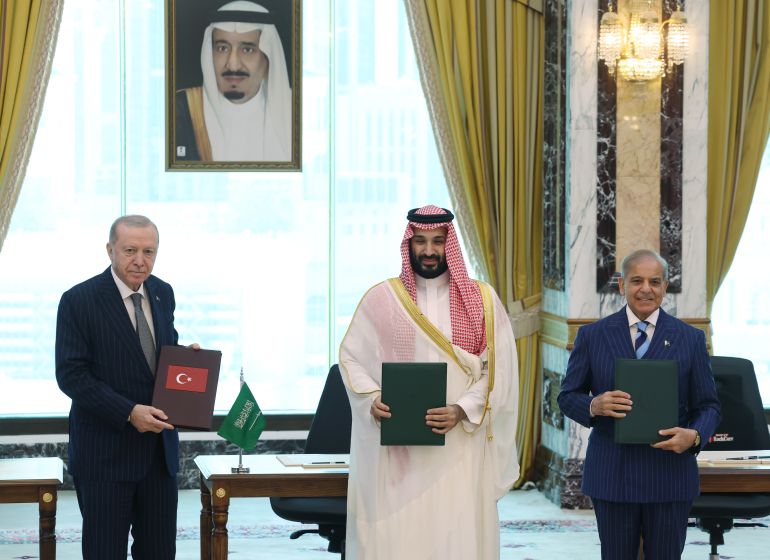
On 7 August 2026, Türkiye, Saudi Arabia and Pakistan signed a historic collective defence agreement in Mecca, modelled on NATO’s Article 5: an attack on one member is considered an act of aggression against all.
On 28 August, The New York Times, citing sources, reported that Saudi Arabia was preparing to resume a large-scale war against the Houthis. According to the newspaper, tensions had risen sharply following several weeks of Houthi attacks on Saudi vessels, airports and oil facilities. The NYT noted that a renewed war could open another front in the confrontation between the United States and Iran, which remains the Houthis’ principal ally. Against this backdrop, Reuters reported that Islamabad fears Houthi actions are highly likely to drag Pakistan into a protracted conflict.
On 8 September, acting on Tehran’s orders, the terrorist group launched large-scale coordinated strikes against four cities near Saudi Arabia’s south-western border. According to Reuters, the Houthis announced the launch of a military operation deep inside Saudi territory using drones and missiles.
The strikes targeted an airbase in the southern city of Khamis Mushait; facilities belonging to the state-owned oil company Saudi Aramco in neighbouring Abha; Najran, on the border with Yemen; and Jazan, a major Red Sea port city that houses a large oil refinery and a power station. At least 73 people, including women and children, were injured in the attacks.
In response, Saudi warplanes carried out airstrikes on the Juba district in Yemen, east of the capital, Sanaa, and on Taiz province in the country’s south-west.
During their offensive, the Houthis seized part of Yemen’s Red Sea coastline and several strategically important islands, establishing a foothold at the Bab el-Mandeb Strait, the southern gateway to the Red Sea. This waterway is a vital artery for Saudi oil exports. Its importance has increased since Iran blocked the Strait of Hormuz, virtually cutting off shipments through the Persian Gulf.
Iran’s objective is clear: to trigger a sharp surge in hydrocarbon prices in order to hurt President Donald Trump ahead of the US congressional midterm elections in early November 2026. Against this backdrop, Brent crude futures for November delivery on London’s ICE exchange rose above $108 per barrel for the first time since 21 May 2026.
Source: AA
According to Reuters sources, the Houthi advance along the coast was conducted under the direct supervision of Iran’s Islamic Revolutionary Guard Corps (IRGC).
Russian news agencies, citing Ansar Allah political bureau member Huzam al-Asad, reported that the militants had recently captured the strategically important coastal town of Dhubab, located directly at the entrance to the Bab el-Mandeb Strait. They also established control over all Yemeni islands in the Red Sea.
In other words, Yemen’s Saudi-backed pro-government forces are being systematically pushed back, ultimately increasing the threat of outright aggression against Saudi Arabia itself.
This raises the question of how Riyadh’s allies under the Mecca agreement have responded to these developments.
According to Reuters, Pakistan has confined its response to condemning the escalation and is not intervening, despite previously promising to send several warships to the conflict zone. Islamabad has priorities of its own and has no intention of complicating relations with Tehran, as doing so could leave it embroiled in a prolonged war.
Türkiye is likewise in no hurry to provide military assistance to Saudi Arabia. It prefers to watch from the sidelines while trying to persuade the parties to pursue diplomatic steps towards resolving the conflict. These efforts also involve Iran, which wields enormous influence over Ansar Allah’s military leadership.
Türkiye verbally condemned the Houthi attacks on Saudi Arabia and called for an immediate end to aggression against the kingdom. Its Foreign Ministry issued the following statement:
“We strongly condemn the Houthi attacks on Saudi Arabia, which disregard the lives and property of civilians and escalate tensions in the region. We reaffirm our support for Saudi Arabia’s sovereignty and territorial integrity.”
The ministry also stated that “these attacks undermine diplomatic efforts to end the conflict in Yemen through a lasting political solution”.
“We call on the Houthis to cease their aggressive actions immediately,” it added.
On 9 September, Pakistani Defence Minister Khawaja Asif said that attacks on Saudi territory could trigger the implementation of the Mecca agreement. Subsequently, however, Islamabad sought to temper expectations of an immediate military response.
On 10 September, Pakistani Foreign Ministry spokesperson Sajjad Haider Khan said that no military response would take place under the agreement at this stage.
“When the time comes, we will act in accordance with the agreement,” he said.
At the same time, Defence Minister Khawaja Asif stated that the expansion of hostilities into the kingdom could activate the joint security mechanism linking Riyadh, Ankara and Islamabad. He explicitly warned that continued aggression against the kingdom could trigger the pact’s provisions.

Source: Reuters
Pakistan ranks seventh in the world in terms of military personnel, and its intervention could prove decisive. Under the defence agreement, Islamabad had already sent several thousand troops and a fighter squadron to the kingdom.
Nevertheless, Pakistan remains extremely cautious about the prospect of joining the conflict. It shares a border with Iran, which is unlikely to abandon its allies. Despite these considerations, the Pakistani spokesperson said Islamabad would act “when the time comes”, but declined to specify what form such action might take.
Ankara has also adopted a cautious position, despite publicly condemning the Houthi attacks. On 8 September, Türkiye’s Foreign Ministry condemned the attacks on Saudi Arabia “in the strongest terms”, reaffirming its support for Saudi sovereignty and territorial integrity and urging the Houthis to cease their actions. Türkiye also said the attacks undermined diplomatic efforts to secure a lasting political settlement in Yemen.
However, Ankara has not announced any intention to launch strikes in Yemen or deploy troops there in response to the Houthi offensive. Türkiye’s current position therefore amounts to an expression of support without a formal commitment to military action.
Faced with an unprecedented escalation that could devastate Saudi Arabia’s economy, Riyadh is seeking outside intervention and protection. Mohammed bin Salman’s appeal to US President Donald Trump has likewise produced no results.
Thus, the three countries on whose assistance Saudi Arabia might potentially count are refraining from direct intervention that could fundamentally alter the course of events.
All this means that Saudi Arabia faces a rapidly changing situation in which it must confront an aggressive Iran and its Houthi proxies alone. Under these circumstances, the kingdom’s chances of victory are slim, and its allies have proved less reliable than expected.
As for the US position, Washington clearly appears intent on exposing the weakness of the Mecca pact, which has proved unprepared to address serious challenges. Washington is also plainly pushing the Saudi leadership towards signing the Abraham Accords with Israel, a framework that has proved highly successful in the case of the United Arab Emirates.
(If you possess specialized knowledge and wish to contribute, please reach out to us at [email protected]).