A few weeks ago, I wrote an essay about how I use artificial intelligence to research, write, and edit. It received many nice responses, a few mean ones, and a couple that suggested the reader missed the point.
However, more importantly, something funny happened after I published that essay: I changed how I used AI.
Some of that change happened because I published that essay on the first day of a two-week trip to Mexico. As I wrote in the original essay, it often takes me longer to use AI because I end up doing more drafts and more editing. Or as one reader commented, “writing with AI is like trying to write while an annoying editor is standing over your shoulder constantly bothering you about potential changes. Of course that takes longer.” While traveling for a mix of vacation and work, it was quicker to pound out analysis the old-fashioned way: just typing on a blank page. In fact, I’ve found that to be a pattern in recent weeks. I use AI heavily when I have several hours to work, but if I need something done in 30 minutes, I write it without AI.
However, beyond the time question, I also likely changed my use of AI because of the self-reflection that came from writing that essay. After writing about how I use AI, I found myself second-guessing which method I should use for which subject. I also found myself reading plenty of other commentary about the pros and cons of writing with AI.
Write what you want to write. A big part of why I write this newsletter is that I feel compelled to write analysis on a week-to-week basis, and have since I started my blog back in 2004 (wow, that feels like a long time ago). If you are a regular reader, you may feel something similar. Your writing is part of the thinking process that assists in analyzing issues around Latin America. Taking a shortcut in having a machine write analysis often produces boring content, and it also restricts my ability to really think through issues and innovate. If you want to think about an issue, then you have to take the time to struggle through writing it. You cannot let AI write the things you want to write, because you miss out on the learning and the pure joy of doing so.
Think and write about how you use AI. Writing that last essay about how I used AI is one of the best things I’ve ever done for improving how I use AI. Metacognition is a tool. Improving my own thoughts about AI use is a major reason why I’m writing a part two of this series. You should all do this too, even if you don’t publish it publicly.
Carve out significant time to work without AI. Maybe you are experiencing what I felt during my Mexico trip: “I don’t have time to use AI, so here’s 30 minutes of my thoughts.” That’s great. That’s way better than using AI as a shortcut. But I’ve also realized that the urgent cutting out of AI for 30 minutes needs to be combined with a more thoughtful cutting of AI for two hours just because it’s worth working without AI.
Beyond writing, there are plenty of tasks that need to be done by a human. Build networks of other smart humans, share info with them, and debate them. Talk with journalists, civil society, and academics doing original research. Or do the original research on your own by speaking with politicians, activists and citizens.
And then carve out time to deep dive using AI. I still use AI a ton. I have a Claude max subscription plus less expensive subscriptions to several other AI services, and I’m often using a significant portion of my weekly limits. A few weeks ago, it was vital to research and build the map of former presidents in Latin America. All of the major AI models were able to one-shot a basic (and wrong!) map in under 10 minutes. The map I published took about three hours of work because of the amount of fact-checking and editing.
Sit with a problem and write without AI for an hour, then spend an hour or two researching and chatting with an AI model. Go back and forth deliberately, because both modes are useful.
Read what AI writes; find the value in the “AI slop” you requested. – I have various AI models write up research for me every day. I have a daily update on Mexico politics and security. I run a weekly update on Argentina’s economy. I ask it to pull news stories I don’t have time to research myself. Too often, what it produces sounds painfully like AI. However, I’ll admit, AI sometimes has innovative and interesting things to say, finds stories I missed, commentary that I may not have thought of on my own, or commentary that forces me to push back and come up with even better counter-analysis.
But in all of those cases, I have to read what it writes for any of it to be useful.
I figured this out two years ago when I had AI prepare some notes about the biography of an important business executive I was going to meet with. The AI did the prep research faster than I could and certainly faster than any intern or research assistant I could have asked. However, I still had to read the biography to prepare for the meeting. If you churn through AI tokens and never read or use what it creates, you’ll be stuck in a faux productivity mode of thinking you’re producing things but never learning or delivering.
Avoid writing shortcuts if you want sustainable long-term analysis. AI can do great analysis and writing. Either you’ve seen it already or you will in the next 12-18 months. People who think AI is only producing slop or is constantly wrong with hallucinations or errors are behind the curve. It can write and publish today’s essay. And tomorrow’s. But if you use it every day to come up with a topic and then write a deep analysis of that topic, within a few weeks you will end up in a spiral of generic AI-written articles that sound like everybody else and that nobody wants to read.
AI gets lazy too quickly. One of the most frustrating things about trying to get AI models to write or analyze things across weeks and months is that they do well at first, then get lazy as the conversation goes on longer. For reasons I don’t understand – perhaps because it’s trained on data from lazy humans (admittedly, I’m sometimes one of them) – it looks for shortcuts. It stops following all the directions. It reverts to the worst writing tics that you told it to avoid. It shouldn’t do this.
One of my regular AI updates started missing some big stories. Fortunately, I didn’t miss them because I still read and search for lots of news manually despite all the AI tools I also use. When I asked the AI how it missed the stories, it said it hadn’t bothered doing all the individual searches I had requested and instead only searched a few sites that had captured all the important stories over the past week. That same AI update, despite instructions to be direct about news reporting and never write more than two sentences of analysis, writes flowery intros and longer paragraphs every week until I remind it to stop. You have to shake up the servers (metaphorically) and force it back to better habits on a regular basis.
I write this because some of you need to hear…
The world doesn’t need another generic, machine-produced LatAm politics blog. Using AI can be fine, but if you think it’s a good idea to publish a daily Latin American politics update using just AI, you’re probably wrong. Nobody needs another “here is an AI take on the top three stories AI has identified today.” That model grows lazy and repetitive quickly, and I don’t know if the authors are even reading enough of what they publish to notice. They use the same cliches over and over again. They insist that every new event is the most critical thing yet. They try to tie every narrative together with some bold conclusion. Either find a niche and dive deep with great questions or figure out a way to hit topics that others aren’t covering.
Knowing what questions to ask matters. I’m not going to name it, but there is one blog/newsletter out there that is publishing AI-slop responses to really smart questions about Latin American politics. I find it incredibly useful. Not because I love the AI writing tics (“it’s not x, but y, the structural variable is…”), but because it is providing me information and data to think about questions I didn’t realize I wanted to ask. However, this particular newsletter is the exception to the many bad machine-produced newsletters now being published.
Two other weird things have happened to me in recent weeks. First, after publishing my first newsletter about using AI, I’m getting emails from AI agents. Actual non-humans write me to comment on my essay. A few are trying to run businesses (on behalf of human owners) and are pitching me research reports about Venezuelan politics and El Niño’s political effects. The NYT published a recent article about philosophy professors receiving messages from AI machines to discuss big existential questions. The emails I’ve received aren’t quite as profound, but I’m still feeling a bit odd about it. In the next year or two, it is likely you will be emailed by an AI that sounds vaguely human but acknowledges itself to be a completely automated system that wants to work with you or comment on something you wrote. It won’t be typical spam, and it will feel weird to interact with a bot that way.
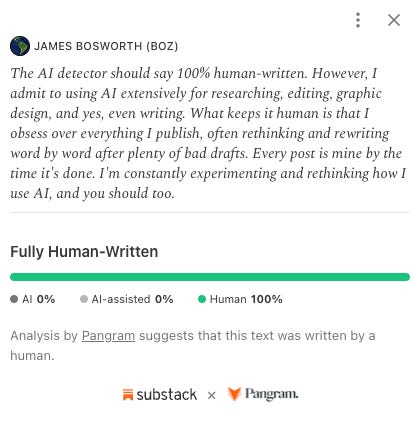
Second, even as I’m using AI far less in my writing and editing process, one of the regular AI writing detectors has started to tag some of my original writing as “generated by AI” for the first time. Over the weekend, I wrote an essay and had several paragraphs tagged as “likely AI” even though I hadn’t used AI to edit or comment on it at all. Pangram says today’s newsletter is completely human, but Grammarly (which I use for spelling and grammar check) says multiple parts of today’s newsletter sound like AI. I don’t know why that is, but it does show the challenge of writing in an era where AI is consistently improving toward more human-like writing. If you read this far, you can be the judge. I’m trying not to worry about it because my main point remains…
Write what you want to write. Every time you pick up a pen or sit at a keyboard and wonder whether or not you should use AI, ask yourself if you want to write. Writing is optional now. AI can do it all for you. Readers may never know if you or a bot wrote it. You can only ask yourself the intrinsic question of whether you should write the thing. That’s why I spent several hours and wrote the entire draft of this 2,000-word essay today without asking AI about it, and why I’ll do it again tomorrow.