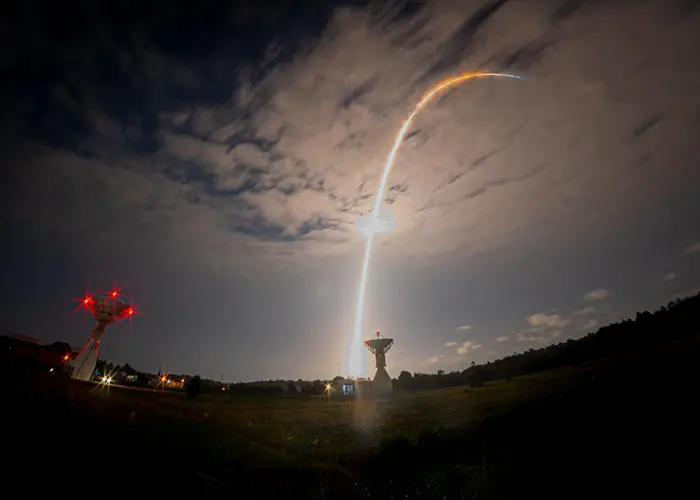
The European Space Agency’s (ESA) FLEX Earth Explorer satellite and the Copernicus Sentinel-3C satellite have been launched together aboard a Vega-C rocket from Europe’s Spaceport in French Guiana, in a mission intended to expand Europe’s Earth observation capacity.
Flight VV30 lifted off on 15 September at 03:21 CEST (14 September at 22:21 local time). ESA said a new launch adapter, Vespa, allowed both satellites to be stacked inside the Vega-C fairing for launch. Sentinel-3C was injected into orbit first, followed by FLEX around one hour later.
ESA’s European Space Operations Centre in Germany received first signals from both satellites after separation, confirming contact with ground control. Mission controllers are now conducting the “launch and early orbit phase” to check the health and performance of both spacecraft.
ESA’s Director of Earth Observation Programmes Simonetta Cheli said, “Today’s launch is the culmination of years of scientific innovation, engineering excellence and international cooperation.” Cheli added: “Developed within ESA’s FutureEO programme, FLEX is a research mission that will advance our understanding of plant health and the role of photosynthesis in the carbon and water cycles. Sentinel-3C is the third satellite in the Sentinel-3 series, systematically measuring Earth’s oceans, land, ice and atmosphere to support Europe’s Copernicus Services.”
According to ESA, FLEX is its first satellite designed specifically to measure photosynthetic activity from space. Its Fluorescence Imaging Spectrometer is intended to detect faint fluorescence emitted by plants during photosynthesis, with the aim of helping scientists assess plant health, ecosystem productivity, and the effects of environmental stress and climate change.
Sentinel-3C will continue long-term collection of environmental data, with instruments intended to observe oceans, land, ice and atmosphere. ESA said the mission will measure parameters including ocean and land-surface temperatures, ocean colour, sea and ice conditions, vegetation and inland-water levels, providing near-real-time information to support ocean forecasting, climate monitoring, environmental management and scientific research.
Sentinel-3C is part of Copernicus, the Earth observation component of the EU’s Space programme. ESA is responsible for developing the Sentinel-3 satellites. After commissioning, ESA said the Sentinel-3 mission is jointly managed by ESA and Eumetsat, with Eumetsat responsible for routine spacecraft operations and delivery of marine and near-real-time atmospheric data, while ESA delivers land, cryosphere, inland water and offline atmospheric products.
ESA said the dual launch also demonstrated Vega-C’s capability to place two Earth observation missions into different required orbits. Vega-C can launch 2300 kg into low-Earth orbit and uses three solid-propellant stages followed by a fourth liquid-propellant stage for precise orbital insertion.
Once fully operational, ESA said Eumetsat will assume responsibility for operating Sentinel-3C, while FLEX remains under ESA’s control. ESA also said FLEX will initially orbit in tandem with Sentinel-3A, and Sentinel-3C will later be moved to replace Sentinel-3A in the tandem formation. ESA said the tandem arrangement is intended to allow FLEX fluorescence measurements to be combined with near-simultaneous observations from Sentinel-3, including atmospheric and land-surface data.