
Welcome to the 231st edition of The Week in Polls (TWIP), a polling newsletter that always welcomes new readers. So please don’t keep TWIP a secret; share it with your friends and colleagues:
With all the stories swirling around Reform, JL Partners and political polling, I am finally tearing myself away from talking about the regulation of polling this week – and instead re-running a previous piece reminding us why the solution to problems with polls isn’t simply to ban or ignore them. Rather, we need them to play a vital role in making our politics – and politicians – better.
This is followed by summaries of the latest national voting intention polls, seat projections from MRPs and the most recent party leader ratings.
Subscribers who pay for the full edition can also read ten insights from the latest polls and analyses, including:
A trio of organisations and a pair of professors have been casting their eyes over the Liberal Democrats ahead of the party’s autumn conference;
What impact did the summer heatwave have on views on climate change? and
Which wins out between chocolate and cheese?
If you are not yet a paid subscriber, you can read all ten by starting a free trial now:
For more polling news as it comes in ahead of next week’s edition, you can also follow The Week in Polls on Bluesky.
Picking up on my doubt last week about whether or not 35% of British train travellers have tried to order a takeaway for delivery to a railway station or carriage, thank you to reader Iain, who has been in touch to say he has done just that… in India.
Another quick pair of updates, this time on the controversies around Reform and polling. Politico has a further scoop – “Farage aide caught in donor sting attended Egypt retreat with JL Partners” – and Ian Dunt has written about the problems with polling too: “Seeing the response of many polling experts in the last few weeks suggests that they are nervous about what is happening and keen to mitigate against it. Seeing the response of journalists, which has been basically non-existent, suggests the precise opposite.”
My usual reminder as well: please do hit reply if you’ve spotted a poll, focus group or new piece of poll-based research that you think should be in contention for coverage in a future edition. Thank you!
And with that, on with the show.
I have written before about the benefits that come from widespread availability of high-quality political polling. We need more polls and more good coverage of polls.
However, what I’ve not dug into before is the research into how accurately politicians estimate public opinion on issues.
Thankfully we have academic research to tell us.
First, the bad news:
We present results from a study of 866 politicians in four countries. Politicians were asked to estimate the percentage of public support for various policy proposals. Comparing more than 10,000 estimations with actual levels of public support, we conclude that politicians are quite inaccurate estimators of people’s preferences. They make large errors and even regularly misperceive what a majority of the voters wants. Politicians are hardly better at estimating public preferences than ordinary citizens.
Walgrave, S., Jansen, A., Sevenans, J., Soontjens, K., Pilet, J.B., Brack, N., Varone, F., Helfer, L., Vliegenthart, R., van der Meer, T., Breunig, C., Bailer, S., Sheffer, L. & Loewen, P.J. (2023a), “Inaccurate Politicians: Elected Representatives’ Estimations of Public Opinion in Four Countries”, The Journal of Politics, 85(1): 209-222.
The bad news is not quite as bad as that makes it sound because, when asked whether the majority of public opinion was for or against various policies, politicians picked the wrong option ‘only’ 29% of the time. However, this included getting it wrong even when public opinion is far from evenly split on an issue:
They do not only get it wrong when the public is divided and hard to read (e.g., when there is a 51%:49% distribution). Seventy percent of the misplacements occur for policies with a relatively clear distribution of at least 60% (dis)agreeing citizens.
Moreover, the public scored only slightly worse than politicians, picking the wrong option 2.7 out of 8 times on average, compared with 2.3 times for politicians.
Turning to the other measure of accuracy (not which side is in the lead but what the percentage support is for each side), politicians on average were 18 percentage points out in their guesses. Again, this was only slightly better than the public, whose error came in at 21 percentage points.
Further research, using the same mix of countries, gives a little more comfort about how (in)accurate perceptions are:
We show that politicians have a better understanding of public opinion when they think the issue matters to voters. Further, when an issue is personally important to politicians they more accurately estimate their party supporters’ opinions. The results confirm that politicians hold more accurate perceptions of voters’ preferences when they think it is important to do so but not necessarily when the issues actually are important to voters.
Butler, C., Walgrave, S., Soontjens, K. & Loewen, P.J. (2024), “Politicians are better at estimating public opinion when they think it is more salient”, Party Politics: 1–13.
Even so, it’s not a good picture.
The remedy for this?
Politicians should spend more time reading the polls.
So forward this newsletter to someone you know…
For a more general argument against banning polls, see my 2024 piece.
The latest episode of my Political Fictions podcast heads across the Atlantic for a dip into one of the political TV classics:
Mark and Cory talk about a giant of American political drama for the first time this week, as they tackle The West Wing. They talk about Let Bartlet Be Bartlet, the nineteenth episode of series one. In it, Mark wonders if The West Wing is actually the epitome of the “Boris Johnson school of politics”, Cory outmanoeuvres Mark into confirming we will record a Christmas Special about Love, Actually and they debate whether the central message of this episode has been misunderstood.
Cory’s email newsletter is Paperback Rioter and Mark has a family of email newsletters.
Subscribe to our newsletter for some additional bonus content and to get alerted whenever a new episode comes out.
Our theme tune is “Monkeys Spinning Monkeys” by Kevin MacLeod/incompetech.com and licensed under the Creative Commons: By Attribution 4.0 License.
You can also listen to our episode on Apple Podcasts, Spotify, the web or YouTube.
Borrowing an idea from Stuart Ritchie and others, if you spot a factual error in an edition of this newsletter, I will give you a free 12-month subscription to the paid-for version (or an extra 12 months on your existing one). Factual errors qualify, but grammatical errors or disagreements over interpretation do not, and my decision is final. Messages about both of those are always welcome, though.
Here are the latest voting intention polls from different pollsters. It is all pretty static at the moment, with a small and consistent Labour lead in nearly all the polls.

The table is also online here, along with explanations about what is included. It is updated regularly throughout the week as new polls are released.
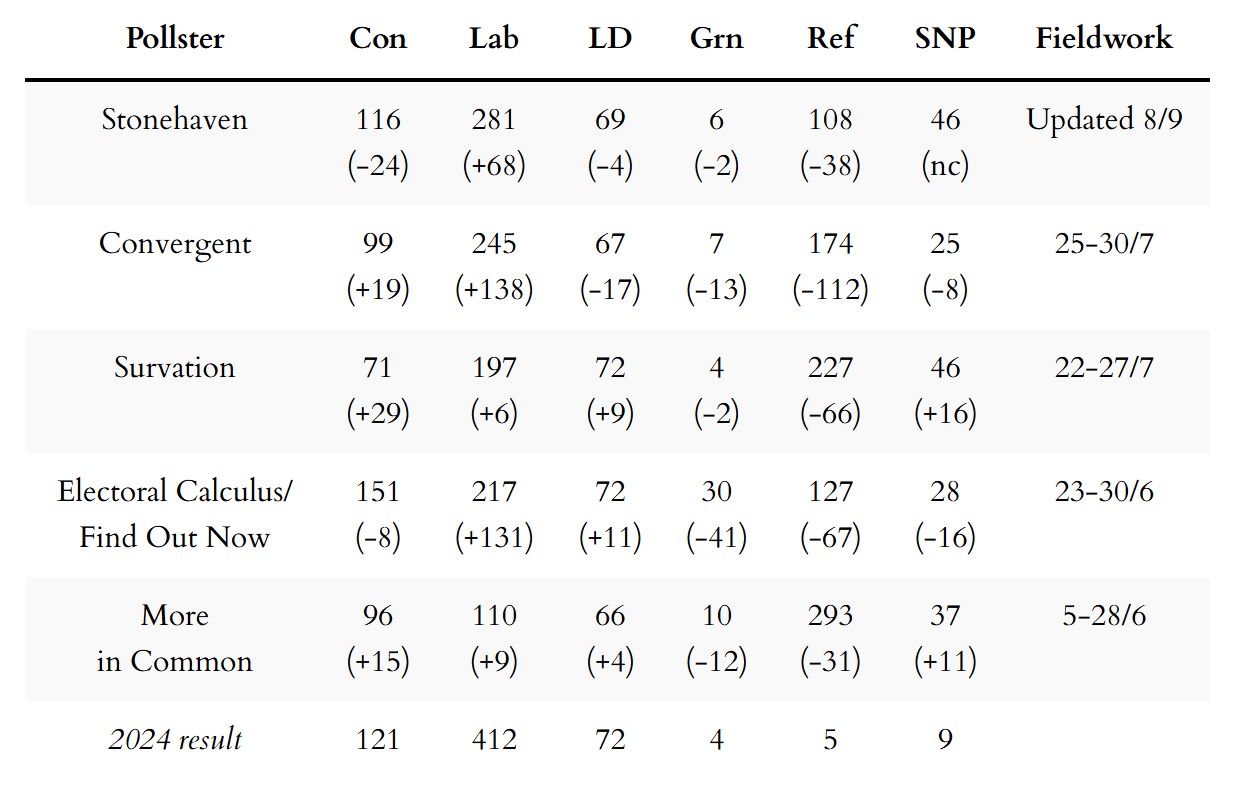
Next are the seat projections from MRPs, also sorted by fieldwork dates, listing those which are based on dedicated fieldwork (rather than models based on averages of other polls). Because such MRPs are published infrequently, some of the entries below are quite old.
Finally, here is a summary of leadership ratings, with a graph from PollCheck:
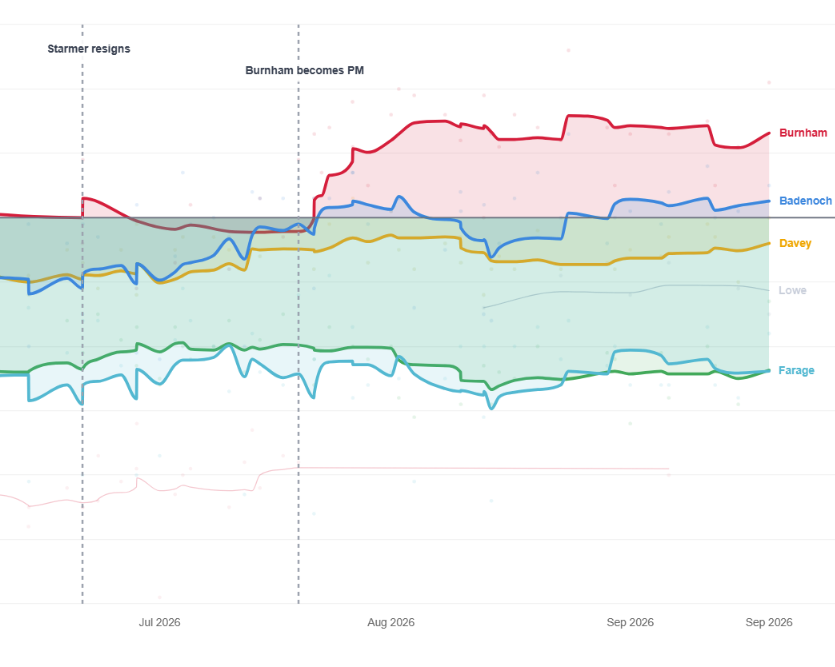
Detailed numbers from the latest polls are online here, and both that and the graph are updated regularly throughout the week as new data comes out.
For historical figures on both voting intention and leader approval stretching back to the 1930s, including Parliamentary by-election polls, see PollBase.


My privacy policy and other legal information are available here. Links to purchase books or other items are usually affiliate links which pay a commission for each sale.
Quotes from social media messages are occasionally lightly edited for punctuation and clarity.
If you are subscribed to other email lists of mine, please note that unsubscribing from this one will not automatically remove you from the others. If you wish to be removed from all my lists, simply reply to this email to let me know.
The following ten findings from the most recent polls and analyses are only for subscribers who pay for the full edition, but you can sign up for a free trial to read them straight away.
Ahead of the start of Liberal Democrat conference, we have a trio of organisations and a pair of professors with pieces out about Ed Davey’s party: