
Water seems the bane of her life, following Nur from the Sundarbans all the way here. In the monsoons, it collects in crevices between homes, creating a sweet nesting spot for mosquitoes. When neighbours are on good terms, they collect coins and bring DDT to sprinkle in the puddles. Acrid smoke rises from burning rubber and old sandals, lit by women trying to stretch the cooking fire a little further because firewood costs Rs 5 a kilo.
Nur and Kajal spot a knot of children playing tiktik, humming its sing-song chant. The older girls are away at their Quran classes, held in a makeshift hut run by a nearby mosque, their scarves neatly pinned beneath their chins. One of the children reaches out and grabs Nur’s hand, pulling her briefly into their circle.
Thakuma – small, ashen-haired, the slum’s oldest at barely 58, dengue having taken her family – returns with packets of biscuits under her arm. She walks with a totter, her voice like cracked betel nut: jagged, never unkind. When a child is left hungry and alone because their mother is at work, it’s Thakuma who notices first. She calls them in with a cluck of her tongue, presses a bowl of rice into their hands or breaks a piece of her own roti to feed them. “Don’t run around barefoot, you’ll catch fever!” she scolds one of them. “Utho [Get up]. Your pants will get dirty,” she tells another, as if it was not already dirty.
Thakuma tugs the little boy to his feet but is promptly pulled off balance herself, pitching straight into a puddle. A startled yelp escapes her as she flails. The children freeze, then break into giggles, clutching their knees and hopping away, mud flying everywhere. Dripping wet but still clutching her biscuit packet, Thakuma whacks the children on their heads, her face twisting in mock horror. “Ami ki tomader machher moto dekhaichi [Do I look like a fish to you]?” she shrieks. Her voice is so high-pitched and absurd that Nur and Kajal can’t help but cover her mouth, sniggering too.
Just when Nur has recovered, Kajal quips: “Don’t you think Taj Mira has more hair on her chest than her husband?” They start laughing again, raucously. An older boy struts past them, combing his hair with exaggerated care in the reflection of a parked scooter’s mirror, his shorts slipping dangerously low as he walks. Even that sends them into another round of laughter. Nur feels a strange thrill of understanding – the way the alley lives and breathes, with its own rules and rhythms. The laughter hasn’t subsided when Madhu madam turns up at Nur’s doorstep. Kajal scuttles away, leaving her with the starchy dhakai sari-clad lady.
“Sob-e-Barat Mubaraak. Tumar ektu time chai [Shabe-baraat mubarak. I need some of your time],” Madhu madam simpers.
Few things spoiled the slum’s mornings as much as these visits by Madhu madam. You’d think with her neat hair bun and bindi she was a neat little plant pot – peaceful – but with her frog-like eyes behind fat glasses and sugary sweet voice, she was a spy and messenger for the landlords of the para – an unsettling figure sidling about the slum, sullen with undeclared reproaches. She always came with some disagreeableness: due rent, overdue electricity charges, a complaint from a neighbour or an eviction notice. With each week, her emergency visits seethe up with greater regularity.
“Hope you enjoyed the sooji halwa?” she warbles.
Nur nods in response.
“Please pay the rent for this month. Otherwise, I will have to call Master.” Then she stretches her lips into an exaggerated English: “Okay, okay,” rounding them like the puffed lid of an overused para toilet tank, always threatening to explode.
“Mother is not at home,” Nur mutters.
“Bibi ke bole din, tell the wife, Master won’t come to the slum unless necessary.”
Nur smiles, though a raw, unbidden twist seizes her. Because when trouble brews up in the slum, Master turns up in his beaten-up Qualis, one or two men in tow stretching, spitting pudiya and adjusting their balls. They walk around, no scowls, because their mere presence is frightful enough for dues to get cleared. Master, however, is the lowest in hierarchy in this unique three-tier tenurial structure.
Most slums in Kolkata developed on land occupied without formal permission – either from the government or private owners – and were usually categorised into a few familiar types: jhupri, the ones clinging to roadsides; khaldhar, lining the edges of canals; udbastu, sprawled across unused public grounds; and rail colony, stitched into the narrow strips flanking railway tracks. Here, in New Town, the arrangement was slightly more hybrid and calculated.
Above Master sat the real landlords of the slum: Mithun and his cousins, their wealth tied up in a handful of vacant plots in New Town. In appearance, Mithun outranked Master. But, in reality, he was like the bird in the Bengali writer Upendrakishore Ray’s children’s story “Buddhir Juddho” (The Battle of Wits). Master played the tailorbird to Mithun’s king, loyal in performance, building his own empire in the margins – rental properties, microloans to residents of informal settlements, scrap trading, connections with local political figures. Mithun, in turn, pretended to trust Master. He allowed Master these liberties because he himself couldn’t risk independence. Both men performed their roles knowing someone else wrote the script. Because above them both loomed the real power – the invisible third tier of the system – unreachable and always watching.
Before the roads widened and the glass towers arrived, New Town was farmland. A wide expanse of ponds, orchards, nurseries and tight-knit villages. The people here were mostly farmers, fishermen, Dalits and Muslims, who didn’t have much, but they had what mattered: farms, schools and electricity. The land wasn’t owned in neat plots. Tenure was shared, split and negotiated – some worked as tenants, others as labourers. The bonds were fragile but sustained a kind of balance.
As Calcutta burst at its seams, the then CPI(M) government came up with a plan of making a “green, eco-friendly, self-sufficient, and smart city” in the 1990s. As a part of their vision of a satellite township, the once wild, cultivable plots dotted with numerous pukurs were reshaped, resized and turned into construction sites for high-rises, factories, offices and malls. Growth piled upon growth. Where wetlands once negotiated space among trees, water and soil, the argument was settled by concrete.
Promises were made – buffer strips to keep the cattle grazing, some land set aside for vegetables – but promises thinned as land prices fattened. In time, the villagers lost their fields, their ponds and their commons.
A few were lucky – or strategic – enough to stay. Families with pucca homes turned landlords, renting out back rooms to distant cousins and migrant workers.
In the mid-2000s, one such landlord, Mithun, his uncle, and cousins began to do an experiment. They decided to build a row of huts for construction labourers and migrants who came in from across West Bengal and Bihar. Soon after, a row of relatively uniform huts was occupied in what once was kola, pepe bagan – banana, papaya fields.
After cyclones Sidr in 2007 and Aila in 2009 – the invisible nexus of power – councillors, thugs, brokers and beat cops – greased the machinery that brought many a migrant in from storm-riddled villages on both sides of the border and kept the profits flowing. Master’s project expanded alley after alley until it became a densely occupied slum of 200-odd families.
On Google Maps, Nur’s slum appears as a blank space. The streets are there – the ones with names, shops and addresses – but the settlement itself remains unmapped. The Sonam Biryani stall. A mechanic for bikes, a one-chair men’s salon and a row of neat high-rises behind. But when the map reaches the edge – just where the huts begin – the view cuts out. No street view, no markers. The canal that divides the slum for the stalls and high-rises looks like a thin blue ribbon on the map, though, in reality, it was a green ooze. Here, help arrives late or not at all: ambulances and fire trucks. Police vans are almost never seen.
Before leaving Bangladesh, Nur had expected Kolkata to be a magical city of wealth. She thought everybody in the city worked until they had reached Topsia, where many women staying alongside them in a room lived off begging, with babies on traffic signals who were made to scream with chilli powder. If their mouths were no longer sensitive, then their anus was so treated. Since Nabeel, the baby of the family, was too old to use as a prop and too useless to be taken around, for the few days they were in Topsia, their mother worked at a construction site. With minimal wages, they rented blankets and bought leftovers from stalls. Nur complained about the food, but Nabeel ate chowmein with zest. He then retched up his indigested food at night, watched by women relieving themselves at the dumping ground nearby, shielded by the dark.
In that short time, Nur had figured out the social map of the city. Those in Topsia were the “employed” class, living in the heart of the city; however, dirty. They had homes made of bricks, factories to work in, many construction sites that offered work and a treasure of trash to pick every morning. In short, it offered three square meals a day. The more downtrodden, surviving on uncertain incomes, lived in smaller, peripheral slums like this one that Lalu had found for them.
Nur rarely left the slum, but since the previous week, she’d started venturing out, going to market to stock rice and buy fish.
A trash-trodden path led her to a tarmac road, a trajectory that takes her to the neighbourhood with homes cocooned by security gates, electric fences and walls embedded with shards of glass. The lights from high-rises twinkled, expanded and contracted through a haze of pollution. These are the same homes where her mother works.
On some days, she tries to walk like she belongs here – shoulders back, eyes ahead, hijab drawn neatly over her head. But the stares always catch up. The guards of the buildings, the sweepers and drivers – everyone carefully assigned to the sanitised side – watch her too long, their eyes wary. They have heard the stories of people coming in illegally from across the border.
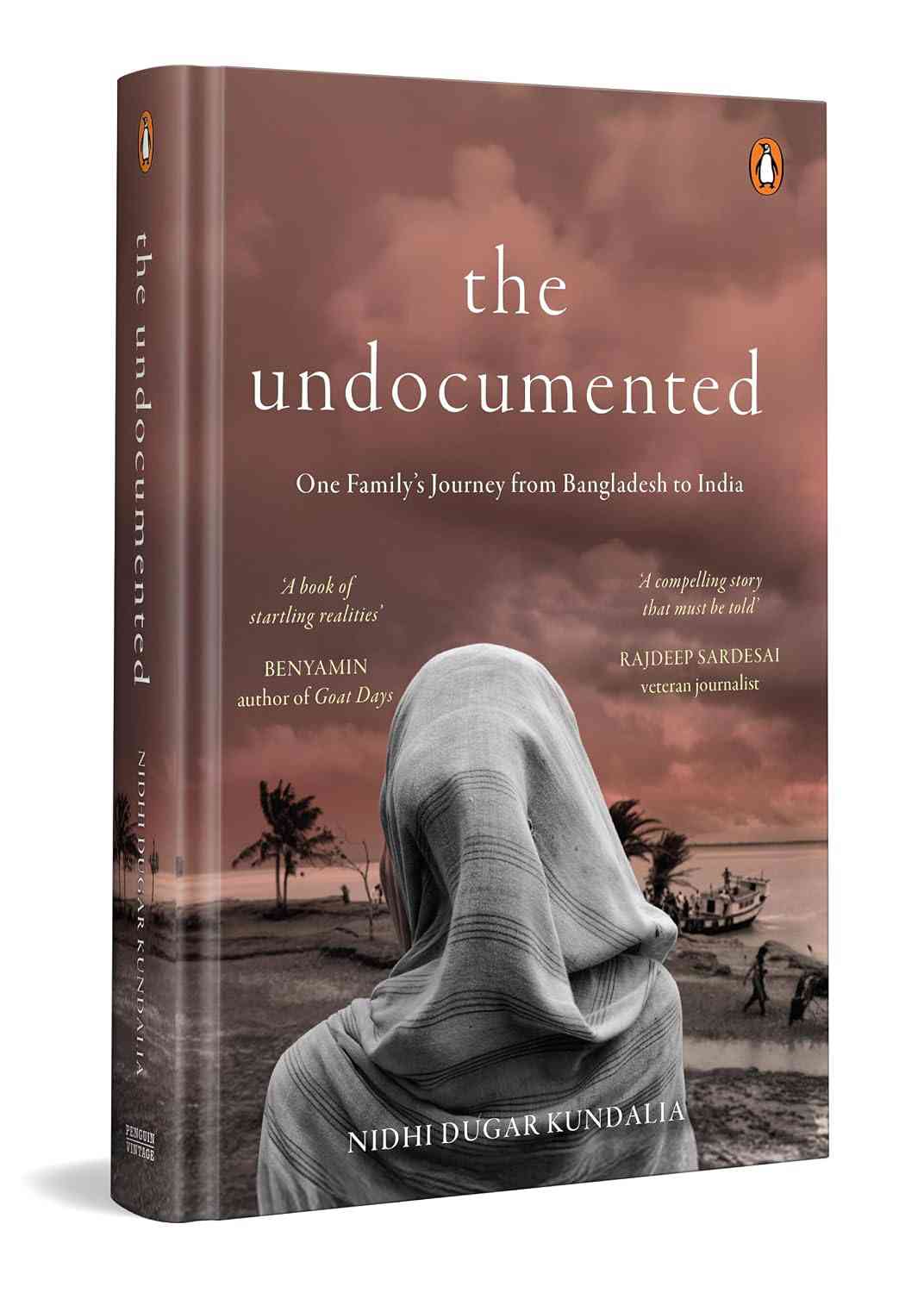
Excerpted with permission from The Undocumented: One Family’s Journey from Bangladesh to India, Nidhi Dugar Kundalia, Penguin India.