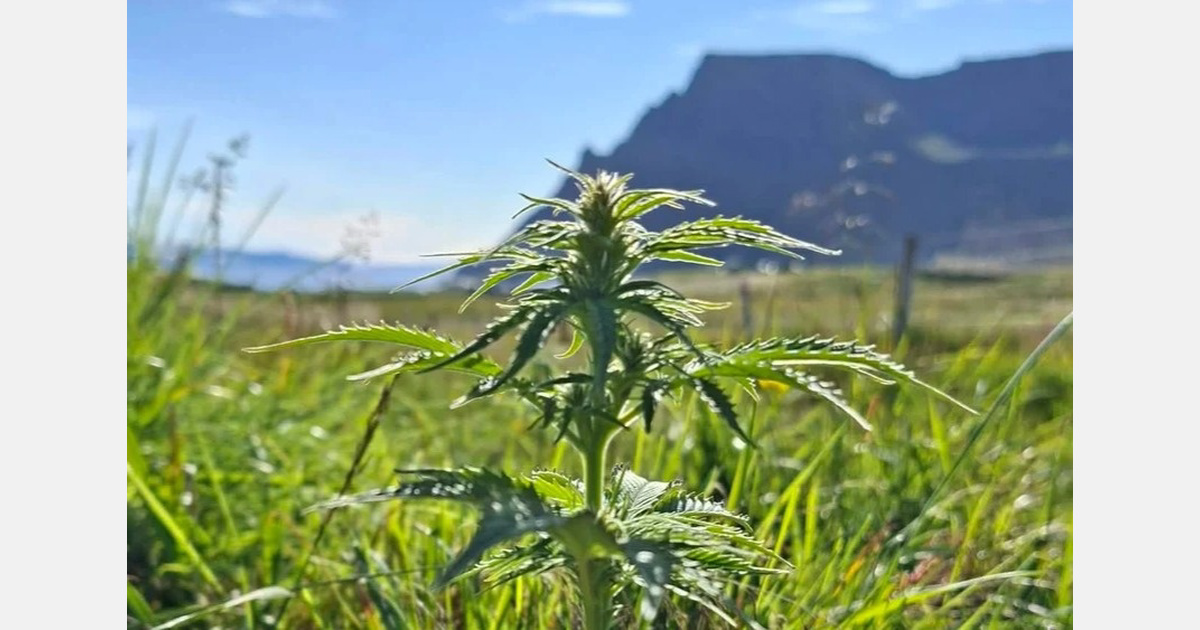
At 66 degrees north in Iceland’s Westfjords, day length does not fall below 12 hours until the 21st of September. This conventional photoperiod hemp plant starting to flower just as the first frosts arrive.
High Latitude Hemp, a small family-owned company based in Bolungarvík, grows CBD-rich hemp in the far north-west of the country. Here, owner, scientist and grower Sigurður Halldór Árnasonis also developing cultivation knowledge and genetics suited to northern conditions. “The biggest challenge is the photoperiod. In Iceland you have 24 hours of daylight all summer, and it doesn’t go below 12/12 until the 21st of September,” says Sigurður. “Around September and October you get frost, so if you´re just starting to flower at this time, then you’re in bad shape.”
The second problem is temperature. According to Sigurður, the north-west of Iceland runs on average 2 to 4 degrees colder than the south, with summer temperatures between 6 and 20 degrees Celsius in a good year. “The first can be overcome with plants we have on the EU list, the second one needs to be worked on with breeding,” he says.
 © High Latitude Hemp
Breeding for a short northern season
Iceland legalized hemp cultivation in 2019 for plants under 0.2% THC, following the EU rules of the time, and growers can import seeds from the EU’s certified catalogue, which according to Sigurður lists about 130 CBD varieties.
However, inclusion in the catalogue does not necessarily mean that a variety is suited to Icelandic growing conditions. At this latitude, the question is not only whether a plant will grow, but whether it can complete its cycle before cold and persistent wet weather arrive. High Latitude Hemp is therefore focusing on developing plant material adapted to the Icelandic season, with strong biomass and CBD production as well as the longer-term potential to support seed crops for Icelandic farmers.
The company’s first outdoor attempts added a third problem to the list. Late summer in the Westfjords brings heavy rain, and the combination of wet weather and falling temperatures creates favorable conditions for mold. “Growing premium hemp flower outdoors is a big challenge, as mold late in the season is going to be a major factor we have to deal with,” says Sigurður. “It gets quite wet in late August and early September.”
Indoors for now
Until plant material suited to outdoor production ready, every product High Latitude Hemp sells comes from a state of the art 120 m² indoor room with LED lighting and four deep water culture (DWC) systems.
The room operates without supplementary CO2, and is kept between 18-22 degrees Celsius. Sigurður harvests around 100 grams of premium CBD flower per plant. He has also run pheno hunts on legal CBD varieties on the EU catalogue, and currently grows eight phenotypes from two varieties. “In Iceland the prices are relatively high, so you get a decent number for your wholesale product,” says Sigurður. “It works if you maximize the space you have.”
According to Sigurður, electricity in Iceland is relatively inexpensive compared to most countries in mainland Europe and North America. He worked with aquarium systems and water chemistry in his earlier research, and now uses the local water with his nutrients while monitoring the pH closely.
“In Iceland we have the best water in the world, I can say that without hesitation,” he says. “Here in the Westfjords we have some of the oldest bedrock in the country, and specifically here in Bolungarvík we use springwater from a newly installed borehole, so the water is very neutral, with a steady at 6.5 pH.”
The company currently sells flowers and pre-rolls which in Iceland are sold openly in stores under the alcohol and tobacco legislation as a smokable herb. High Latitude Hemp is also developing ointments and a CBD oils due to launch in the coming months. According to Sigurður, most CBD ointments on the Icelandic market are made abroad, and he knows of no one making a cream from Icelandic-grown CBD. High Latitude Hemp currently sells their CBD Flower and Pre-rolls in retail stores in Ísafjörður in the Westfjords and Reykjavík, as well as in the company’s online store, highlatitudehemp.is,
An industry beyond CBD
The research side of the company runs on grants from Icelandic funding bodies, including the national research foundation, while the products cover the running costs. “The product side is what keeps the company running from day to day,” says Sigurður. “Through these other grants, we do the research.”
 © High Latitude Hemp
This two-track model allows High Latitude Hemp to grow and sell Icelandic hemp today while developing the cultivation knowledge and plant material needed for Icelandic hemp agriculture tomorrow.
The longer-term plan extends beyond CBD. According to Sigurður, much of Iceland’s agricultural land is underused, while farmers have relatively few higher-value crops suited to those conditions. “We aim to develop not just an Icelandic CBD industry, but an entire hemp industry from A to Z, so farmers can produce protein, oil, fiber, all of the things the plant gives us,” he says. “People think that hemp belongs in warmer agricultural regions, and we want to challenge that assumption.”
For more information:
High Latitude Hemp ehf.
[email protected]
+354-774-7330