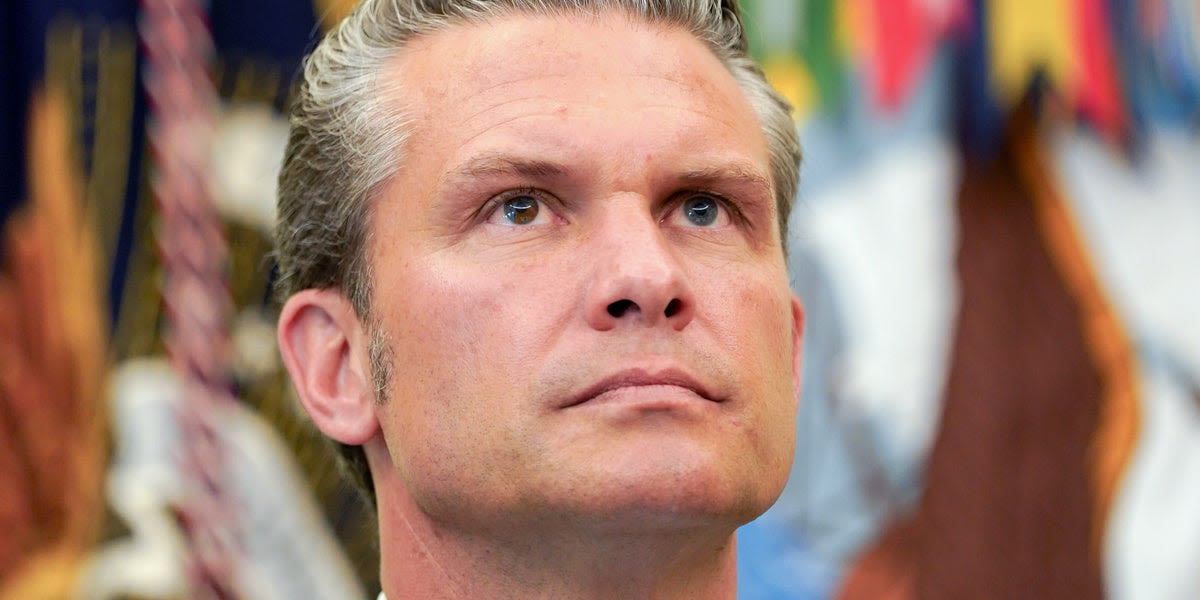
On top of everything else going on this week, Defense Secretary Pete Hegseth is now working Christian nationalism into his military pep talks.
Over the weekend, Hegseth kicked off his “Send Me Tour” in Texas. The name is an allusion to a well-known passage from the Old Testament, Isaiah 6:8, in which God asks, “Whom shall I send?” and the prophet Isaiah responds, “Here am I. Send me.”
Politics: Pete Hegseth’s Pastor Says He Wants James Talarico To Die
That religious framing didn’t stop with the tour’s name. During a stop at Texas A&M University, Hegseth further blurred the lines between worship and military service, invoking prayer and religious language in a speech to a group of young recruits.
“For 250 years of this country, there have been men and women who raised their right hand and said, ‘Send me,'” Hegseth shouted.
“Send me to go fight the Redcoats. Send me to go fight the Communists. Send me to go fight the Islamists,” he said, adding, “If we don’t have Texans like these out there on the front lines, we don’t have a republic, so we need the nation to raise their right hand and say ‘Send me.'”
The viral moment comes as Hegseth’s net favorability has fallen to a record low, according to a recent poll, amid growing public opposition to the Iran war. It also comes as Republican Rep. Thomas Massie of Kentucky pursues an impeachment effort against Hegseth.
Christian leaders HuffPost spoke to criticized Hegseth for using Scripture in a military recruitment campaign for an unpopular war and framing the conflict as one religion against another.
Life: Experts Sound The Alarm On Trump’s New Streaming Channel ‘Tactic’
Rev. Paul Brandeis Raushenbush, president and CEO of Interfaith Alliance, an ordained Baptist minister and former HuffPost editor, said that Hegseth’s motivational speech was better suited to the 12th-century Crusades than the U.S. military in the 21st century.
“The U.S. is not a theocracy and we don’t fight holy wars,” he said. “[Hegseth] refuses to recognize that the U.S. military is meant to serve and respect all Americans, regardless of faith, and not to carry out Christian nationalist crusades.”
“Pete Hegseth is exactly what he appears to be: an extremist who believes that the U.S. government and military should be a tool for advancing a narrow, repressive and violent religious worldview,” Raushenbush said.
Rev. Brandan Robertson, the pastor of Sunnyside Reformed Church in New York City, said Hegseth’s “Send Me Tour” is another example of the Trump administration “manipulating Christianity to justify its ungodly agenda and retain conservative Christian support.”
Life: Trump Often Practices This Unusual Habit For A President. Experts Say It’s A Political Weapon.
“When he talks about ‘the Islamists’ and ‘fighting the communists,’ he isn’t referring strictly to extremists and terrorists; he’s talking about Americans who hold different political ideologies or belong to different religions ― people who are our neighbors and friends,” he said.
And people who serve in Hegseth’s military; according to official data from the Department of Defense, there are nearly 6,000 self-identified Muslim service members actively serving across all branches of the U.S. military. (Roughly 400,000 service members at the time choose not to declare a religious preference on their records, so the number is likely higher.)
Like this article? Keep independent journalism alive. Support HuffPost.

Rev. Brandan Robertson, the pastor of Sunnyside Reformed Church in New York City, said Hegseth’s “Send Me” tour is another example of the Trump administration “manipulating Christianity to justify its ungodly agenda and retain conservative Christian support.” Bloomberg via Getty Images
Scripture calls people to love and respect that kind of diversity and difference, Robertson said, “yet Hegseth has made it clear, for the world to hear, that he intends to wage war on them. That is not only un-Christian; it is fundamentally un-American and poses a dire threat to our democracy.”
There’s a war on non-white Americans, too, if we look at the Trump administration’s other recent use of Isaiah 6:8: the Department of Homeland Security (DHS) quoted the verse in a dramatic ICE recruitment video just last summer. In the one-minute clip, a narrator with a Southern accent and U.S. Customs and Border Protection patches quotes Isaiah 6:8 while military-style operations play out, soundtracked to Johnny Cash’s “God’s Gonna Cut You Down.”
Life: People Are Celebrating Joyce Beatty For Standing Up To Trump — Here’s What She Said That’s So Huge
“While Isaiah 6:8 has inspired people of faith over millennia to follow their God-given callings in life, Hegseth and his allies at DHS use it as a naked appeal for their would-be Christian warriors to carry out repressive violence at home and abroad in the name of the Trump Administration,” Raushenbush said.
It fits their worldview, Raushenbush said. “For them, God and religion is never about compassion, charity or mercy, but always about power and subjugation.”
‘A textbook example of American Christian nationalism.’
All of this is a “textbook example of American Christian nationalism,” said Andrew Whitehead, a sociology professor who studies the topic at Indiana University Indianapolis.
“Christian nationalism aims to privilege a particular expression of Christianity in our national identity and social policies, and to do so it must cultivate fear of ‘others.’ ― Muslims, communists ― in order to motivate Americans to engage in violence to ensure this version of Christianity maintains its privileged position,” he explained.
Life: Experts Spot An Alarming Comment In This Otherwise Ridiculous Trump Statement: ‘He’s Not Joking’
“The goal of securing power by cultivating a sense of fear and threat will inevitably lead to violence toward those deemed as ‘outsiders,'” Whitehead told HuffPost.
While U.S. leaders have leaned on religious themes to legitimize their plans to use military force, the Trump administration’s willingness to directly quote specific Christian Bible verses to baptize their use of military force is unique, Whitehead said.
“The use of Isaiah 6:8 is essentially trying to say that God has commanded these leaders to send people to fight and die for this particular cause,” he explained. “Quoting Isaiah 6:8 serves to baptize their military plans in the will of the Christian God. And if the Christian God is commanding it, who can oppose it?”

While U.S. leaders have leaned on religious themes to legitimize their plans to use military force, the Trump administration’s willingness to directly quote specific Christian Bible verses to baptize their use of military force is unique, said Andrew Whitehead, a professor of sociology who studies the topic at the Indiana University Indianapolis. Andrew Harnik via Getty Images
What’s worse, Hegseth has a ‘clear ignorance of the Book of Isaiah,’ one pastor said.
Using Bible verses to justify violence runs counter to Jesus’ teachings, but Isaiah 6:8 was a particularly bad choice here, said Benjamin R. Cremer, a Wesleyan pastor, theologian, and writer based in Idaho.
“Using [it] as the scripture of choice for this tour just makes it all the more superficial and performative,” he told HuffPost. “Picking it as a verse encourage people to fight wars reveals a clear ignorance of Isaiah, who repeatedly warns against trusting in military power.”
For instance, Isaiah 2 envisions a future in which, “They shall beat their swords into plowshares…” and “nations shall not train for war anymore.” Isaiah 30 criticizes Judah for relying on military alliances instead of trusting in God.
“And Isaiah 31 specifically condemns reliance on horses and chariots from Egypt,” Cremer said. “A recurring message throughout Isaiah is to trust God, not military might. (Hegseth must have missed Bible study that day.)
It should be alarming to all Americans ― Christians included ― that the highest-ranking civilian leader of the U.S. Department of Defense is using the Bible to frame military service and war as holy.
“If this were a radical Muslim military leader in another country using a passage from the Quran in front of a crowd of recruits to stoke their commitment to a “holy war,” the condemnation would be swift and severe, especially from Christians in America,” he said. “It would be called ‘terrorism’ and ‘radical.'”
Yet when similar behavior occurs within our own country and among our own religious communities, condemnation from Christians in America remains largely focused on extremism in other religions rather than within Christianity itself, Cremer said.
It makes him think of another Bible verse.
“As Jesus said in Matthew 7:3, we look at the speck of sawdust in our neighbor’s eye but ignore the plank in our own.” the pastor said. “If you’re wondering why Christianity at large is becoming increasingly unpopular in America, this hypocrisy and blatant misuse of the Bible in pursuit of power, in complete disregard for our Constitution, is a huge reason why.”
Related…