
The college partnered with Kingsborough Community College in Brooklyn to deliver a five-day, hands-on training from Sept. 21-25 for students to learn practical skills in clean energy fields, as well as connect them with jobs that are increasingly in demand as New York raises its climate goals.
Bridges to Renewable Energy and Sustainable Technology (REST), a free multi- and single-day continuing education program, is funded by the New York State Department of Labor (DOL) through its Office of Just Energy Transition (OJET). It also receives supplemental funding through Con Edison for single-day training.
According to Robert Zandi, associate director of Renewable Energy Programs at Kingsborough, as well as lead director of Bridges to REST, the intention of the program is to provide first-step exposure and information about renewable energy and sustainable technology sectors.
Zandi, who has 25 years of experience in the sector, created the program’s curriculum and secured all of the resources and funding needed to operate it.
The curriculum covers history, science, methods, systems, trends and practices related to renewable energy and sustainable technology, along with information about New York’s climate goals, recent regulations and laws designed to utilize and implement more clean energy systems and practices throughout the state.
 Students build renewable energy kits and learn to power electric vehicles using solar and wind energy. Photo by Renee DeLorenzo
Zandi sources information through the NYC Economic Development Corporation, which provides data on workforce projections, and has published his own findings to help identify what the training program should be focusing on most.
Since Kingsborough received its grant from OJET early this year, the college has already collaborated with other schools, community-based organizations and environmental justice organizations to host training sessions.
To date, the multi-day program has been presented at Kingsborough, LaGuardia, Cypress Hills Community Center in Brooklyn, East Side House Settlement in the Bronx and Good Shepherd Services.
The benefits of the program are multilayered, Zandi said. Not only does it provide job training to the community, but it also helps inform them of the impacts of climate change.
“It’s an amazing opportunity for people to get a vast understanding about the history, science, technology, jobs and additional training programs in these sectors,” he continued. “Not only do we provide different supportive wraparound services for the students participating in this free program, but we also facilitate career navigation.”
Zainab Koli, one of the Bridges to REST instructors, said the multi-day program spans topics across many energy sectors, including solar, wind, geothermal, hydropower, and green buildings and infrastructure.
The program is not lecture-heavy, however. Koli explained that it provides hands-on activities to help students learn practical skills as well.
On Tuesday, students walked around the school and acted as a consulting team to evaluate the building’s sustainability, providing feedback and suggestions to improve its efficiency. On Wednesday, students built renewable energy kits and experimented with solar, wind and battery storage to power miniature electric vehicles.
“Obviously building a solar panel isn’t easy,” Koli explained. “But it’s to get them to understand how powerful solar can be, even on a small scale.”
Students also toured LaGuardia’s urban farm, Finca La Florecira, located on the campus.
 A student learns how to use a wind turbine to store energy. Photo by Renee DeLorenzo
Koli said the curriculum is extensive, and she tries to cover as many topics as possible. That includes, she continued, career-ready topics such as how to create a LinkedIn account, apply to jobs and prepare for interviews.
The program emphasizes New York’s investment in energy storage, Koli continued, and the class often talks about local laws and renewable energy efforts on a global scale.
“I think this is where we are in the world,” she said. “We talk about the seasons shifting. We’re seeing flooding, and extreme heat is killing people who don’t have access to AC. But then we look at the bigger picture. There’s so many issues people are dealing with, and it’s usually impacting Black and Brown low-income people across the world. A lot of these students come from these same communities and have their own lived experience and knowledge.”
Students in the program are not required to be enrolled at LaGuardia, and many of them come from other fields and countries looking for opportunities to switch careers.
Leandro Mesia, who attended this week’s program with a friend, said he currently works in dialysis but is interested in transitioning to another career path.
Mesia is an immigrant from the Philippines who arrived in the United States in 2001. He explained that while his home country continues to pursue actions that address climate change, it does not have the same kind of educational and hands-on programming as the U.S.
“In our country, they’re pushing renewable energy to improve the standard of living,” he said. “But there, they don’t have this type of program. It’s very limited.”
After learning various skills throughout the week-long program, Mesia said he’s interested in pursuing solar installation and even plans on taking his education further through another 14-week program.
 Leandro Mesia, right, helps build an energy kit to power a small electric vehicle. Photo by Renee DeLorenzo
Thierno Barry, who was born in Guinea, West Africa and immigrated to the U.S. six years ago, said he earned a bachelor’s degree in finance in his home country before earning another bachelor’s degree in political science in the U.S. While he’s highly educated, he said it’s still been difficult finding jobs.
That’s why, Barry said, he joined the Bridges to REST program — to help learn and develop more skills in a field that is in high demand. By using his existing skills in finance and political science, he continued, he could help advocate for change in renewable energy and help ensure it’s economically feasible.
“I think sometimes about how it’s good to go back and learn new skills,” he said. “If I start now, then maybe down the line I can go back to school.”
He said the most interesting part of the program is learning the ways the city, state and federal government can finance renewable energy. “It’s something that will be very good in the future, and a lot of people will need to do these jobs,” he said.
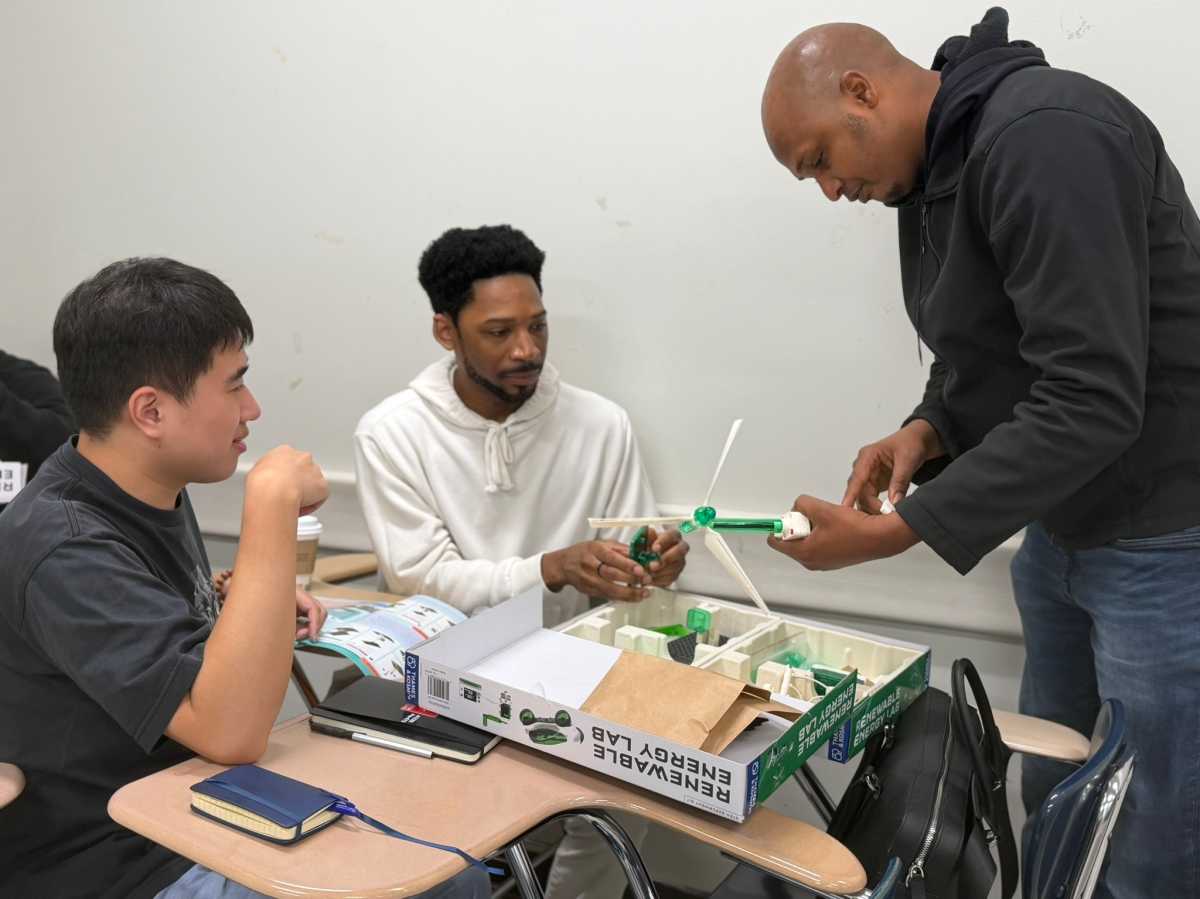 Thierno Barry, right, helps build a miniature wind turbine. Photo by Renee DeLorenzo
Zandi said the program is attracting participants from all walks of life with varying levels of knowledge about the renewable energy sector. Some already work in the field, he noted, but there are plenty of others who have no experience in the industry.
“There’s such a plethora of opportunities within the renewable energy and sustainable technology sector thanks to New York State’s ambitious climate goals,” he said. “There’s a lot of workforce gaps, so there’s a lot of opportunity to fill these jobs.”
Koli added that the program shares information with students that they can bring back to their own communities. She said it can help them implement solutions more tailored to their community’s needs.
“It’s about bringing material impact to communities,” she said. “It’s not just wealthy people who have access to renewable energy jobs. We want to train up New Yorkers and immigrant communities who’ve been the most impacted by climate change and let them be the ones leading and benefiting in the future.”
Bridges to REST is always gauging interest in the program through a survey visitors can fill out online.
“We try to cast as wide of a net as possible and invite anybody and everybody that might be interested in checking it out,” Zandi said. “It’s projected that 400,000 jobs need to be filled by 2040, so it’s a vital part of fulfilling New York State’s climate goals while inspiring, educating and empowering our community to be part of the future renewable energy workforce.”
Upcoming multi-day training sessions will be presented at Malikah Safety Center in October, Red Hook Initiative in November and Kinetic Communities Consulting (KC3) in December, along with single-day presentations at Opportunities for A Better Tomorrow in October, Brooklyn Navy Yard STEAM Center in November, and Good Shepherd Services with dates to be announced.
For more information about the program, visit their website here.