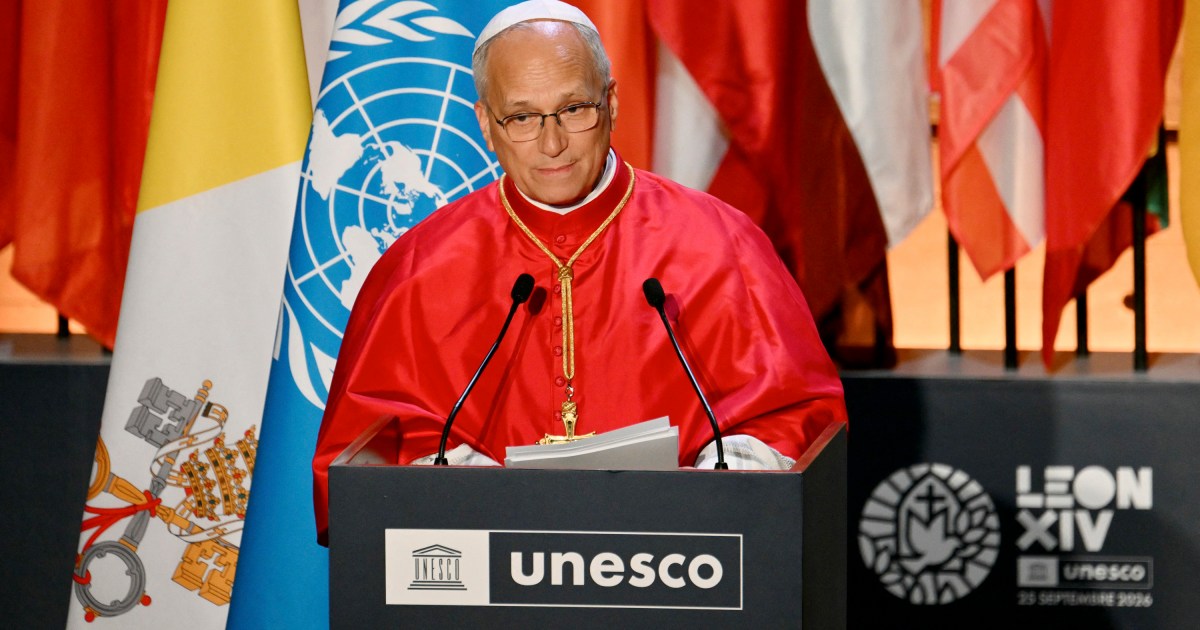
On Friday, September 25, the first day of Pope Leo XIV’s trip to France, he visited the headquarters of UNESCO, the United Nations Educational, Scientific and Cultural Organization. The text of his speech is rich in ideas, and cites Paul VI, John Paul II, Benedict XVI, and Francis, as well as Vatican II and UNESCO’s own constitution.
Here are some key ideas and quotes from this dense and powerful text.
UNESCO’s mission
Pope Leo XIV quoted UNESCO’s constitution, which states that its mission is “to contribute to peace and security by promoting collaboration among the nations through education, science and culture in order to further universal respect for justice, for the rule of law and for… human rights and fundamental freedoms.”
In the light of this, he expressed his appreciation for UNESCO and its mission, describing the international organization as a “privileged partner in the service of the common good.” It is also, he says, an “objective and a means for pursuing” the commitment to “building a just world.”
He also recognized that in today’s world there is a crisis of trust in international institutions. These organizations are “expected to respond to challenges that no individual State can face alone.” At the same time, they are “experiencing a crisis of effectiveness” because dialogue is often “seen as an obstacle to action” or as “a charade.”
In this light, the Holy Father stressed the need to promote the virtue of trust: “Trust that differences do not necessarily constitute a threat” and “trust that honest dialogue can bring about a greater good than what individuals could achieve on their own.” He went on to say that the Holy See wishes to increase this trust specifically in UNESCO and other international organizations.

ALBERTO PIZZOLI | AFP
Education
Education is one of the three main areas in which UNESCO works. The Holy Father highlighted the Church’s own “ancient tradition” of education at all levels, “even in the poorest and most remote places.” He also noted that our “first educational setting” is the family.
Leo XIV emphasized that education is incomplete without addressing “the question of life’s meaning.” Reflecting on the meaning of life from a Christian perspective implies recognizing in every human being “that transcendence of the person which is part of the fullness of their humanity.” Education means helping people “to ‘be’ more and not merely to ‘have more.’”
When education “abandons the truth,” it “can become an instrument for manipulating consciences.” Indeed, “those engaged in education know that only the truth sets us free,” the Pope says, whereas “error enslaves us to ignorance and superstition.” Education is vital for peace, because it is “the way to overcoming mutual distrust.”
Science
Leo XIV points out that science can and should be “at the service of every human being.” However, it “risks losing its proper meaning,” ceases “to serve and reflect human dignity,” and “risks degrading the fruits of human endeavor” when it is “pursued without ethics” or “reduced to a technique of power.”
Such is the case when “science itself is placed at the service of an inhumane will to destroy and kill” through war. “Scientific progress, when severed from wisdom, can turn into a weapon of destruction,” he emphasized.
On the contrary, science—along with education—is called to cultivate both the earth and “the humanity that inhabits it.”
Culture
“Man lives a truly human life thanks to culture,” Leo XIV said, quoting Pope St. John Paul II’s 1980 address to UNESCO. Culture “implies the process by which humanity bestows meaning upon all its activities.” “Every culture,” he explains, “according to the very etymology of the word, is an act of cultivation,” of making humanity grow in harmony with creation.
Every culture has to face the question, “What does it mean to be human?” Even when guided by right reason alone—as the Holy Father tacitly demonstrates through several arguments—we can discover that all people are brothers and sisters. We all receive life without asking for it or choosing the circumstances of our birth, and we are all born naked and in need. We all have “immense dignity,” no matter if we are young or old, weak or strong, and we all will die.
From a Christian perspective, every person is “a creature willed and loved by God.” This truth is foundational for Christian culture.
A “culture of peace” based on the virtue of justice and “an upright will” is essential for building a lasting peace among nations. Treaties without a culture of peace are “not sufficient.” Every culture “realizes its highest wisdom when it seeks peace and the good of all.”
However, when culture is “subjected to ideology,” Leo XIV warns, it “can degenerate into falsehood and propaganda.” Culture is also threatened by the breakdown of substantive communication that can occur when modern communication technologies and artificial intelligence are abused.
Technology
The advent of new technologies has made communication faster but “not necessarily more truthful,” the Holy Father points out. These technologies risk spreading false information and “words devoid of meaning,” which “hinder dialogue rather than fostering it.”
Artificial intelligence can make this problem worse. Although AI systems “can correlate data, they cannot answer questions that concern the meaning of life” because they do not have “lived experience.”
Leo XIV also warns that children and young people are especially vulnerable to exploitation through these technologies, and he encourages the international community to protect them.
This makes education in the area of technology essential, the Pope notes. Consequently, he praises UNESCO’s Media and Information Literacy program, which “promotes the responsible use of media and digital tools.”
“May these technologies support their growth, education and relationships,” Leo XIV says of children and young people, “safeguarding their freedom to think and discern, and always remaining at the service of the dignity of the human person.”
War
War is “the most terrible of ‘human works,’” the Pope said, because it uses science—which should serve the good of all—at the service of violence.
UNESCO was founded immediately after World War II, and its horrors were fresh in the world’s memory. The organization should be “a place where humanity can reflect on itself, on its history and its future,” Leo XIV explained. In fact, he points out, reflecting on what was then recent history led the founding states of UNESCO to recognize and enshrine in its Constitution a key principle: “Since wars begin in the minds of men, it is in the minds of men that the defences of peace must be constructed.”