

Competition in AI hardware is expanding beyond the number of compute units to how data is stored and moved. Higher processing throughput delivers limited value when model weights, intermediate results, and context cannot reach the processor quickly enough. As AI extends into robotic perception and control, and agents that execute sustained tasks, systems must retain more information while responding within increasingly demanding power budgets.
 Beyond Moore’s Law: The Rise of AI System Scaling :SEMICON Taiwan 2026 — From Advanced Packaging and CPO to Memory, Test, and Thermal Innovation
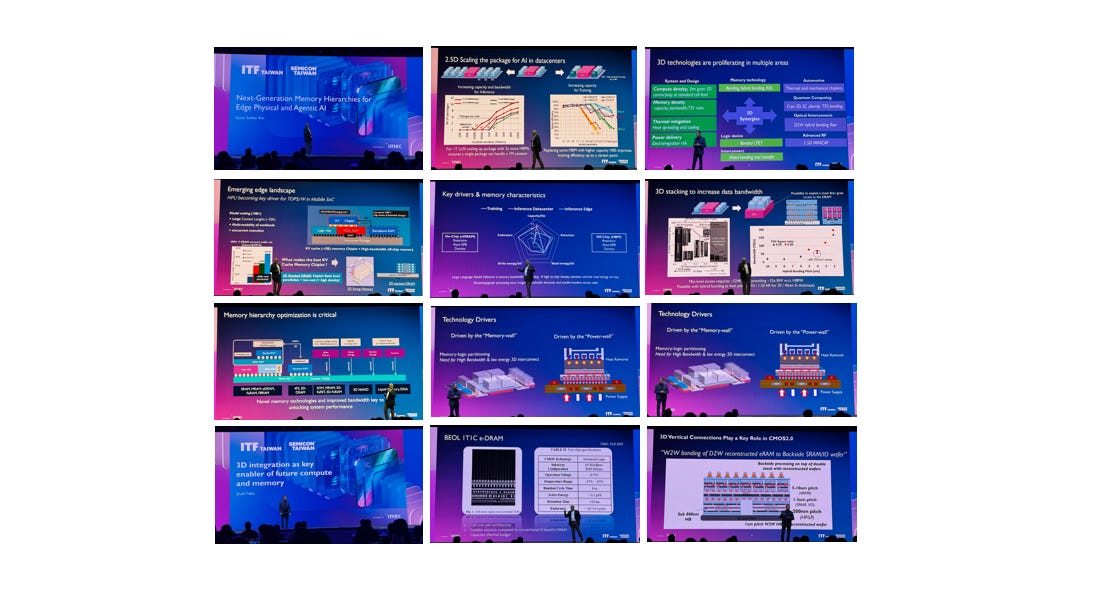
At SEMICON Taiwan’s imec Technology Forum, memory architecture and 3D integration emerged as closely connected parts of this challenge. Gouri Sankar Kar examined next-generation memory hierarchies for edge, physical, and agentic AI, while Zsolt Tőkei addressed the interconnect and integration technologies needed for future computing systems. A common direction was clear: select memory according to how data is used, then connect it vertically at the density and proximity the workload requires.

This direction has implications across memory manufacturing, foundries, packaging, equipment, and design tools. Its value must ultimately be measured in usable capacity, effective bandwidth, response time, and system energy efficiency.
Below we will share…
 From Scale-Up and Scale-Out to Scale-In: How Agentic AI Is Redefining NVIDIA’s AI Factory Network Architecture
 Hot Chips 2026: HBM Base Die Evolves from a Memory Interface into a Computing Engine — Samsung Unveils a Three-Phase Roadmap Toward Custom HBM, aHBM, and zHBM
 Samsung’s zHBM & zNAND Signals a New Era of 3D AI Chip Architecture
Physical AI converts camera, radar, and other sensor inputs into an understanding of the environment, followed by planning and control. Each stage places different demands on memory. Sensor processing needs sustained throughput, control loops require predictable latency, and larger models need both capacity and bandwidth. Strong average performance can still conceal occasional data transfers that cause a control deadline to be missed.