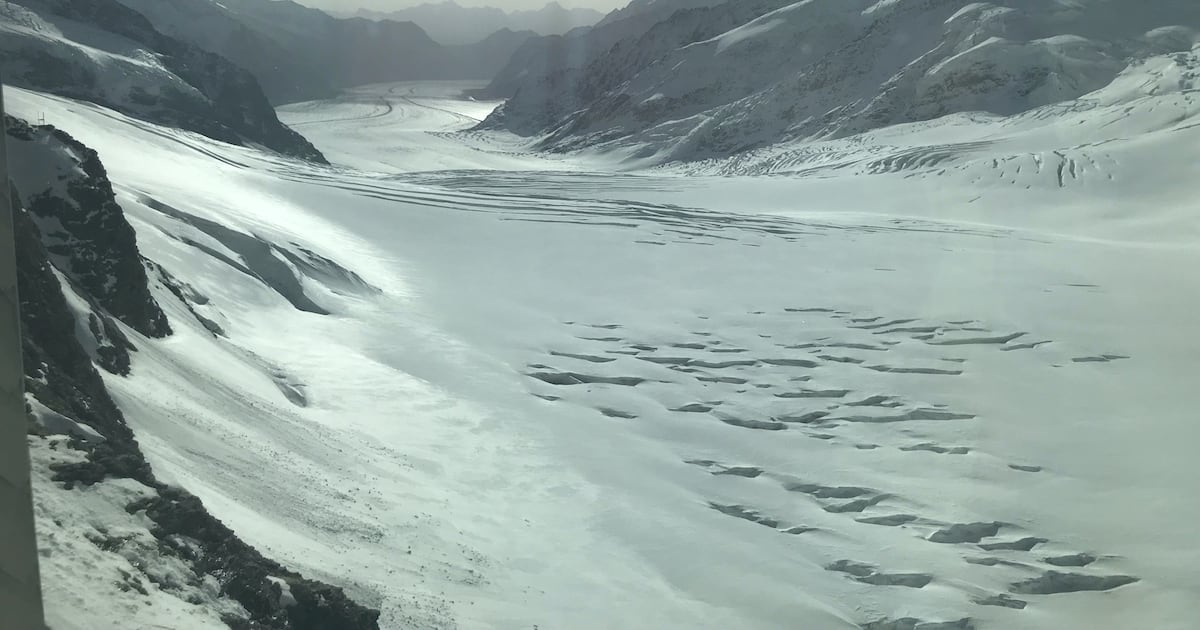
In late October 2022, I travelled on Switzerland’s Jungfrau Railway to Jungfraujoch, a saddle between the Jungfrau and Mönch mountains in the Bernese Alps. Stepping out into the freezing cold, I had arrived at Europe’s highest railway station, 3,454 metres above sea level.
I boarded the cogwheel train at a mountain pass called Kleine Scheidegg (2,000 metres) where I had an uninterrupted view of the large 10km long wall comprising the north faces of the Eiger, Mönch and the Jungfrau.
From there, I could admire the majestic, snowy beauty of their presence against the pale winter sky, much as Clint Eastwood had while filming The Eiger Sanction.
To get there, I had taken another train from the valley floor in Lauterbrunnen. On the winding ascent, I could not but notice how threadbare the snow cover seemed to be on the lower reaches of these three icons of Swiss alpinism.
The winter wonderland that I was half-expecting was not quite materialising in front of my eyes and I was inclined to put it down to the fact Europe had just experienced its hottest summer on record.
A more nuanced picture would emerge two years later when the Swiss Commission for Cryosphere Observation issued a report detailing a record-breaking 6 per cent reduction in Swiss glacier volume in 2022.
Apart from three summer heatwaves, other factors were the low snow cover from the 2021/2022 winter months followed by deposits of Saharan dust which reduced further the glaciers’ capacity to reflect radiation.
That year, snow disappeared at all elevations about four weeks earlier than usual, exposing the ice to the relentless heat of the sun. Swiss glaciers were becoming the squawking chicken in the coal mine of climate change.
It took tunnelling crews 16 years to blast their way through the Eiger and Mönch mountains to reach the Jungfrau so that the 9km railway line could finally open in 1912. Today it can whisk tourists up to the Jungfraujoch from Kleine Scheidegg in 35 minutes.
To my relief, there was snow on the ground when I made my way out of the concrete labyrinth that is Europe’s highest railway station and let my gaze swing back and forth between the summits of the Mönch and the Jungfrau.
As I stood outside the Glacier Cafe nursing a paper cup of tepid tea, I could see below me the Konkordiaplatz. This is the great gathering point of the Aletsch glacier system, the largest ice mass in the European Alps. The Great Aletsch Glacier is a corrugated 22km carpet of ice and snow swirling its way down to the Rhone Valley.
Unknown to me at the time, in 2022 the Aletsch was undergoing record-breaking mass loss with thinning rates beyond four metres. Things did not get much better in 2023. A tenth of the total glacier volume disappeared in those two years.
I was reminded of my visit to Jungfraujoch when I saw new data this month. It found that while the record melt rates of 2022 were not reached, Swiss glaciers lost more than 5 per cent of their volume in 2026 following a winter with exceptionally little snow and record-breaking summer heatwaves.
It’s a sad commentary on the state of the planet and fossil fuel consumption that over the last five years, Switzerland has lost nearly 20 per cent of its total glacier volume and several of its smaller glaciers have now completely disappeared and are not coming back.
Swiss glaciers are estimated to have lost around 2.2 trillion litres of water between July and September, which is more than four times the annual drinking-water consumption of Swiss households.
Further denting expectations of a pristine Alpine experience, scientists report that in September there was little or no fresh snow at Jungfraujoch, so exposing the glacier directly to further melting.
On busy days, the Jungfraujoch can be overcrowded. Post-Covid, it is back to attracting more than a million visitors per year. They struggle their way around the Ice Palace, the luxury watch stores, the viewing platforms, the photo ops with the Swiss flag, queues for the lifts and the restaurants.
My own memory is that the tourist plateau on the Jungfraujoch required maintenance in the form of a piste machine to push snow on to it from the foot of the Jungfrau. This was to support the claim of an all-year-round “snow and ice” experience.
That experience was at its maximum in August 1858 when a young man from Wicklow, Charles Barrington, crossed Konkordiaplatz on his way to the summit of the Jungfrau. Remarkably, he was walking across an ice surface roughly 200 metres above today’s level. He famously went on, a few days later, to become the first person to climb the Eiger.
Changed times. The Ice Palace attraction in the Jungfraujoch now requires cooling systems to avoid a meltdown caused by the warmth emanating from the large numbers of tourists passing through its ice-lined corridors.
Despite the Aletsch glacier’s reduced size, the panorama remains spectacular. It’s a vista fully appreciated even by those who complain about using such an environment to stoke mass tourism.