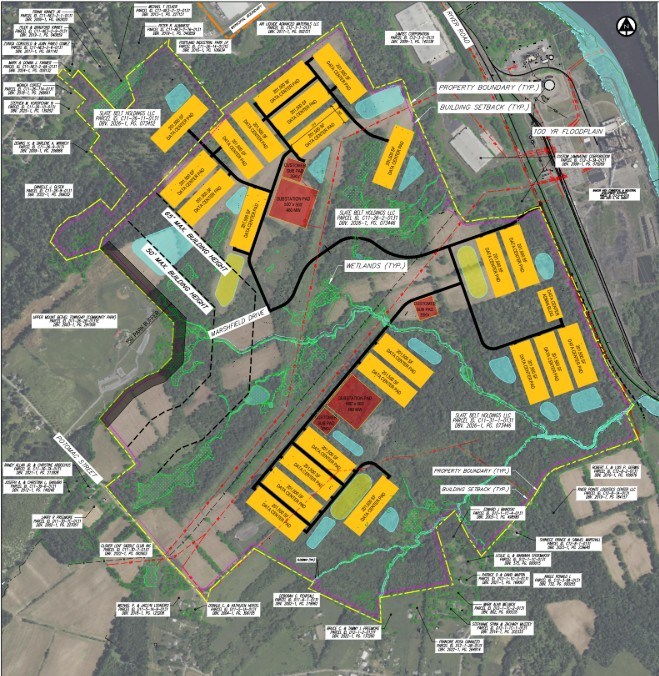
Upper Mount Bethel Township supervisors sent a letter of support to developers of a proposed data center campus 17 months ago. Now, they’re preparing a legal defense against the developers’ challenge of the township’s zoning ordinance.
Increasingly heated public opposition to data centers has turned some board members against the project, and closed off private negotiations between elected officials and developers ahead of an Oct. 19 zoning hearing board proceeding that could affect the fate of the data center campus proposed for a sprawling industrial complex that has seen its share of controversy over the years.
How consequential the hearing proves remains to be seen. Legal experts say a favorable ruling toward the developers could allow them to advance their project under existing township regulations but add that objectors could still argue that plans submitted so far are not enough to freeze development rights.
What the zoning challenge has already accomplished is reopening old fights about how much say this particular developer should get in drafting township regulations.
Supervisors who agree Upper Mount Bethel gave away too much six years ago when it amended its ordinances to help advance River Pointe Logistics’ warehouse park — a project that devolved into a tangle of lawsuits — are split on whether to keep pushing for direct dialogue with the Pektor family, now partnered with Talen Energy on data center plans.
At stake this time around is a community benefits agreement that could be worth 10 times the township’s annual budget, which fell a little under $5.5 million for 2026.
A deal floated in August would have obligated township officials to collaborate with developers on zoning changes and eventually approve their data center plans, in exchange for up to $50 million if the project reached 2 gigawatts of computing capacity.
Discussions on the deal stalled, however, as attention turned to the township’s long-delayed data center ordinance, which supervisors voted on Sept. 21 to advance to the Lehigh Valley Planning Commission for review.
Slate Belt Holdings, the development team partnership between River Pointe and Talen, declined to comment on whether or not it would consider further delaying its zoning challenge as the township works to finalize its ordinance.
Asked to clarify where discussions stand, a spokesperson for Slate Belt Holdings said in an email, “While there are no ongoing conversations with the township regarding a memorandum of understanding and discussions on a community benefits agreement have not advanced, the developers remain committed to a CBA of no less than $25 million and as much as $50 million depending on the ultimate scale of the campus. These funds would be controlled by the township, not the development team, and could be used to provide property tax relief, funding for first responders, investment in roads and bridges, workforce and education initiatives, or other township priorities.”
Setting township priorities
Supervisors John Bermingham and Jon Erler both credit closed-door negotiations this year with raising the upper limit for what Slate Belt was willing to consider for a community benefits agreement.
They’ve ended up much further apart on the question of whether a data center campus is still the best option for the township’s industrial zone.
A data center campus would not generate the kind of truck traffic that stirred up opposition to previous warehousing plans at River Pointe, and could “force the hand of the power company to revamp our grid,” Erler told The Morning Call, saying “it’s a no-brainer that our township would definitely do better with a data center as opposed to the alternative.”
On the other side of the debate is Bermingham, who said that, although a data center at first seemed preferable to warehouses, he’s shifted his thinking as opposition has grown.
“The people are against data centers, so my job as a representative of the people is to do what the people want,” Bermingham told The Morning Call.
The people of Upper Mount Bethel first heard rumors of a data center in fall 2024, when a town hall meeting included the news that a “major corporation” was interested. Amazon was rumored to be that client, but wasn’t publicly identified until April 2025, when Bermingham announced that negotiations had fallen apart.
It would be another year before River Pointe partnered with Talen to form Slate Belt Holdings and restart private discussions with township officials.
“I understand, in the beginning, they wanted hush-hush so the competitors don’t come in and grab the deal from them,” Bermingham told The Morning Call.
Pairs of supervisors met with Talen between April and July, said Township Manager Nick Graziano, who also attended those meetings. No written agreements were made, but the developers verbally agreed to address community concerns, he told The Morning Call.
Erler said his interest in private negotiations came from a fear that Slate Belt could put forth a proposal at any moment that would be regulated under the township’s existing zoning ordinances. He felt it was important to negotiate additional environmental protections developers and supervisors could agree on before presenting data center regulations to the public for review.
The negotiations “were setting the tone to have a very good intermediate agreement” that included reduced building height, increased setbacks, and a commitment to not use river water or groundwater for cooling, Erler told The Morning Call.
When developers formally proposed their own version of a data center ordinance, those specific provisions were not as strong as what had been discussed, Erler said, but added that he felt township consideration of a curative amendment had forced the developers’ hand.
Slate Belt Holdings filed its zoning challenge shortly after supervisors posted notice that they would discuss a curative amendment, which would have given the township 180 days to revise its zoning regulations while being shielded from legal challenge.
Momentum on that plan soon fizzled, in part due to supervisors’ concerns that taking that step would validate Slate Belt’s argument that current zoning is unlawfully exclusionary to data centers.
Supervisor David Friedman, who pushed for a curative amendment, has continued to advocate for more aggressive action from the township. At the Sept. 29 board meeting, he supported hiring an additional attorney who specializes in land-use issues, saying the hyperscale data center proposal is “one of the biggest things” the township will confront.
“We’re in the big leagues,” Friedman said. “It’s about time we started acting like it.”
The pace of business
The hundreds of people who have packed public meetings and lit up the township’s Facebook page have asked increasingly pointed questions, including how the township got from fall 2024, when rumors broke of Amazon’s interest in building a data center, to now, without amending its zoning regulations to specifically address data centers.
In the year after Amazon pulled out, advancing a data center ordinance “didn’t feel urgent because we didn’t know what was coming in here,” Bermingham said.
Erler said “other pressing concerns” pushed the idea the township might need a data center-specific ordinance to the backburner, citing immediate needs like addressing health issues from burning garbage and longer-term needs like protecting township financial reserves.
In local government, “there’s always an issue you need to solve,” Erler said.
Tom Gilmour, an Upper Mount Bethel resident who’s helped lead opposition to data center development, said that proposal was the first time the possibility that this rural township could become a Big Tech outpost felt tangible. The Amazon deal felt like it never advanced past kicking-the-tires stage, he said.
“It never got to the reality that we’re facing currently, and also it was really hyperbolic and speculative,” Gilmour said. “It wasn’t what it’s become. It was never real.”
A litigious history
Upper Mount Bethel’s current fraught debate over data center development bears the weight of past political and legal controversies.
The township last revised its zoning ordinance in 2020, when River Pointe was seeking to move forward with an industrial park for warehouses and manufacturing.
At the time, Bermingham was the sole vote against changes that increased allowable building height and square footage. The Concerned Citizens of Upper Mount Bethel group mounted opposition to the project, and one of their members, Friedman, successfully ran for office the next year, arguing that developers had been allowed to dictate their own terms.
Erler, appointed in 2024 and elected a year later, told The Morning Call a belief that the township had given too much away also motivated him to seek a leadership role.
The three men, alongside the other two current supervisors, Cori Eckman and Jason Albert, got caught up in litigation as River Pointe’s Lou Pektor turned to lawsuits to try to save the industrial park plan. One lawsuit, filed in April 2024 and stayed in September 2025, outlines a dispute over sewer treatment at the site that the developer alleges was an inappropriate interference with their building rights.
Friedman’s move from a member of the citizens group who sued the township over the River Pointe-related zoning amendment to supervisor came with additional legal fallout. While in office he was named in a lawsuit the developer filed against residents who had opposed the project. He also faced state ethics charges regarding votes he cast as the township rejected a plan to sue the concerned residents to recover the legal costs of defending their zoning decision.
As plans for the industrial park devolved into legal wrangling, River Pointe pivoted to courting data center clients. Initial discussions remained largely private.
A month after the deal with Amazon fell apart, supervisors sent a letter to River Pointe that stated, “We hope that you will share this expression of support with any data center developers you are discussing with and we look forward to the opportunity to foster a positive working relationship with whichever developer decides to move forward with this project.”
Supervisors and the development team alike still refer to that letter as proof that the township welcomed a data center in.
Opponents say rising awareness of what communities across the country have faced as data centers move in have them focused on preventing environmental damage, with concerns ranging from noise and vibrations to impacts on the Delaware River.
Graziano, the township manager, said outbursts at public meetings and online have made it increasingly difficult for anyone to speak up in favor of a data center’s potential benefits, including tax revenue.
“No one’s First Amendment rights should be vacated because they’re on the wrong side of something,” Graziano said. “Whose side is the right side and whose side is the wrong side will be determined. Just like an election — somebody’s got to lose, and someone’s going to win, but it’s done in a mature way.”