
I never thought I would ever write a book.
At The Jerusalem Post, I wrote more than 10,000 articles, but I don’t think any of them exceeded 4,000 words. How could I ever write 60,000? Some magazine articles I wrote covered six pages, but that’s far from 200 pages.
I had every reason to doubt that I would be able to concentrate and maintain focus for the time it would take.
But when Wicked Son Publishers in New York presented an opportunity and a unique professional and personal situation permitted it, I jumped at the chance.
After more than 20 books in English and Hebrew were written on what went wrong on the military and intelligence battlefronts, I became aware of the glaring need for a book presenting an Israeli insider’s perspective on what went wrong on the media battlefield for Israel and the international Jewish community. After all, every day since Oct. 7 has arguably gotten progressively easier on the military battlefield, while every day since the massacre has gotten progressively harder in the narrative war.
It could also be argued that while most of the lessons from the blunders on the military battlefield that led to Oct. 7 have long been learned and implemented, the media battlefield’s mistakes are still far from being internalized, and they have led in part to the antisemitism that is currently spiraling out of control in America and around the world.
My book reveals that unleashing that overwhelming and no longer shocking hatred of Jews was actually the goal of Hamas head Yahya Sinwar and the Hamas leadership, who were unaware of the Nova music festival taking place 5 km. (3.1 miles) east of the Israel-Gaza border fence.
They were, however, well aware that the Palestinian cause was gradually being forgotten, as the Abraham Accords were about to expand to Saudi Arabia and then to other countries and leave them behind. They wanted to bring the Palestinians to the forefront of the world’s agenda, and no one can deny that they have succeeded beyond their wildest dreams.
Hamas’s political bureau head Ismail Haniyeh said very openly in a speech to the International Union of Muslim Scholars in Doha, Qatar, on January 9, 2024, that Hamas initiated what it strategically called Operation Al-Aqsa Flood to return the Palestinians to the international agenda.
“The world, the international community, and global decision-making circles no longer raised the issue of Palestine,” Haniyeh complained as he justified the attack. “The world began to deal with it as an internal Zionist matter, to be handled in its own way. There were no international resolutions, no conferences, and not even talk of a two-state solution. Such talk was no longer circulating among decision-makers worldwide. The issue became completely marginalized.”
The element of surprise
SO HOW DID they succeed in drawing back the world’s attention? By using what Haniyeh called “verbal jihad” and taking advantage of several assets, which are each explained from behind the scenes in the book.
Their first asset was the element of surprise, which caught both the Israeli government and the American Jewish establishment completely off guard. And Israel was even less prepared for Oct. 7 on the media battlefield than it had been on the military battlefield.
The IDF may have mishandled Oct. 7 completely, and its functioning was briefly limited, but at least it continued to exist. The Israeli government employed no English spokesperson on Oct. 7, nor did it have a consul-general in New York, where most of the international media is based. There was no strategic plan ready to deal with a crisis and media circus of this magnitude.
Hamas, by contrast, did have a strategic plan for the narrative war – formulated by their notoriously brilliant veteran propaganda chief Abu Obeida – which Hamas documents have revealed was prepared well in advance, alongside their military plans. They also had an army of trained journalist loyalists who worked for top international media outlets during the war, due in part to Israel’s decision not to let independent media into Gaza since 2014.
These terrorists, whom the world accepted as journalists, became part of the blood libel machine, funded by the Qataris who maintained an open channel of communication between Hamas and their government mouthpiece Al Jazeera, which was deeply involved in all aspects of strategically broadcasting the war to the world.
This all overwhelmed the leadership of the American Jewish community, which had been concentrating on building bridges with progressive groups to deal with intersectionality but found itself abandoned by purported allies when it needed them most. Jewish college students were nowhere near ready to go on defense in a fight forced on them and certainly not to go on offense.
Just like Hamas had 16 years to prepare for this war while Israel had not one day, anti-Israel groups in the United States and other countries around the world had been preparing for Oct. 7 for decades, with unlimited funding at their disposal. They were an integral part of the strategic plan – and the blood libel machine – and unlike Hamas, Hezbollah, Syria, and Iran, their success has not been halted.
Continuing to spread hatred of Jews and of the State of Israel
They have continued to spread hatred of the Jewish people and the Jewish state, gaining positions of influence and scaring ordinary Jews who had no connection to what was going on in the Middle East, some 12,000 km. away. They exploit their numerical advantage and their head start on social media and AI platforms in what is nowhere near a fair fight.
Sinwar’s goal was to initiate a future multifront war that could succeed after Israel lost the world’s support, and ideally after Iran obtained a nuclear capability. That may appear more unrealistic now because of Israel’s military successes on seven fronts, but if international condemnation of Israel continues making the Jewish state even more isolated, it certainly cannot be ruled out.
That is why the book urges future governments of Israel to make the narrative war a top priority – as this column has repeatedly – which even Prime Minister Benjamin Netanyahu himself admits openly has not been the case since Oct. 7. It is also why the book offers readers more than 30 tools for fighting for Israel on social media and AI platforms.
Those tools were praised in the book’s endorsements by hasbara (public diplomacy) heroes Natan Sharansky, Michael Oren, Nachman Shai, and Gil Troy, as well as Noa Tishby, who put the book in context in the foreword she wrote.
Because the narrative war has been at the forefront of international headlines lately, Wicked Son advanced its publication by a month, and it went on Amazon on the eve of the massacre’s Jewish calendar anniversary, Simchat Torah. I symbolically – and chillingly – received my first copy from the Pomeranz bookstore in Jerusalem on Oct. 7.
So I really did write a book, and I hope it makes the positive impact it needs to, so there won’t be anything like Oct. 7 ever again – on either the military or media battlefields. ■
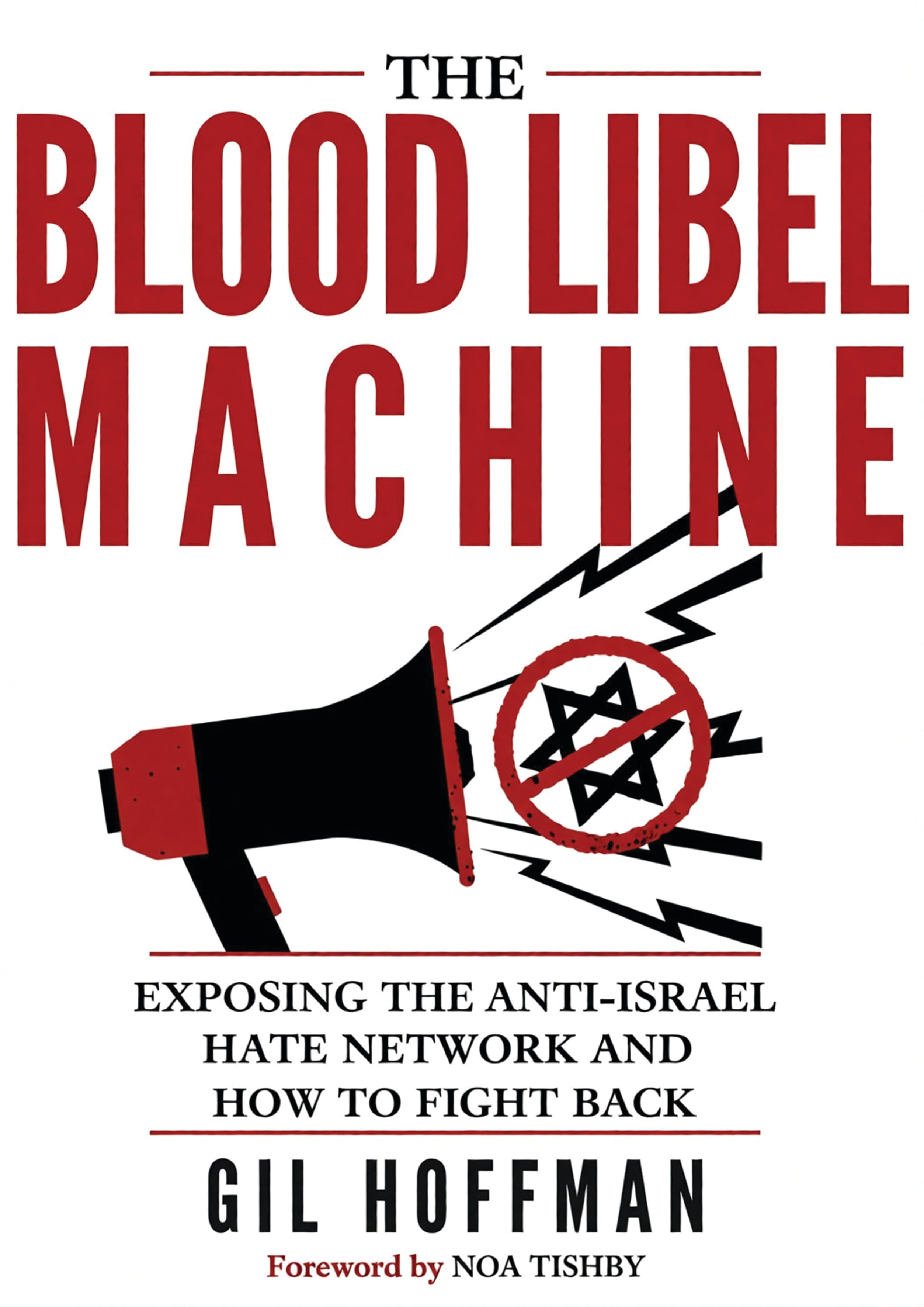
The writer is the author of the book The Blood Libel Machine: Exposing the Anti-Israel Hate Network and How to Fight Back, which can be ordered from Pomeranz Books in Israel and Amazon around the world.