
The Iran war, El Niño and rising energy costs are driving global food prices higher, adding pressure to Korea’s grocery bills.
Fruits are displayed at a supermarket in Seoul on Oct. 2.
NEWS1
Global food prices are surging as the war in Iran and extreme weather disrupt agricultural production and supply chains. This has raised concerns that rising costs could drive up grocery bills worldwide well into next year.
The global Food Price Index stood at 136 in September, its highest level in nearly four years since November 2022, according to data from the United Nations Food and Agriculture Organization (FAO) Tuesday. The index, which tracks changes in international prices of major food commodities, rose 1.5 percent from the previous month and 5.8 percent from a year earlier.
The cereal price index climbed 5.1 percent from the previous month, while international wheat prices rose 6.3 percent, corn prices 5.6 percent and sugar prices 6.1 percent.
War and extreme weather are among the main factors behind the surge in food prices. The Iran war has disrupted shipments of energy and fertilizers through the Strait of Hormuz, while uncertainty continues to cloud grain shipments through the Black Sea.
El Niño, a climate phenomenon marked by rising sea surface temperatures in the central and eastern equatorial Pacific, is also threatening global agricultural supplies.
The World Meteorological Organization (WMO) forecast in a recent report that sea surface temperatures in parts of the Pacific would reach record highs between October and December due to El Niño. The organization also warned that the strengthening weather phenomenon would “impact economies, ecosystems and communities across the globe.”
El Niño can trigger droughts and heavy rainfall, depending on the region, which can threaten the production of crops such as sugar and rice.
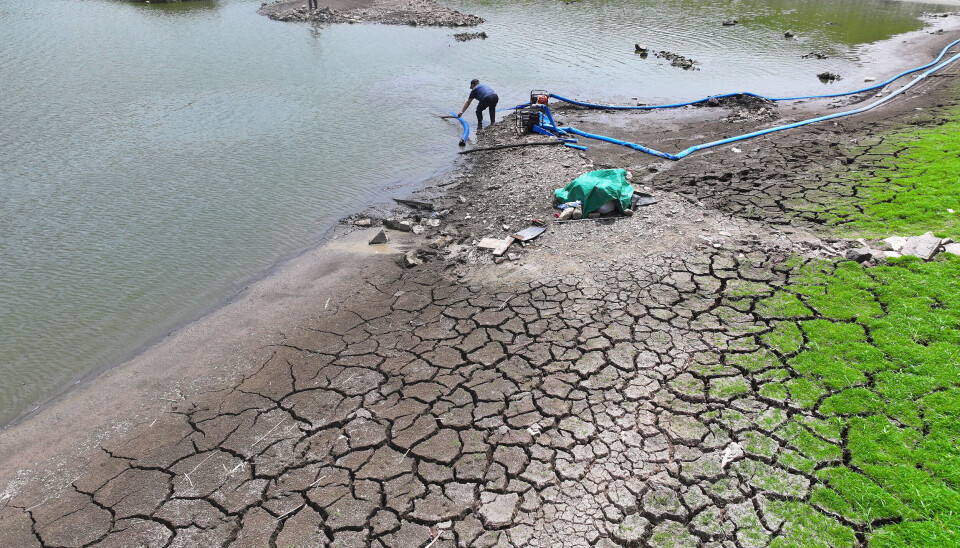
Farmers install a water pump to irrigate rice paddies at a reservoir in Daegu on Aug. 11 amid a prolonged drought.
YONHAP
International sugar prices have climbed to their highest level in 18 months, while wheat futures reached a three-year high early last month.
The FAO forecast that global cereal production would fall 2.1 percent from a year earlier to 3 billion metric tons (3.3 billion U.S. tons) this year. Although that would still mark the second-largest harvest on record, global cereal trade is projected to decline 3.5 percent, partly due to logistical disruptions.
Soaring diesel prices, in particular, are driving up costs throughout the food supply chain, from farms to consumers’ tables.
Long-haul spot trucking rates in the United States have surged approximately 50 percent from a year earlier, the Financial Times reported on Oct. 14.
U.S. trucking freight costs rose 19 percent in September from a year earlier, its sharpest increase in more than four years, Reuters reported on Friday.
Average input costs across the first two stages of the food supply chain, as reflected in the Producer Price Index, also jumped 15.6 percent year over year. Prices of energy-sensitive commodities, including corn, hay and oilseeds, rose more than 25 percent.
However, the increase in production costs has yet to be fully reflected in consumer food prices in the United States.
As cost pressures mount, food manufacturers are beginning to raise prices.
U.S. food company Campbell’s has notified retailers of price increases of 4 to 5 percent across 60 percent of its product portfolio. Packaged food manufacturer Conagra and beverage and snack giant PepsiCo are also moving toward price increases.
“Food price inflation is going to accelerate,” said Ricky Volpe, a food economist at California Polytechnic State University, to the Financial Times. “When you do the margin math for manufacturers, wholesalers and retailers, it’s really hard to see how food prices aren’t going to bump up in the next two, three months.”

Shoppers wait in line to pay for groceries at a large supermarket in Seoul on Sept. 2.
NEWS1
Korea is also facing growing pressure on food prices.
Consumer prices rose 2.9 percent in September from a year earlier, according to the Ministry of Data and Statistics.
Import prices rose 1.7 percent in September from the previous month, which marks the first increase in four months amid a sharp rise in international oil prices, the Bank of Korea said in a report released Friday.
As higher global grain and energy prices gradually feed into processed food and restaurant prices, they could complicate efforts to stabilize inflation in Korea.
“We are seeing a persistent and increasingly broad-based buildup in global commodity prices, as disruptions in the Strait of Hormuz and the Black Sea combine with climate shocks, putting pressure on energy, transport and key food commodities,” said FAO Chief Economist Maximo Torero.
“If sustained, these pressures will soon pass through to consumer food prices, especially in food- and energy-import-dependent countries.”
BY PARK YU-MI [kim.jiye@joongang.co.kr]
This article was originally written in Korean and translated by a bilingual reporter with the help of generative AI tools. It was then edited by a native English-speaking editor. All AI-assisted translations are reviewed and refined by our newsroom.