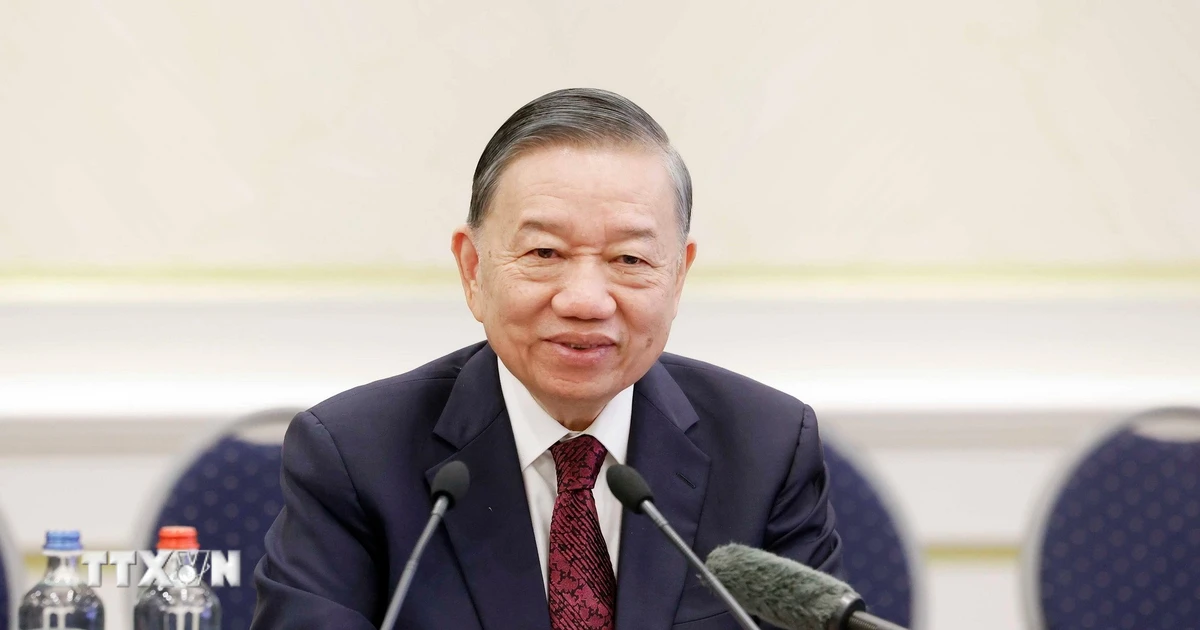
During his official visit to the Kingdom of Belgium, on the morning of October 24th (local time) in Brussels, General Secretary and President To Lam and the high-level Vietnamese delegation met with representatives of Vietnamese experts and intellectuals in Belgium and Luxembourg.
At the meeting, the Ambassador Extraordinary and Plenipotentiary of Vietnam to Belgium, Head of the Vietnamese Delegation to the European Union (EU), Nguyen Huong Tra, reported on the activities of Vietnamese intellectuals, experts, and scientists living, studying, researching, and working in Belgium and Luxembourg, as well as neighboring countries such as France, the Netherlands , and Austria.
On this occasion, experts and intellectuals proposed specific solutions: making Vietnam a leading artificial intelligence (AI) service center in Asia; cooperation between Vietnam and Belgium and the EU on nuclear, semiconductor, and green materials; a comprehensive resilience framework for Vietnam’s critical infrastructure; a modern, self-reliant, and sustainable agricultural biotechnology ecosystem; a circular industry model from straw to green steel; developing quantum technology from experimentation to human resources; laser satcom, and space connectivity infrastructure.
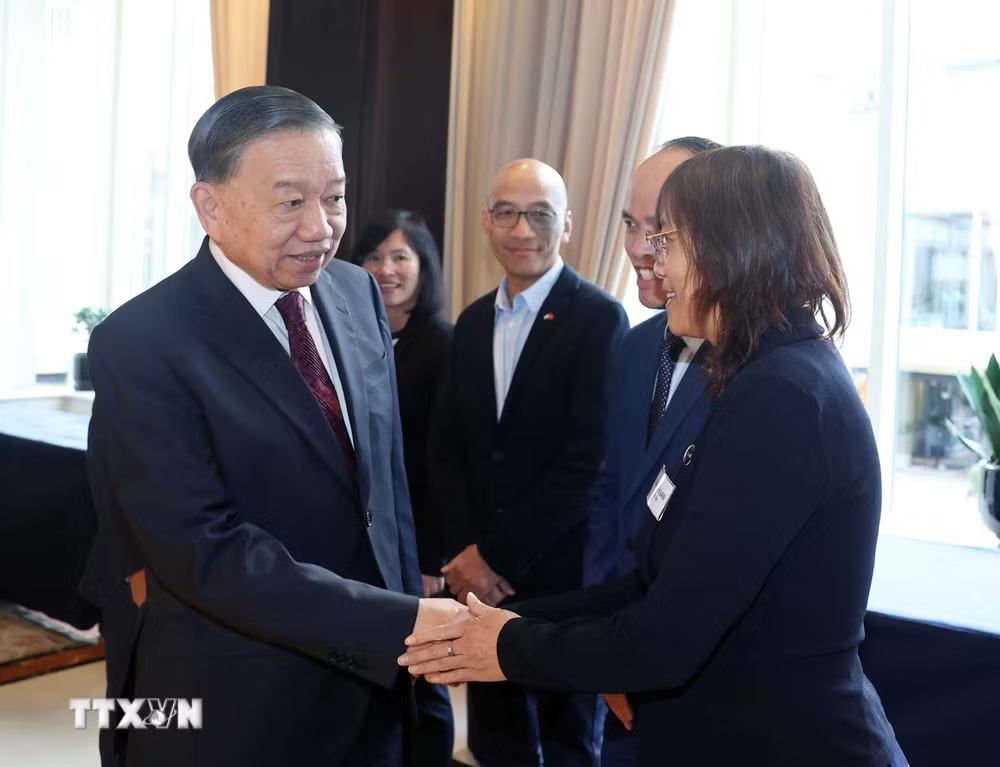 General Secretary and President To Lam meets with Vietnamese experts and intellectuals in Belgium and Luxembourg. (Photo: Thong Nhat/VNA)
At the meeting, on behalf of the Party and State leaders, General Secretary and President To Lam highly appreciated the policy recommendations of experts and intellectuals in Belgium and Luxembourg. These experts and intellectuals not only outlined what the country needs to do, but also identified what they could do and were ready to undertake. This reflects the mindset of those directly involved, a love for their homeland expressed through concrete actions.
General Secretary and President To Lam pointed out that the 14th National Congress of the Party set the goal of making Vietnam a developed, high-income country by 2045. This path cannot continue relying on cheap capital, cheap labor, and raw resources. Science, technology, innovation, and digital transformation are no longer an option, but a necessary path. However, the actual results have not been commensurate with the determination. The biggest bottleneck currently is the implementation phase.
General Secretary and President To Lam frankly acknowledged that many heartfelt suggestions from overseas Vietnamese intellectuals have been recorded at various forums but then left unaddressed, with no one responding. Many experts and intellectuals return to the country with good ideas but are hampered by procedures and financial mechanisms, forcing them to stop. This responsibility lies primarily with the government apparatus, not with the experts or intellectuals.
General Secretary and President To Lam suggested that in the coming period, the country’s practical problems should be the starting point; the shift should be from “seeking resources” to “connecting resources with needs.” Ministries, departments, localities, and businesses must clearly state their requirements: what problems need to be solved, what technologies are lacking, who will receive them, and what the final product will be; he urged experts and intellectuals to boldly volunteer to undertake tasks related to major national problems and strategic technologies.
General Secretary and President To Lam emphasized the importance of choosing fewer tasks but doing them thoroughly and decisively. Relevant ministries and agencies should select key tasks that are feasible, have domestic partners, and have the potential for widespread impact. Each task must have clear objectives, timelines, and accountability; and it should only be considered completed when there is an operational product, verifiable data, actual users, and measurable results. Once successful, the process should be expanded and developed further.
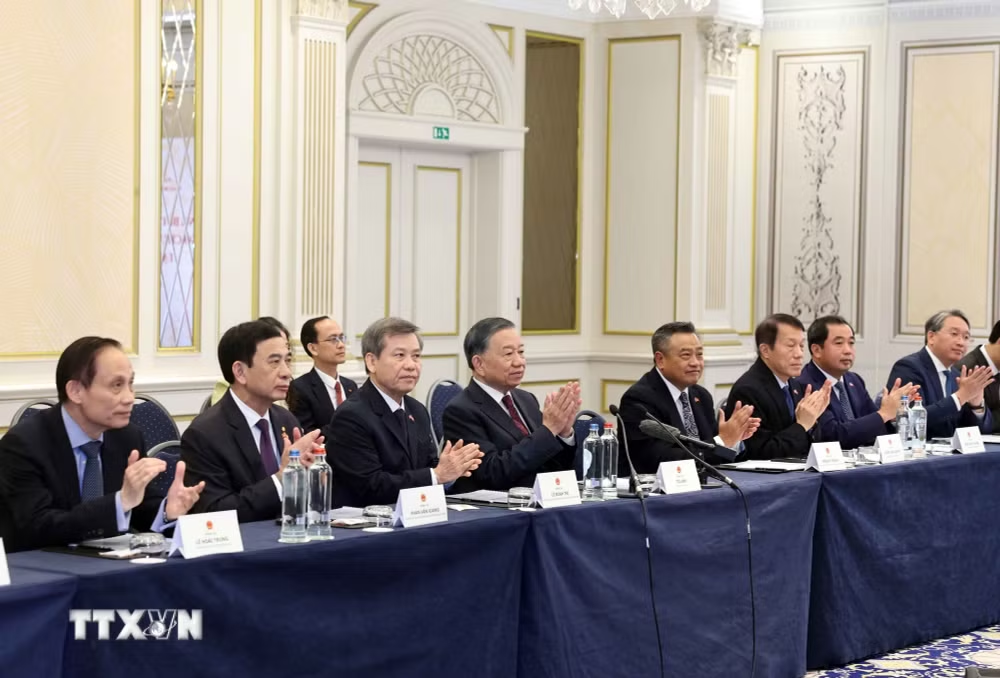 General Secretary and President To Lam and the Vietnamese delegation participated in a meeting with Vietnamese experts and intellectuals in Belgium and Luxembourg. (Photo: Thong Nhat/VNA)
We need to drastically reform mechanisms so that intellectuals everywhere can contribute, and scientists don’t need to return permanently to contribute; flexible mechanisms are needed: expert contracts based on tasks, remote work, collaborative research, and lump-sum payments based on the final product; sufficiently flexible financial mechanisms to allow experts and intellectuals to directly participate in specific projects; clear intellectual property rights; and acceptance of risks and delays in research. Intellectuals must be evaluated based on results and respect for their expertise, selecting the best to assign tasks and implement them, rather than creating obstacles due to administrative procedures.
Every collaborative project must leave behind capabilities in Vietnam. The ultimate measure is not how many memoranda of understanding are signed, but how many domestic engineers and scientists are trained; how many strong laboratories, research groups, and technology enterprises are formed. Transfer is not enough; we must develop together; and develop together to move towards self-reliance.
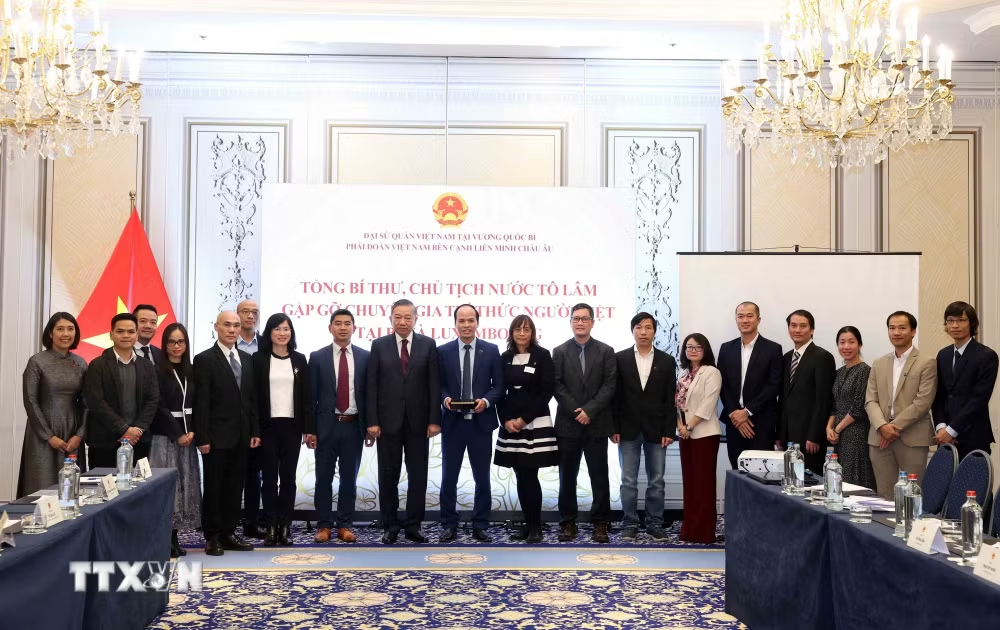 General Secretary and President To Lam with Vietnamese experts and intellectuals in Belgium and Luxembourg. (Photo: Thong Nhat/VNA)
General Secretary and President To Lam requested the Ministry of Science and Technology to take the lead and coordinate with the Ministry of Foreign Affairs, the Ministry of Education and Training, and other relevant ministries and agencies to receive all recommendations from experts and intellectuals; matters within their authority must be resolved immediately, while those exceeding their authority must be proactively addressed; written responses must be provided, and specific contact points must be assigned for each task. The Vietnamese Embassy in Belgium, also the Mission to the EU, will be the permanent contact point, periodically reviewing progress and reporting to the Ministry of Foreign Affairs for reporting to the Central Office, while also coordinating with relevant ministries and agencies to resolve any obstacles.
General Secretary and President To Lam expressed his hope that the Association of Vietnamese Intellectuals in Belgium and Luxembourg would continue to expand its network with universities, research institutes, and technology companies in Belgium, Luxembourg, and Europe; help European friends understand a Vietnam that is undergoing reform and integration; and pay special attention to guiding the younger generation of Vietnamese intellectuals in Europe, so that the flow of knowledge towards their homeland would not be interrupted.
Experts and intellectuals should boldly propose ideas, frankly offer criticisms, and take on responsibilities. The Party and the State have a responsibility to listen, resolve obstacles, and respond with results.