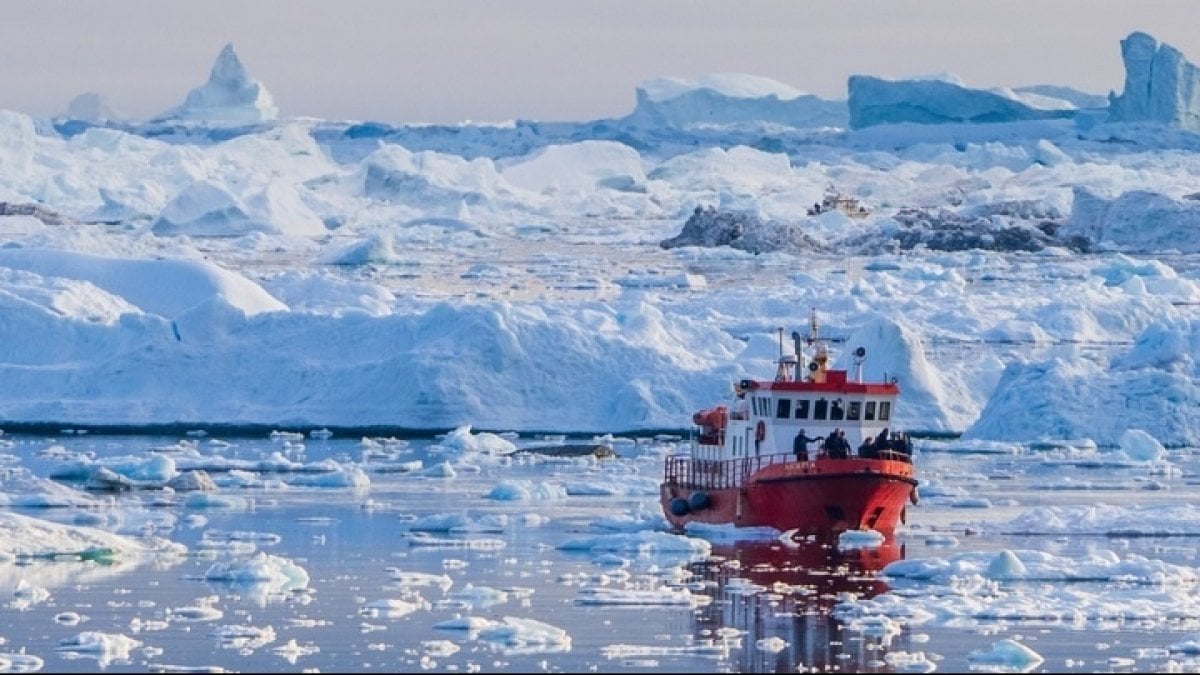
 Russia and China are stepping up shipping cooperation in the Arctic, turning the region into a new hotspot in geopolitical competition with Europe. (Source: Getty Images)
Recently, Russia and China agreed to expand shipping operations along Arctic shipping corridors, enhance services between ports, and cooperate in shipbuilding for operations in the polar region.
This move comes after the EU announced a new Arctic strategy aimed at countering the growing influence of Russia and China in the region.
According to analysts, while the Arctic is becoming increasingly strategically important, Europe’s ability to challenge the burgeoning partnership between Moscow and Beijing remains limited. Russia controls the Northern Sea Route, from licensing shipping and collecting transit fees to operating a large fleet of nuclear icebreakers. Meanwhile, China provides the goods, ships, and industrial capabilities necessary to develop this shipping corridor.
Conversely, Europe’s limited icebreaking capacity and infrastructure in the Arctic make it difficult for the region to create a commensurate competitive advantage, despite Europe being a large consumer market.
The Arctic – the frontline of global power competition.
The Northern Sea Route is gaining attention as an alternative to traditional shipping corridors, amid disruptions in the Middle East that have shown existing shipping lanes to be vulnerable to geopolitical shocks.
According to data provided by Fertmax FZCO, this route could shorten freight transit time between Asia and Europe to 18-22 days, compared to 28-35 days when going through the Suez Canal, equivalent to a reduction of approximately 35%.
For Moscow, the Northern Sea Route opens up opportunities to redirect energy exports to Asia, amid Western sanctions restricting access to European markets. Industry observers believe this is one of the key benefits of this transport corridor for Russia.
Meanwhile, Beijing gains another trade route, which could reduce its reliance on traditional maritime bottlenecks.
David Roche, a veteran strategist at Quantum Strategy & Geonomics, argues that the most significant aspect of the Arctic lies not in its potential to fundamentally change global shipping, but in the increasingly deep economic interdependence between Russia and China.
“Energy shipments from Russia to China will increase Moscow’s dependence on Beijing for energy consumption, compensating for the lost share of the European gas market,” David Roche stated.
The EU also acknowledges the growing challenges in the region. Kaja Kallas, the EU’s foreign policy chief, stressed that with Russia and China increasing their presence and ambitions, the Arctic has become a frontline of global power competition.
Can Europe close the gap?
The EU’s new strategy proposes expanding icebreaking capabilities, strengthening maritime surveillance, and developing infrastructure to connect Arctic trade networks with European markets.
The plan also addresses the establishment of a maritime security center and enhanced protection of undersea cables. These proposals reflect Europe’s growing concerns about Russian military activity and the risks to critical infrastructure.
However, according to experts, these measures may not be enough to change the structural advantage that Moscow and Beijing currently hold.
Alicia Garcia-Herrero, chief economist for Asia-Pacific and the Middle East/Africa at Natixis CIB, notes that Europe’s advantage stems primarily from its large consumer market position and the presence of large-scale shipping companies. However, many shipping businesses have avoided the Arctic route due to environmental and commercial risks.
According to Garcia-Herrero, without a program to promote sustainable industry, an area the EU has only just begun to discuss, Europe could increase trade costs and regulatory requirements for this route, but it would be difficult to prevent or replace the existing Russia-China partnership operating the transport corridor.
Europe also faces a strategic dilemma: Joining the new transport route could increase its dependence on infrastructure controlled by Russia, while the EU is seeking to reduce Moscow’s economic influence.
Daeijin Lee, former global research director at Fertmax FZCO, said Western businesses face hurdles related to sanctions, insurance, and regulatory compliance, making the Arctic route significantly less attractive to Chinese companies.
 The Arctic will primarily develop into a seasonal express shipping route for certain high-value goods, rather than becoming an alternative to the Suez Canal. (Image of the Suez Canal. Source: Shutterstock) Its role in global shipping remains limited.
Despite attracting geopolitical attention, the Arctic currently accounts for a small share of global shipping activity.
Mr. Roche estimates that trade through the Arctic currently accounts for about 0.3% of total global shipping and could increase to around 1% by 2030.
Data from Russia’s state nuclear corporation Rosatom and CNBC ‘s calculations based on figures from the United Nations Conference on Trade and Development also show that this share is approximately 0.3%. Specifically, the volume of goods transiting the Northern Sea Route is expected to reach 37.02 million tons in 2025, while the total volume of global maritime trade in 2024 was 12.72 billion tons.
According to the High North Logistics Center, only 3.2 million tons of that cargo actually made it along the entire route, less than one-tenth of the total recorded volume. The rest was mostly cargo originating from or destined for the Russian Arctic region.
However, shipping volume is showing signs of increasing. The latest data from the High North Logistics Center, as of September 2026, shows that the route has 104 confirmed transits, carrying approximately 3.7 million tons of cargo. This figure has already exceeded the total transit cargo volume of 3.2 million tons for the entire 2025 shipping season.
The majority of current traffic consists of Russian oil, liquefied natural gas, and other commodities, rather than international containerized cargo.
Furthermore, the Arctic route still faces significant trade obstacles. Icy conditions restrict maritime activity for much of the year, while the costs of specialized vessels, insurance, and shipping fees associated with Russia can diminish the economic benefits of shortening the journey.
Matthew Wright, an analyst at Kpler, emphasized that the Northern Sea Route is not yet suitable to replace existing shipping corridors, as businesses need stable shipping services that operate year-round.
Similarly, Lee predicts that the Arctic will primarily develop into a seasonal express shipping route for certain high-value goods, rather than becoming an alternative to the Suez Canal.
These developments indicate that the Arctic is gradually taking on significance beyond a seasonal shipping route. While not yet capable of replacing key global shipping corridors, the region is increasingly linked to energy interests, trade, and strategic competition among major powers.