Photo Fides
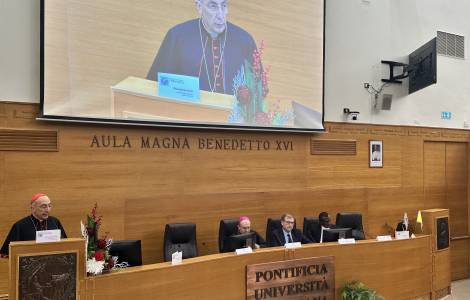
Rome (Fides News Agency) – “The Gospel reaches Rome so that from Rome it may keep on running.” Cardinal Baldassare Reina, Vicar General of His Holiness for the Diocese of Rome, reflected on the missionary vocation of the Church of Rome in the inaugural lecture that opened the 2026–2027 Academic Year on Thursday, October 29, in the Aula Magna of the Pontifical Urbaniana University.
In his lecture, entitled “Church of Rome, Missionary Church,” Cardinal Reina traced a path from the New Testament to Pope Leo. He explained that already in the Acts of the Apostles, Rome is where the journey of the Word arrives in the story, and also where it sets out again: the book closes with Paul in the capital of the empire, proclaiming the Kingdom “with all boldness and without hindrance.” Rome’s missionary face, indeed, goes back to its origins: around the year 200, as Benedict XVI recalled during a general audience in 2009, a Roman priest named Gaius could already invite visitors to see ‘the trophies of those who founded this Church’ the tombs of Peter on the Vatican Hill and of Paul on the Ostian Way, where the two basilicas still stand today/ Referring to the Council’s decree Ad Gentes, the Vicar recalled that every particular Church is also sent to the non-believers living within its territory. For Rome, this means mission cannot be reduced to multiplying religious presences, because the Gospel must meet the real life of the city.
The Cardinal then reviewed what the Popes have taught their own diocese and highlighted several milestones. John Paul II convened the Diocesan Pastoral Synod (1986–1993), and in 1992 he described Rome as a “hearth of missionary outreach.” In 2005, Benedict XVI sought to make the city mission permanent by giving parishes and other church communities a missionary character. In 2009 he asked that lay people be recognized as “truly co-responsible for the Church’s being and action.” In 2019, Pope Francis invited the Diocese to listen to the city’s imbalances, its poor and its vulnerabilities, and he warned against a Church deaf to the cry of the people.
The Cardinal spoke at length about the Apostolic Constitution In Ecclesiarum communione, by which Pope Francis reorganized the Vicariate of Rome in 2023. In June 2026, Leo XIV renewed its rules on the governance of the Vicariate with the Motu proprio Confirma fratres tuos. He kept the preamble, which entrusts the Church of Rome with a “mission of exemplarity.” The Cardinal made clear that this exemplarity rules out any triumphalism and should be understood as a debt of witness. The document recalls the missionaries who have gone out over the centuries from the Church of Peter and Paul. It asks the whole diocese to be open to the missio ad gentes and names as an urgent task the proclamation of the Gospel and the witness of charity toward every inhabitant and in every setting. At the Diocesan Assembly in September 2025, Pope Leo asked Rome to become a laboratory of synodality.
The Cardinal closed with seven features of Rome’s missionary exemplarity. Among them, he stressed being rooted in the real city, made up of people, families, cultures and forms of poverty, and the universal dimension: “mission in the city does not replace the missio ad gentes.” He expressed the hope that the Urbaniana would contribute its scholarship so that Rome may also be the driving centre from which missionary commitment sets out “to reach the ends of the earth,” with the same fire as the Apostle: “Woe to me if I do not preach the Gospel!” Speaking again, Archbishop Sangalli invited the University to develop the perspectives the Cardinal had set out, from the communion rediscovered under Paul VI to the synodality promoted by Francis and Leo.
The morning began with Archbishop Samuele Sangalli, Adjunct Secretary of the Dicastery for Evangelization. He spoke on behalf of Cardinal Luis Antonio Tagle, Pro-Prefect of the Dicastery, Grand Chancellor of the University and, for the past few weeks, Dean of the College of Cardinals. Archbishop Sangalli recalled that for almost four centuries this institution has trained men and women able to bring the Gospel into different cultures and to serve the Churches in every part of the world. At the Urbaniana, he observed, the catholicity of the Church becomes an everyday experience: a European priest, an Asian woman religious, a Latin American student, an African professor, a seminarian from Oceania and a researcher from the Middle East may all be found in the same classroom. He spoke of the beauty of this experience and said that such richness brings an equally great responsibility, because no one possesses the full richness of the Church alone.
The Archbishop named Saint John Henry Newman as the guide for the new year. Newman was a student of the College, and on November 1, 2025, Pope Leo XIV proclaimed him a Doctor of the Church and patron of the Urbaniana. He quoted the Pope’s words to the students of La Sapienza University: “Whoever researches, whoever studies, whoever seeks the truth, is ultimately seeking God.” “A true university does not extinguish questions,” the Archbishop said; “rather, it teaches us to face them with intelligence, rigour and freedom. It does not just offer answers, perhaps ready-made ones; rather, it forms people capable of continuing to search.” Addressing the students, he added: “One day you will return to your congregations, dioceses and countries: what you have received here must become responsibility, true service, authentic witness.”
On behalf of the students, Abrahan Moreno Murillo, president of the Omnes Gentes Association, told the Cardinal Vicar that they are ready to help with pastoral activities in Rome’s parishes, as a sign of communion among all the Churches. In his closing remarks, the Pontifical Delegate and Rector Magnificus, Professor Vincenzo Buonomo, said that last year ended with 1,136 students and 42 permanent faculty members. He added that some faculties have seen enrolment rise this year, especially in the first year. He announced that the new Statutes will be presented to the Plenary Assembly of the Dicastery. He then recalled Leo XIV’s address to UNESCO on September 25 and gave assurance that the University, as part of the Pope’s Diocese, is ready to contribute to the diocese’s pastoral work. He then declared the new Academic Year open.(MLK) (Fides News Agency 29/10/2026)
Share: